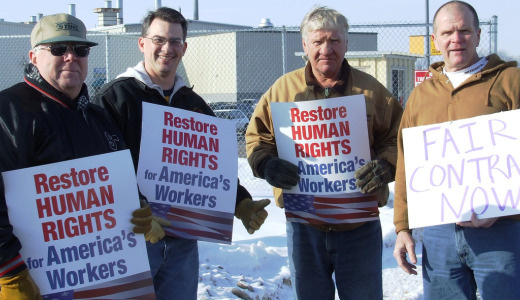
Worker rights are key to economic recovery, union leaders say

WorkerRights

ORLANDO, Fla. - The economy cannot truly recover unless the United States moves out of "the dark ages" in the area of workers' rights, the nation's labor leaders say.

Union leaders gathered here for an AFL-CIO executive council meeting this week emphasized that point, as they also pressed for massive federal spending to create millions of jobs.

"We are dealing with a management class that is the worst ever in the history of capitalism," Larry Cohen, president of the Communications Workers of America, said. "No modern society on this planet has as small a percentage (7.2 percent) of its private industry workforce organized as we do. Management in this country is brutal. Even in apartheid South Africa, 10 percent were organized in the private sector."

Cohen, who wears a second hat as chair of the AFL-CIO's organizing committee, noted, "Today in countries all over the world, workers get a union when only 30 percent sign union cards. The Employee Free Choice Act standard of majority sign-up, which management spends millions of dollars to prevent, is actually a far tougher standard than the one required today in countries like South Africa and Peru."

"This is an issue for not just the labor movement, but for our country as a whole," he declared. "Germany has been hit with the same economic crisis that hit us, but the suffering you see there is far less than the suffering you see here."

"The crucial difference," Cohen said, "is the higher degree of workers' rights in that country."

"Yes, we need a second stimulus and yes we need to fix regulations, but we must move ahead on workers' rights, particularly the right to collective bargaining, and that is why we are pushing so hard for passage of the Employee Free Choice Act."

"Unfortunately," he said, "there is no current path for passage of the EFCA with the Republicans able to filibuster in the Senate."

According to Cohen, however, that roadblock will not prevent the labor movement from continuing to push on several other fronts.

The first of these, he said, is the push to get President Obama to fill National Labor Relations Board vacancies during the congressional Easter Recess. The Republicans filibustered his appointment of Craig Becker, a labor attorney, to that board, but the president has the power to make recess appointments which would last until the end of the year. He refrained from making the NLRB appointments during the President's Day recess in exchange for Republican votes for many of his other nominees to non-controversial posts.

Labor Secretary Hilda Solis, who came to the executive council meeting here, was asked whether the president would make the appointments during the upcoming recess. Although she would give no commitment, she said she had spoken to the president about the matter and indicated that "labor will be pleased with the outcome on this issue."

In addition to filling the NLRB posts, the second approach to advancing workers' rights, Cohen said, is to press ahead on some "gigantic organizing drives." These, he said, would result in 200,000 more union members. Among them are a drive under way by the American Federation of Government Employees at the Transportation Security Administration, efforts by the Machinists and Flight Attendants to organize workers at Delta, a successful push by the United Auto Workers at Foxwoods Casino and numerous campaigns to organize hotels and manufacturing outfits.

The third approach, Cohen said, is to push for passage of the Public Safety Workers Collective Bargaining Act, which would require states to allow public workers to form unions.

The fourth, he said, "is to link organizing to political work." To that end the federation and its unions plan to spend millions of dollars in a primary election in the right-to-work state of Arkansas to defeat Democratic Sen. Blanche Lincoln, who they say has betrayed the labor movement. "We will support Bill Halter," Cohen said, "because he believes in putting people back to work and he will stand up for the organizing rights of workers."

In June, Elizabeth Bunn will move into the position of director of organizing for the AFL-CIO. She is currently secretary-treasurer of the United Auto Workers.

Bunn said her "main lesson over 12 years is that in this country in the private sector there is brutal, fierce unrelenting employer opposition to unionizing. We are not the ones promoting class warfare, they are." She said she intends to help unions deal with companies that stall on union contracts even after workers win union recognition.

"Every organizing drive from the very beginning has to be a drive to get a first contract," she said.

Photo: http://www.flickr.com/photos/labor2008/ / CC BY 2.0


Post your comment

Comments

  • At the sake of "getting into a pissing match with a dog," I do feel that I have to answer what is probably the most ridiculous, absurd, totally off the mark response to any article I've seen here.

    First of all, Corky, who start off by blaming the victims, rather than the wealthy CEO's that caused this economic crisis. You compound the error by misdyagnosing the causes of the crisis and end up my throwing in some completely incorrect information.

    The nature of the economic crisis is that it is a crisis of overproduction, or, to be more accurate, a crisis of underconsumption. While the ultra-right and the corporations yell about 'debt,' it is really a symptom of the problem, not the cause or the center of the crisis. Based on economic policies of the right/Republicans, there has been the most dramatic redistribution of wealth, from working folks to the super wealthy in our nation, over the past two decades. Second place in this dubious distinction was the massive redistribution of wealth upwards in the 1920's. That time, like the present, created a massive economic crisis due to the inability of working folk to continue to purchase goods, leaving the economy without an internal market. The solution lies NOT in repaying a debt to the wealthiest banks, but in getting relief to working class people and families. Not only will this help recreate a home market for goods, but will bring needed basic relief to people suffering due to the capitalist crisis.

    Also, the housing bubble was unequivically NOT caused by nasty, sneaky and greedy poor folks trying to buy expensive homes! Just the opposite, (if you'd PLEASE do just a little research before connecting your email), that bubble was caused by banks and real estate companies who'd already made millions, red-lining especially African American communities, denying them basic credit, then creating sub-par lawn programs which would trap unsuspecting people in ballooning loans which could never be repaid.

    I'm afraid I'll just have to be a bit less polite when I answer the attack on our nation's embattled labor movement. Your response here Corky, may be the dumbest one I've ever read! You blame oour nation's union workers for "making too much," at a time of the nation's most massive redistribution of wealth AWAY FROM working people, which has caused an impoverishment of working folk. Even conservative economists now admit that, even with a "recovery" beginning, there is a crisis of inequality. On average, Corky, CEO's made approximately 30 times what the average worker brought home in the 70's, but this gap has increased to over 400 times the gap presently. The biggest reason for this gap is the constant and growing attack on worker's ability to organize freely.

    As one whose seen unions work first hand, as a union steelworker for over 30 years, I'd like to ask you who on earth represents workers if not the union movement. Unions fought for and helped win unemployment comp, child labor laws, civil rights legislation, as well as being the only groups fighting for workers pensions, health care and ability to have any say on the job!

    I almost hesitate to point out that yours facts are ridiculously wrong! Workers productivity is NOT down, but, in fact way UP! U.S. manufacturing workers have the highest productivity rate in the world, bar none. That, however, is not a good thing. What it means is that U.S. workers produce far more, in less time, than any compairable group of workers across the globe. In terms of "how far upside down workers benefits are," I'm one of thousands of steelworkers (along with thousands of other American workers), whose pensions and health care were stolen, with the help of the Bush regime. I really wonder what of human writes the outlandish crap you write. While corpoarate CEO's are enriching themselves at a rate faster than any time in history, the entire structure of retiree security, which helped establish a decent middle class in our nation, has now been nearly wiped out by corporate assualt. ONLY with union organization do workers have any ability to address this inequality.

    Finally, the private market is dead, at least for the present. There is NO ability to create private jobs and rebuyild our nation's infrastructure, green energy, etc. There is NO home market. Therefore, only the public sector---the govt. has the ability to put folks back to work and rebuild our nation.

    Corky, please, please, please research what are writing before you write!

    Posted by bruce bostick, 03/10/2010 6:12pm (6 months ago)

  • Well, it's good to know that there are really people alive that believe that spending on unions are the way out of this financial mess created by lending money to people that basically had no way to pay for the goods they bought. Let's see, that policy was brought to us by people that believe that everyone should be able to own a home.

    It's clear that you'll have to work this through government, because more and more people working in private industry see the waste that the union is, and move away from it.

    So go for government, just like in Greece. Let' see, when the country is unable to support it's debt, and targets it's largest financial drain (unionized, over paid/benefited government employees), the response is to riot! And I sure your response is that the employee's were targeted unfairly!

    Fortunately as people become more and not less educated, they figure out that the unions do not represent the workers!


    Let's count the decline in US productivity and manufacturing, basically being competitive, with the support of the unions. Sure, unions help its workers get paid beyond their worth with benefits and retirements. But, you cannot survive except through intimidation and fear. How far upside down are the union benefit funds?

    More union jobs is not the key to recovery, it is the sure way to diminish it. But he, the union's first priority is itself.

    Posted by corky, 03/05/2010 6:43pm (6 months ago)

RSS feed for comments on this page | RSS feed for all comments