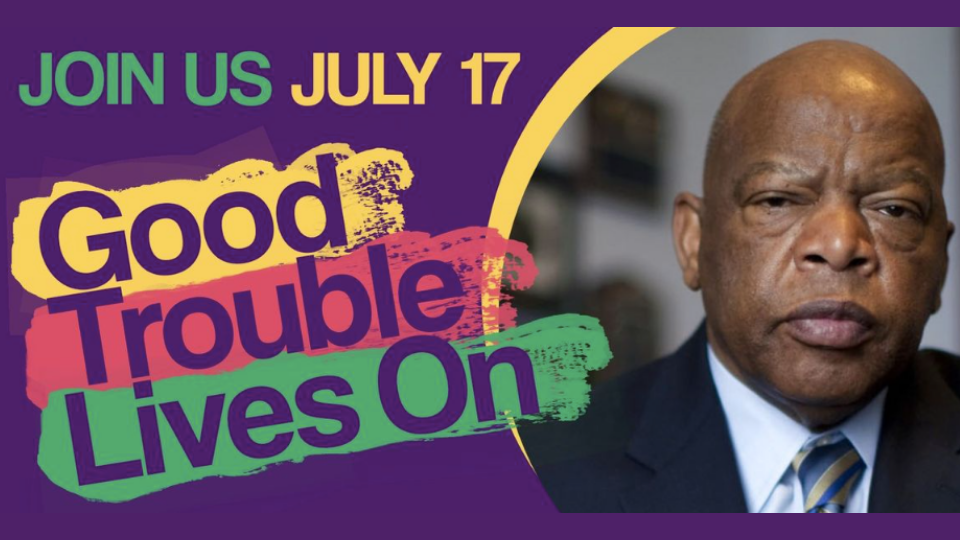
WASHINGTON —Mass marches in Chicago and Atlanta will lead the nation in more than 1,600 cities stretching all day and into the evening of July 17, commemorating the late civil rights icon and Atlanta congressman John Lewis. The marches will be all over the U.S., and there’ll be at least one abroad, in Oaxaca, Mexico. And they won’t stop with one day of mass marching, organizers vow.
Marchers fully intend their crusade for the causes Lewis espoused–voting rights, civil rights and economic and social justice–to continue beyond Thursday. More information is available at the Transformative Justice Coalition.
“John Lewis knew that to do good, sometimes you have to take risks, and sometimes get in good trouble,” said Celina Stewart, national League of Women Voters president, at a Zoom press conference on July 15. Lewis’s “Make Good Trouble” statement is now a mantra for civil rights and voting rights crusaders nationally.
“Today we are called on to respond to attacks that make voting harder for Blacks and browns and women,” she added.
An estimated 400,000 people have already signed up. “We’re getting two more registrations every minute,” on her phone and on websites, says Betty Magness of the Chicago League of Women Voters, which is coordinating the flagship event there, starting at 5 P.M. Central Time.
It will culminate in a nationally televised candlelight vigil in Daley Plaza starting at 7 P.M., after speeches by African-American leaders: Chicago Mayor Brandon Johnson–a former Chicago Teachers Union organizer–CTU/AFT President Stacy Davis Gates, and Rep. Jonathan Jackson, D-Ill., one of the Rev. Jesse Jackson’s sons.
There will be two events in D.C., an “umbrella raising” at the Metro Center subway station during lunch hour and a rally and speeches in Franklin Park starting at 5 P.M. There will also be events in nearby suburbs. And it won’t be just marches. Other events nationwide will include voter registration, banner drops from highway overpasses, and at least one more candlelight vigil.
Evelyn DeJesus, executive vice president of the National Teachers/AFT, will speak at the march in the Maryland state capital, Annapolis. The march in Atlanta will start downtown and culminate at the historic Ebenezer Baptist Church, home church of Lewis’s mentor, the famed civil rights leader Dr. Martin Luther King Jr.
“The idea is not only that we’re going to be celebrating John Lewis, but also discussing how these issues are impacting us today,” said Helen Butler of the Georgia Coalition for the People’s Agenda. The march will precede a panel discussion about where the movement must go in coming days.
The commemorations mark the fifth anniversary of the death of Lewis, who first rose to national notice as a young ally of the Rev. Dr. Martin Luther King Jr. Lewis was in the forefront of the famous 1965 voting rights march from Selma to Montgomery, Alabama. As the marchers crossed Selma’s Edmund Pettus Bridge, named for a racist Southern politician, Selma police chief Eugene “Bull” Connor unleashed vicious guard dogs, high-pressure fire hoses, and state troopers on the peaceful protesters.
Lewis was so severely beaten that his life was endangered, and he carried the head scars for the rest of his years. He also used his voice to become a moral force, first in Atlanta and then in Congress, where he became known as “the conscience of the House.”
Stewart recalled that “65 years ago, President Johnson called out the National Guard to protect civil rights marchers” after Lewis was beaten and the others were chased by Connor’s cops, hoses, and dogs. “Now President Trump is using the National Guard to suppress dissent,” she said.
The Republican president has commandeered California’s Guard to occupy Los Angeles—over the governor’s and mayor’s protests—while Trump’s ICE agents raid churches, schools, hospitals, and workplaces to beat, arrest, detain, and deport working people as “illegal aliens.” Many of the immigrants among them are citizens.
“What else can this be but a constitutional crisis?” asked Stewart. The answer came from another speaker, Leslie Proll of the labor-backed Leadership Conference on Civil Rights: “Trump is taking us to an autocracy.”
Lewis’s particular cause—and one the marchers will emphasize on July 17—was to restore the teeth in the 1965 Voting Rights Act, by recreating its “preclearance” section. The act mandated that jurisdictions, mostly but not exclusively in the South, with a history of voting bans and discrimination had to “preclear” any election changes with the Justice Department’s Civil Rights Division.
Preclearance meant in practice that the DOJ could veto any changes in everything from voter ID requirements to ballot box locations to redistricting that would curb the voting rights of people of color and other victims.
Congress enacted the act in 1965 after the TV images of Connor’s cops, hoses, and dogs—and of Lewis—galvanized the nation for the civil rights cause. LBJ ended his speech for it by declaring, “We shall overcome!” and got a standing ovation.
The GOP-named majority on the U.S. Supreme Court, 12 years ago, threw out “preclearance.” Republican-controlled states rushed to enact voting restrictions, recreating Jim Crow.
Instead of protecting the voting rights of people of color and others, such as disabled people, LGBTQ people, women, and workers, who suffer discrimination, it now, under GOP President Donald Trump’s mandates, protects supposedly endangered voting rights of white conservative Christians.
The marchers will make all those points, and call for a return to strengthening the historic legislation Lewis championed, plus other civil rights causes, when they hit the streets. Those demands include “an end to the Trump administration’s crackdowns on civil rights,” statehood for Washington, D.C., which is majority people of color, and “an end to wealthy and well-connected people slashing programs the rest of us depend upon,” one speaker said.
But Congress’s Republican majority is moving the other way, considering the so-called SAVE Act, to enshrine tough restrictions on voting rights, said Proll. That makes it all the more urgent, all the speakers said, for masses of people to march in Lewis’s name and take the country back.
“One thing John Lewis understood is that America is still becoming” the nation envisioned in the stirring words of the Declaration of Independence and the Constitution,” said April Albright, legal director of Black Voters Matter. “It’ll become what we desire it to be. So this Thursday, people of goodwill of different races, different genders, different faiths, and different ages must come together and assemble a mighty justice team again.”
We hope you appreciated this article. At People’s World, we believe news and information should be free and accessible to all, but we need your help. Our journalism is free of corporate influence and paywalls because we are totally reader-supported. Only you, our readers and supporters, make this possible. If you enjoy reading People’s World and the stories we bring you, please support our work by donating or becoming a monthly sustainer today. Thank you!
CONTRIBUTOR