

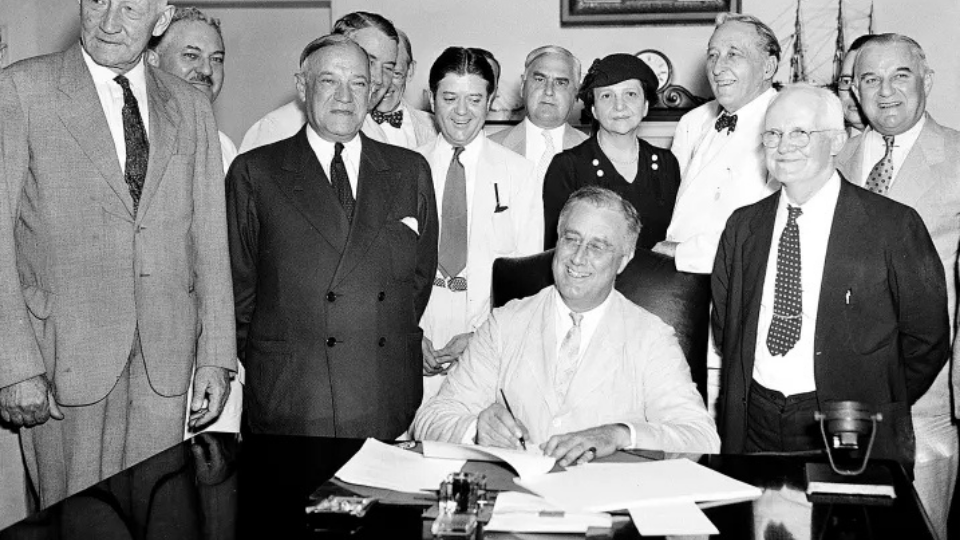
WASHINGTON—Virtually unnoticed in the celebrations over July 4, the National Labor Relations Board, and the New Deal-era law that created it, turned 90 years old the next day. Now the question is: “Will the law, and the board, be around to celebrate their 100th birthday?”
And the short answer is “Not if Donald Trump has any say in the matter.” And he’ll have quite a say, by both what he does and doesn’t do.
The Republican president has a long record of labor repression. Trump’s bias isn’t quite as old as the National Labor Relations Act (NLRA), but it’s close. After all, the law is 90. Trump is 79.
His first headline-making attack on workers was in 1990, when Trump, then a swashbuckling New York-based developer, had Laborers members, many of them naturalized Polish immigrants, build his Taj Mahal casino in Atlantic City. And then he stiffed the 100 contractors who hired them and other unionists. He didn’t pay them a penny.
It took the union local years of fighting, at least one lawsuit, and the casino going broke before workers made any headway. Trump walked away before the workers got any money, ending up with 40 cents on the dollar after selling it to another mega-mogul, Carl Icahn. After years of claimed losses, he forced a strike by the casino’s workers over health care cuts, and then closed it down in 2016.
Fast forward to this year, when Trump executed what AFL-CIO President Liz Shuler calls the biggest union-busting action in U.S. history, unilaterally demolishing 30 union contracts covering a million federal workers. Lower courts said Trump broke the law and the Constitution, too. The six-justice GOP majority on the Supreme Court—three named by Trump—reversed that. The eliminations stand.
That same majority also let stand Trump’s firing, on January 27, of NLRB member Gwynne Wilcox, even though her term doesn’t expire legally until August 2028. In one stroke, Trump neutered the independence of the NLRB. No Wilcox means no quorum, which means the board can’t have the final word on worker-boss disputes, unfair labor practices, or labor union elections and certifications.
The No Wilcox ruling also declares that Trump, and any president, can remove an NLRB member for political reasons, which he did. The NLRA—also called the Wagner Act, for Sen. Robert F. Wagner Sr., D-N.Y., the lead congressional advocate—bans political firings. Firings can be for cause, period.
“If you don’t think he [Trump] is eventually coming after the private sector, you’re not paying attention,” Pima County (Tucson) Federation of Labor President Cecilia Valdez told the Progressive Democrats of America on July 20. “He wants to eliminate us altogether.”
Left in Limbo
All this leaves the NLRB in limbo. Two states, New York and California, are trying to fill the legal void, with Massachusetts considering doing so, too. But a prominent pro-worker academic, Joseph McCarlin, is asking seriously whether keeping the NLRA, and the board, is worth it.
And to understand that, let’s back up and review the history of how the NLRA and NLRB came to be.
The story began during World War I, when the Wilson administration, which then included Franklin D. Roosevelt (in the Navy Department) created the War Labor Board to impose mandates on labor-management relations during that conflict. That board ended after the Great War did. But FDR, his Labor Secretary Frances Perkins, and Wagner picked up its language and system years later.
That’s where the NLRA’s basic premise that “it shall be the policy of the government that employees shall have the right to organize and bargain collectively through representatives of their own choosing,” comes from word for word.
That’s also where the assumption by FDR, Perkins, and Wagner came from that once the law was enacted and board members named, corporations would obey the law and workers would be more equal when facing off against bosses—because of collective bargaining.
Ninety years of disputes, decisions, GOP weakening and outright conflict, up to murders of workers by “rented” cops in the Twin Cities in 1934 and on Chicago’s South Side in 1937, plus Detroit’s “Battle of the Overpass” which put the UAW’s Reuther brothers in the hospital, prove that’s wrong.
Frustrated workers, hammered by the Great Depression, wanted a say in their futures and to reap more of the profits their hands produced. They still do. Their bosses should be punished, but aren’t. The board’s minimal fines are, for a Walton family, a Jeff Bezos, a Howard Schultz, and an Elon Musk, a tax-deductible “cost of doing business.” The inequality gap between workers and bosses is wide.
FDR, Perkins, and Wagner argued the way to industrial peace is to balance the scales between capital and labor. Capital was organized in great trusts and in the Chamber of Commerce and other lobbies, and protected by state government incorporation papers and U.S. court rulings. Labor wasn’t.
Other laws covering wrongdoers, notably civil rights laws, assume malefactors willfully and knowingly break the law. Their penalties feature higher fines and sometimes jail terms. The Wagner Act imposes “net back pay” to harmed workers and orders to firms to post a we-broke-the-law-and-we-won’t do-it-again notices. Which hasn’t stopped bosses, time after time, from doing it again. No jail terms.
Corporate clout and cash also weaken the NLRA and by squashing all attempts at pro-worker reform, up to and including the Protect The Right To Organize Act, labor’s #1 legislative priority.
Prior results were compromised by FDR to omit farm workers, who were and are mostly Hispanic, and domestic workers, who were and are mostly Black, from the law’s coverage. In the 1947 GOP-passed Taft-Hartley Act, lawmakers turned organizing and voting on unionization into a long legalistic obstacle course, complete a federal OK for racist-origin state “right to work” laws.
Bosses also tried to kill the NLRA in court, but lost, 5-4, in a conservative Supreme Court in 1937. Now Trump allies Jeff Bezos and Elon Musk, two of the nation’s richest people, are trying again, before judges in deep-red Texas and Louisiana. The duo calls the NLRA and the NLRB unconstitutional.
Weakened the law
Meanwhile, bosses weakened the law and the board during the GOP-run Congress of 1947, via the Taft-Hartley Act, turning unionization into a legalistic obstacle course. Roosevelt, Wagner and Perkins never envisioned it would take 25 years to organize Smithfield pork plants in the South, or 17 years for News Guild members at the Toledo (Ohio) Blade to reach a contract. They never envisioned open defiance of court orders by the Block brothers who own the Pittsburgh Post-Gazette (and the Blade).
Bosses got a big “go” sign in their war on workers when GOP President Ronald Reagan fired all 14,000 U.S. air traffic controllers in 1981, destroying their union, PATCO. The controllers had struck over unsafe conditions on the job and in air traffic towers.
Now, along comes Trump, with his unilateral trashing of collective bargaining agreements and his firing of Wilcox.
That’s not all. During his first term, Trump White House aides openly boasted that once they got done shredding government-sector unions, they’d go after the private sector workers and their unions. Project 2025, Trump’s platform when he ran for a second term, makes that clear.
“Congress should pass legislation allowing waivers for states and local governments, under certain conditions,” from federal labor laws, including the Wagner Act and the Fair Labor Standards Act– which governs the federal minimum wage and when and which workers get overtime pay–wrote Jonathan Barry, author of the project’s labor chapter.
Barry gives lip service to saying those waivers must still require states and local governments “to accomplish the purpose” of those two laws and “not take away any current rights held by workers or employers.” He was silent on who would define those rights. He also wants to exempt many more small businesses from the NLRB’s jurisdiction “to match changes in inflation since 1935.”
Given this threat, there have been very divergent responses. One, from lawmakers in New York and California, is to take over the functions and jurisdiction of the NLRB in their own states, using state agencies that now rule on labor-management relations governing state and local public workers.
The other, by Professor Joseph McCartin, head of the Labor and Working Class History Project at Georgetown University, is to give the NLRA—and the NLRB—a decent burial, and return to the militance, unrestricted by law, of the 1930s.
New York is the farthest along in expanding state agency powers to regulate labor-management relations. AO8590, the NLRB Trigger Bill, passed the state Assembly on June 17 and is headed towards Democratic Gov. Kathy Hochul’s desk. It says New York’s Public Employees Relations Board, which now handles cases involving state workers—mostly in the Empire State’s sprawling community college and state university system—would handle private sector cases, too.
That board would certify workers had filed enough authorization cards to seek an election. The state board would run it and publish its outcome. It would decide cases of unfair labor practices, the formal name for labor law-breaking. But it would do so only when the NLRB can’t function.
“This is uncharted territory,” Harvard Law School Professor Benjamin Sachs, editor of its OnLabor blog, told Bloomberg News.
California’s bill, AB288, is similar to New York’s, but with important differences. Its state labor relations board would have permanent jurisdiction over the private sector not just when the NLRB can’t function. And when workers lose federal labor law coverage, California would cover them.
Fails to provide timely remedy
And a third is if the federal NLRB “fails to provide a timely remedy, AB288 gives the state the ability to enforce workers’ rights.” As of mid-July, AB288 is still pending before the California State Senate.
Meanwhile, the number of cases at the NLRB has jumped and its workforce has shrunk and would shrink even more under Trump. It handled 25,000 cases last year, a 20%-plus jump since 2019. The result is an ever-longer backlog of cases. “Justice delayed is justice denied,” so California workers, facing a declining NLRB budget and shrinking workforce, could appeal to the state Public Employment Relations Board to act.
The Democratic-dominated State Assembly approved AB288, by State Rep. Tina McKinney, D-Inglewood, by a bipartisan 68-2 vote in early June. Teamsters Joint Council 7 and the California Federation of Labor Unions lobbied heavily for it.
“Today, Assemblymembers did the right thing and stood with working Californians who want to unionize against union-busting billionaires,” said California President Lorena Gonzalez, a former state legislator. “This isn’t a Democratic issue or a Republican issue. This is a working-class issue. I am pleased to see lawmakers on both sides of the aisle standing up for what’s right. We will keep fighting for AB288 and Californians’ right to organize until it is an enforced law.”
“When major corporations like Amazon violate workers’ rights with impunity, the right to a union is meaningless,” said Teamsters Joint Council 7 President Peter Finn. “California cannot stay on the sidelines. It’s time to ensure working people who build this country and make our economy run have their rights protected and have a voice on the job.”
“AB288 gives the state the ability to enforce workers’ fundamental rights to organize, to come together with their coworkers, and to exercise control over their own labor,” the state fed added.
California corporate interests will try to stop AB288 in the State Senate. Looking down the road, if that doesn’t work, and Democratic Gov. Gavin Newsom signs it, they could initiate a huge corporate-backed campaign for a referendum to repeal it. That’s what Uber, Lyft, and DoorDash did against AB5, the law which mandated their drivers are “employees” with the right to organize and to strike.
The three firms spent more than $200 million to defeat AB5, trotted out pro-corporate drivers to bleat they would lose money and flexibility on ride-sharing—and the corporate interests won.
The National Labor Relations Act also has weak remedies. Total presidential control of the NLRB, granted by the six-Justice U.S. Supreme Court majority, makes things worse, McCartin pointed out in his American Prospect analysis.
And if organized labor couldn’t get the Protect The Right To Organize (PRO) Act passed even when Democrat Joe Biden was president—on top of prior labor law reform failures due to corrupt corporate influence and lobbying—the whole “reform” concept is “a fantasy” and dead—and labor should act accordingly, Professor McCartin of Georgetown University contends.
“To appropriately mark the Wagner Act’s 90th anniversary, unions…should engage in the kinds of struggles, including mass civil disobedience, that made the act’s passage possible in the first place,” McCartin wrote in his Prospect column. If they succeed, maybe the law will celebrate a centennial.
“By doing so, they will at least have some hope of opening a way where none currently exists for the passage of 21st-century legislation that protects workers’ capacity to organize and bargain collectively. By waging that fight, labor might also inspire other progressive forces to join them in the long struggle to build a just and democratic social order from the rubble in which we now sit,” he concluded.
We hope you appreciated this article. At People’s World, we believe news and information should be free and accessible to all, but we need your help. Our journalism is free of corporate influence and paywalls because we are totally reader-supported. Only you, our readers and supporters, make this possible. If you enjoy reading People’s World and the stories we bring you, please support our work by donating or becoming a monthly sustainer today. Thank you!
CONTRIBUTOR

MOST POPULAR TODAY
Communists work to save ‘Millionaire Tax’ in Evergreen State

Controversial ‘God made Trump’ campaign ad produces bipartisan uproar

Westland Starbucks workers vote to unionize, becoming 20th Michigan store
HBCU students march to demand justice for Nolan Wells: “No water in his lungs!”

Leonard Peltier, longest serving U.S. political prisoner, should be free