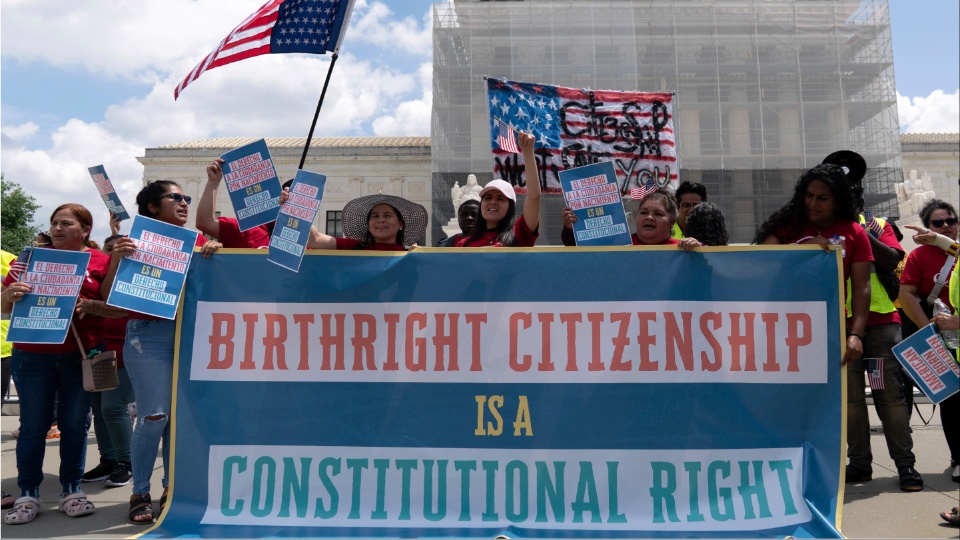
A federal appeals court panel in San Francisco has upheld birthright citizenship, adding that Donald Trump violated the Constitution by trying to yank it from pregnant women—and their then-unborn kids.
Upholding most of a decision from a federal district court in Seattle, Appellate Judge Ronald Gould stated bluntly that Trump violated the 14th Amendment to the Constitution when he issued an executive order banning birthright citizenship if either the mother or the father was not a citizen, born or naturalized.
He also pointed out that Trump’s lawyers never actually challenged the 14th Amendment, which grants birthright citizenship, in their arguments. Trump’s order would deprive thousands of babies each month of citizenship, Judge Gould said.
In the July 23 unanimous decision, Judge Gould said states that sued Trump and his Cabinet officers could do so because they could get hurt financially by being forced to follow Trump’s dictate. They’d have to scrub birth rolls to see which mothers or fathers are documented or “legal” and which are not and then pay out of their own pockets, not from federal money, for medical care of the kids, or for aid from the Children’s Health Insurance Program.
And the kids couldn’t get Social Security cards, either.
But the mothers lost the right to sue, even as a class, Judge Gould wrote, because between the date they filed the case in January, just after Trump’s order, and now, one of the two named mothers has given birth and the other, as of July 23, was about to do so.
First ruling on birthright citizenship
The San Francisco decision is the first appeals court ruling on details about birthright citizenship. Earlier this year, bypassing appeals courts, Trump got the six-justice GOP-named U.S. Supreme Court majority to rule that people claiming birthright citizenship could sue as a class.
Other birthright citizenship cases are headed for the High Court from Massachusetts and New Hampshire. The district court judge in New Hampshire also issued a nationwide injunction against Trump.
In all the cases, including this one, the district judges issued both temporary orders and permanent nationwide injunctions against Trump. But the Supreme Court recently vetoed national injunctions, limiting such bans to either the district or the group of states that particular court covers.
The case is important both constitutionally and for workers. People without birthright citizenship—virtually all of them people of color and most of them Latino—become part of the “shadow economy.” They’re easily exploitable by vicious and venal employers and forced to work for cash, if they’re paid at all.
And undocumented people can organize and join unions, according to prior NLRB and court rulings, bosses can retaliate by calling ICE and having them rounded up, jailed and deported. That’s what ICE raiders did during Trump’s first term. None of those details were in San Francisco appellate Judge Gould’s ruling.
Since “1898, and until this challenged executive order, the Judiciary, Congress, and the executive branch have consistently and uniformly protected the citizenship clause’s explicit guarantee of birthright citizenship regardless of the immigration status of an individual’s parents,” Judge Gould wrote.
“The states contend that they will need to create new systems to determine citizenship and maintain compliance with federal law,” and they would lose “$7,320–$38,129 per year per person” covered if Trump’s dictate is upheld.
Those are direct costs, and the Trump regime argued they were “incidental.” Judge Gould rejected that.
The Trump regime’s lawyers also argued that because the parents are in the U.S. illegally or on temporary visas, such as student visas, the kids born here are ineligible for citizenship. They’re not permanent residents the Trump lawyers said.
The 14th Amendment kills that argument, too, the appeals court ruled—because, among other reasons, it was written in plain English that everyone could understand.
“In interpreting the text of the Constitution, courts are guided by the principle that the Constitution was written to be understood by the voters; its words and phrases were used in their normal and ordinary as distinguished from technical meaning,” the judges declared.
CONTRIBUTOR