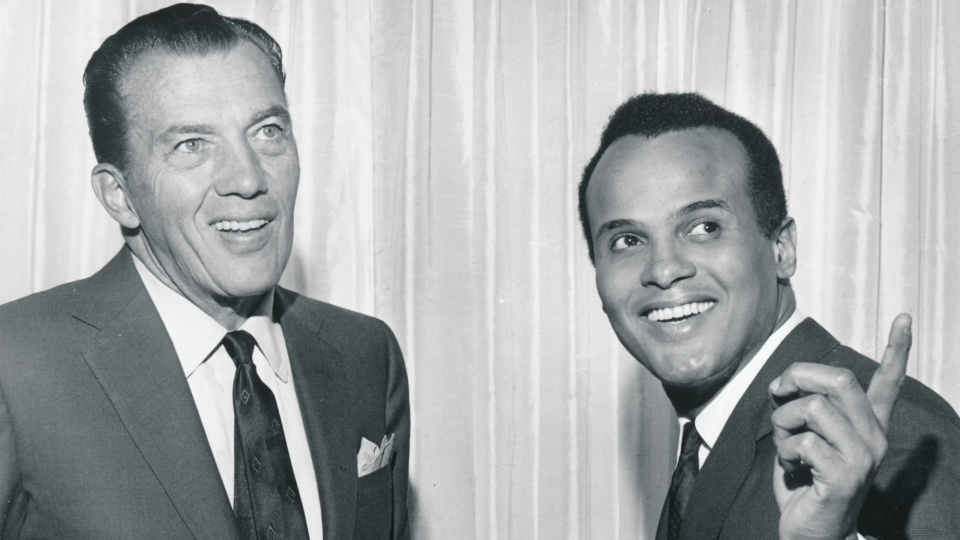
At a key moment in the now-streaming Netflix documentary Sunday Best, a young Harry Belafonte takes the stage in Ed Sullivan’s famous 1950s and ’60s television show and wows the largely white audience with a powerful song evoking the determination and struggle of oppressed people everywhere.
Some 35 million people, in a country that then had only 150 million people, no internet and just three national networks, watched and listened to The Ed Sullivan Show every week. And across the country, they loved what they heard and saw.
The fact that Jim Crow was the rule then across the South and the Ku Klux Klan was rallying to “Keep television white” did not stop families, in the privacy of their own homes across the South, from joining with families in the North that Sunday night in enjoyment of Belafonte’s performance.
 Belafonte was, at the time, on the McCarthyite blacklist because of his support for left-wing and progressive causes. Belafonte appears on Sunday Best to explain that Sullivan met with him the night before the show to tell him that he was under orders from CBS to keep him off the air because of his “communist ideas.” Belafonte knew that Sullivan, born in Harlem in 1901, came from an Irish family that supported the fight by Irish revolutionaries against the oppression of Great Britain. Harlem, at the time, was home to Irish and Jewish immigrants that had fled oppression in Europe.
He told Sullivan that the fight of African Americans against their oppression was closely related to the fight of the Irish against their oppression. It had an impact on Sullivan, who had already made his show the home for many of the first performances on TV ever of many African American performers.
Belafonte tells us on Sunday Best that the next morning he got a call from Sullivan telling him they would go ahead with his performance regardless of what CBS was saying. Network execs were floored when they saw that what Sullivan did resulted in 35 million people tuning in.
It was great to see Sunday Best earlier this week, especially since Trump, like the Ku Klux Klan back then, is trying to control what Americans watch on TV. The show makes clear how a brave and fearless TV host, even at the height of the McCarthy era and Jim Crow, was able to tell the racists where they could go.
Sunday Best reminds us that television had a key role to play in building the civil rights movement, not just because of people like Sullivan, but in the way it exposed millions to the true viciousness of the opponents of voting and civil rights. Images of Bull Connor’s crimes against the people, the turning of fire hoses on people simply engaging in peaceful protest, and the beating and killing of civil rights activists were all beamed right into homes across the nation because of television.

I watched the performances of countless African American performers every Sunday night as a child. To me, it seemed normal that talented singers, dancers, actors, musicians, and others would appear on television. And it was fun watching the positive reactions from the studio audiences.
As a child in Brooklyn, I didn’t realize that what I was watching was, at the time, also an act of bravery, not from a “white savior” TV host but from a man who was a determined supporter of the struggles of African American and other oppressed people.
It helped me question the empty-headedness of those of my Brooklyn elementary school teachers who were telling us, during the week, that segregation in the South, including restrictions on public transportation, was “normal” and bound to continue forever. It made me agree with those other teachers who said that Jim Crow was wrong and even criminal.
Sacha Jenkins’ film about the Sullivan show featured the testimony of people like Lena Horne, James Brown, Diana Ross, Nina Simone, Smokey Robinson, and Motown’s Berry Gordy. They recall how it was the hope and dream of every Black performer at that time to snag a spot on the Ed Sullivan Show. For most of those who scored an appearance, it became the path to national recognition. And to the vast majority of Americans, it was an awakening to the fact that there was a real wealth of talent in the African American community.
Watching the program also brings back the incredible variety of great entertainment for its own sake. Watching a 13-year-old boy, Stevie Wonder, sing and play the harmonica while the audience went crazy for him was just one example of how refreshing the documentary is.
For people who want to learn more about the history of the struggles for racial justice in America, the documentary offers plenty. We learn that Sullivan, aside from his variety show, played a great role when he was a sports reporter. When the University of Georgia came to New York for a football game against New York University, at the demand of the Georgia team, NYU actually benched a Black player. During the game and afterward, Sullivan attacked NYU for its racist capitulation.

Belafonte tells us in his interview that Sullivan was told repeatedly by his network bosses that he couldn’t do what he was doing for long because “the South would never accept it.” Belafonte said, “Ed pushed the envelope as far as he could push it.”
To Sullivan, “Amos and Andy” was unacceptable as the main TV feature of African American talent. He knew that there was so much more out there. There was Rhythm and Blues, Bo Diddley, Louis Armstrong, Jackie Wilson, Ike and Tina Turner, Pearl Bailey, Mahalia Jackson, Ella Fitzgerald, Lena Horne, Dionne Warwick, Gladys Knight, Ethyl Waters, Ray Charles, Nat King Cole, the Jackson Five with the superstar, the young Michael Jackson. All of these greats had their first big breakthrough on The Ed Sullivan Show.
Sullivan first hit the airwaves in the period of transition from radio to TV. It is no exaggeration to say that without all of these greats gracing the TV screens, the beginning years of television would have been a mere shell of what they became.
Today, giants in the entertainment industry have buckled under to the Trumpite fascists, demonstrated with their cancellation of Stephen Colbert’s night time show because of its criticisms of right-wing politics and with Paramount caving in to the administration’s lawsuit against it.
A few, including Colbert himself, are using air time to fight back. Hopefully more of the entertainment giants will remember what Ed Sullivan did during other dark times. We need more of the bravery showcased in Sunday Best if democracy is to survive.
CONTRIBUTOR