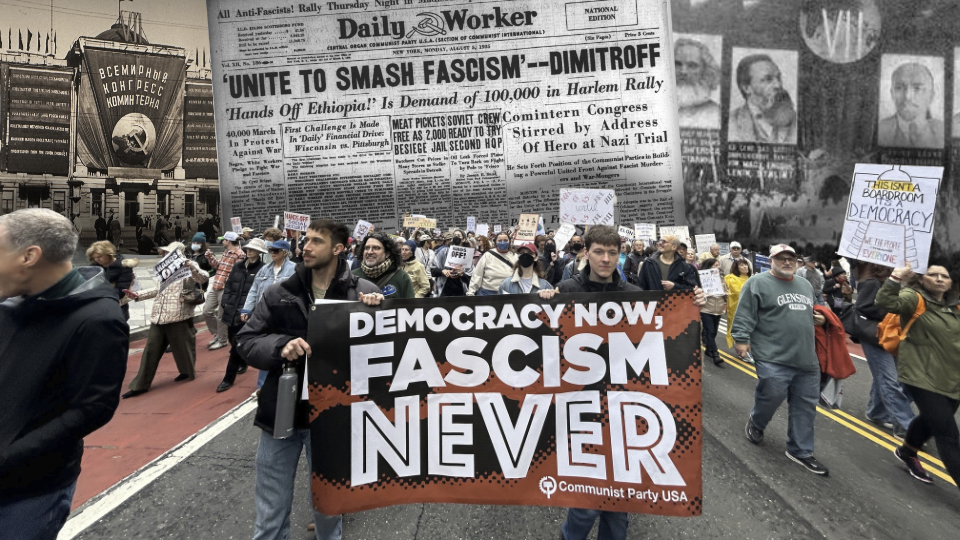
Fascism—the word is on more lips today than at any time since the 1930s. Back then, it was associated with names like Hitler, Mussolini, and Franco. Today, it’s frequently attached to figures such as Trump, Orban, or Le Pen. And just like then, debates rage about the best way to combat it.
This summer marks the 90th anniversary of the “Popular Front” strategy, known more commonly in the U.S. as the “People’s Front.” During July and August 1935, the Communists of the world met in Moscow for the 7th World Congress of the Communist International (Comintern). From Rome to Berlin, Madrid to Paris, fascists were already in power or on the verge of capturing it.
In the U.S., demagogues like Huey Long and Father Coughlin were building mass bases of support, the open terror of the Klan ruled in the South, and the police and hired guns of the capitalist class attacked workers and the unemployed in places like Harlan County and Minneapolis.
Fascism was not just a danger looming on the horizon—it was an immediate threat to the survival of bourgeois democracy—which, however limited it was, provided the opening and organizing space for the working class and people to fight. The urgency that inspired the delegates to the Comintern congress ninety years ago echoes in our own time—and demands a similar response.
Coalition politics
The Comintern’s new approach urged Communists to join forces with other political and class forces—socialists, liberals, and progressives of all kinds—to stop the fascist tide. It was a defensive move, to be sure, rooted not in sectarian idealism but in historical necessity.

The switch in strategies, which was a clear break with the isolationist rhetoric and positions that had characterized left tactics in the previous period, didn’t come out of nowhere. Carl Winter, a former editor of People’s World and an attendee of the 1935 congress, recalled the process by which Bulgarian anti-fascist and Comintern General Secretary Georgi Dimitrov, who gave the speech inaugurating the Popular Front, came to his conclusions.
Speaking to our reporter Tom Foley in 1982, Winter remembered that Dimitrov asked every party from around the world to submit papers on their national situation ahead of the congress. “In that way, he was able to draw on each party’s experiences and to weld them all together in his report to the congress; an example of his collective style of work,” Winter said.
“From us [the Communist Party USA], he asked for papers giving details on the youth question, unemployment, the Afro-American and women’s struggles. He asked for similar detailed, specific papers from every party.”
Winter said that Dimitrov didn’t hold back, making “some incisive criticisms of certain mistakes that had been made” by Communists, especially in Germany, where earlier unity with other anti-fascist forces might have stopped Hitler and the Nazis from taking power. “But the criticisms were compassionate, inviting serious examination and correction of what he had pointed out.
“Dimitrov was a man of great modesty and conscious of social responsibility. He always emphasized the individual responsibility of Communists to their own nation and to other peoples fighting fascism and oppression.”
Winter said that prior to Dimitrov’s report, there had been “some reluctance expressed and the idea was put forward by some that it was not right to fight just for democracy, that this was a bourgeois aim. These people didn’t understand that the bourgeoisie itself in several countries had abandoned democracy. This took a great deal of clarifying,” Winter said, “and that is exactly what Dimitrov did—and this marked the turn of the movement toward the ‘united front against fascism.’ Dimitrov’s report mobilized the entire world movement.”
The Popular Front had its “left” critics, of course. Self-styled ideological purists called it a sell-out of the working class. Leon Trotsky said coalition politics “stemmed the revolutionary tide” and represented “the submission of the proletariat to the bourgeoisie.” For his followers and other sectarians on the infantile left, only an immediate Communist-led working-class revolution could stop fascism, apparently. Luckily, few listened to them.

Instead, in the 1930s, in the midst of the greatest economic crisis ever and with another world war looming, U.S. Communists, labor activists, left-liberals, New Deal Democrats, progressive cultural figures, and others gave life to a political strategy which not only blocked the road to fascism in America, but also organized unions in the major industries and won Social Security and unemployment insurance along the way.
At the core of the Popular Front strategy that they forged was the idea of broad-based coalition politics, and it is formulated around a couple of key strategic questions. First, it asks what goal, if won, can change the relationship of forces and open up the possibility for advance. Second, it sets out who are the main opponents and possible allies in the struggle to achieve that goal. This means determining who has the self-interest to fight for the goal and assessing their organization, consciousness, and capacity to join in the fight.
For the Popular Front of the 1930s, the goal was the containment of fascism and the defeat of the anti-New Deal section of capital and the Republican Party. As delegates to a convention of the Communist Party heard in June 1936, “There are two chief and opposite directions of possible development in political life…. All parties and groups must be judged by their relation to these two fundamental political tendencies.”
To win a people’s recovery program in the Great Depression, this meant lining up all the forces of progress on one side to take on the forces of reaction on the other.
A December 1936 CPUSA document followed up: “Our country, in common with the rest of the capitalist world, is threatened with reaction, fascism, and war…. Everything that organizes and activates the working class and its allies is progress toward socialism; likewise, everything that weakens and discourages the forces of reaction goes in the same direction.”
There were two main camps, and those who cared about stopping the worst assaults of the reactionary right and opening a way forward for the working class and democracy had to answer the question: Which side are you on?
Fascism’s return
Nine decades later, we again confront a fascist danger, and the lessons of that earlier period are more urgent than ever.
The Republican Party—which has been completely taken over and turned into a vehicle for Donald Trump and his MAGA movement—has thrown away even the pretense of believing in bourgeois democratic norms. Like major sections of the Democratic Party, it has long been a political representative for the interests of big business, but it has evolved into something more dangerous.
GOP lawmakers at the federal, state, county, and local levels, along with their allies in the far-right think-tank universe, work openly to suppress the vote, stack the courts, vilify immigrants, roll back civil rights, and funnel wealth upward from those who have the least to those who have the most. The MAGA minions who acted as stormtroopers on Jan. 6, 2021—the Proud Boys, the modern-day Klan, and the rest—are the street muscle for this fascist assault on democracy.

From book bans, forced birth laws, mass deportation raids, attacks on labor rights to its open glorification of political violence and the fomentation of war abroad, the MAGA movement has crossed the threshold of right-wing conservatism into the early stages of fascism. Trump is at the head of this movement, but behind him are ideologues who promote conspiracy to gain influence and capitalists (particularly in the tech and finance sectors) who dream of unrestrained power.
This is an extremist coalition—a united front of the right—rooted in white supremacy, nativism, patriarchal backlash, and corporate oligarchy. To have any hope of beating it, we still need the Popular Front.
Today’s Popular Front
The left and working-class movement cannot meet the moment if it retreats into comfortable “left” forms and slogans. Neither the Popular Front of the 1930s nor the “All-People’s Coalition” variant initiated by the CPUSA after the victory of Ronald Reagan in 1980 were compromises of principle; they were a recognition that defeating fascism required unity across the working class and democratic forces.
There are some out there, though, who still want to divert the left and labor from coalition politics. Think pieces from the heirs of Trotsky are still alleging “The Popular Front Didn’t Work” or that alliances between the working class and other people’s movements are a “Stalinist” strategy that “only leads to disaster.”
Even some Communists in other countries have decided that going it alone is a better course for the labor movement than allying with other democratic forces. They point to historical detours like Eurocommunism or Mikhail Gorbachev in the USSR to justify tossing out the entire strategic experience and wisdom of the world Communist movement going back not just to Dimitrov but even to Lenin.
It is true, no doubt, that today’s Popular Front isn’t and won’t be identical to that of the ’30s. Forms must change and tactics must adjust as circumstances change. Coalitions come together, are reshaped, and sometimes fall apart around specific challenges and objectives. The more forces that are involved in the front, the more fragile is the basis of unity.
And of course, it’s necessary to constantly review how the Popular Front strategy is applied and pursued. Just like Dimitrov urged Communists to be self-critical in 1935, contemporary understandings of the Popular Front strategy also have to be scrutinized. As CPUSA Co-Chair Joe Sims recently pointed out, for a long time, the Popular Front concept was oversimplified to the point that it resulted in the near-disappearance of Communists as an independent part of the front:
“For far too long, the party’s electoral work has—albeit with some districts’ exceptions—consisted in coalescing every election cycle with the broader democratic movement to defeat far-right candidates, but without running for office ourselves. What began in the 1980s as an absolutely correct tactical adjustment became a permanent, now decades-long policy. In practice, it amounted to sacrificing our existence as an independent electoral force and minimized our posture as a working-class, revolutionary party.
“While it remains essential to defeat far-right candidates and work within broad united front efforts, this cannot come at the expense of shutting ourselves down completely or even supporting other left candidacies at times. Nor should we pursue strategies that risk helping MAGA Republicans. Our primary objectives must always guide our electoral tactics, but part of our primary objective must be to build the party.”

This is a recognition and restatement of a point made by Dimitrov himself at the 7th Congress. “We fight for the united front not from the narrow standpoint of recruiting members for the Communist Party, but the Communist Parties must enlarge their membership precisely for the purpose of seriously consolidating the united front,” he said in his famed speech.
The Popular Front today needs a strong and growing Communist Party—along with labor unions; tenant unions; climate justice organizers, feminist, queer, and abolitionist groups; Black, brown, and indigenous-led movements; immigrant rights groups; anti-war and peace organizations; cultural workers; educators; and everyday people of all walks of life who are committed to stopping Trumpism.
Building a Popular Front is not about watering down socialist politics; it’s about building a fighting alliance capable of defending what democracy we have left—and then expanding it through organized power. It’s also not the property of the Communist Party alone; there are many outside its ranks who recognize the necessity of coalition politics and agree on the need to always look for firm points of unity.
This is no time to be diverted from the task of building the broadest possible unity in action because fascism isn’t coming—it’s already at the door. The left and labor must fight it with everything we have, and that means coalition, not fragmentation. Strategy, not sectarianism.
Ninety years ago, the Popular Front helped stop fascism and build a generation of radical resistance that even the McCarthyite anti-labor Red Scare could not extinguish. We face the same responsibility. The Popular Front is not a historical relic but a roadmap providing direction to do what must be done.
As with all op-ed articles published by People’s World, the views reflected here are those of the author.
CONTRIBUTOR