Wendy Wasserstein’s 1988 play The Heidi Chronicles earned Tony and Drama Desk Awards, a Pulitzer Prize, plus accolades from the New York Drama Critics’ Circle. Wasserstein became one of the era’s feminist icons, along with figures such as Betty Friedan, Gloria Steinem, Simone de Beauvoir, Germaine Greer, Bella Abzug, and novelist Erica Jong (whose daughter seems to be cashing in on her mother’s fame with a tell-all about the Fear of Flying author’s alleged dementia).
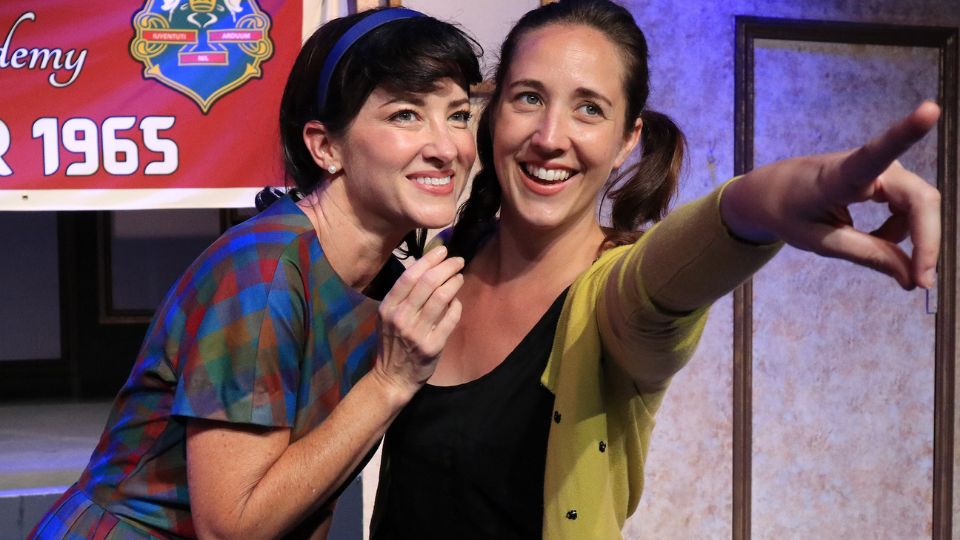
What propelled The Heidi Chronicles into the feminist pantheon is the play’s brilliant interweaving of Second Wave Feminism with the personal lives of the protagonist, Heidi Holland (Amy Earhart), and the dramatis personae. The emerging Women’s Liberation Movement forms the backdrop for this two-act play, with the dating, mating, and career paths of Heidi and the other characters in the foreground. The action takes place from 1965 to 1989 and is set largely, but not exclusively, in New York City, which has been an epicenter of the struggle for women’s rights in America.
Interestingly, Heidi’s career path yields more success and satisfaction than her romantic life does. She studies to become an art historian and pursues a career in that field. In particular, Heidi is dedicated to recognizing the work of female artists—generally overlooked—throughout the centuries. Of course, there have been many great women daubers, but male talents have usually been put in the limelight. For example, Heidi waxes poetic about: “Lilla Cabot Perry, 1848 to 1933, was, along with the better-known Mary Cassatt and Berthe Morisot, a major influence in American Impressionism.” (Today, one of NYC’s greatest living artists is Sharon Florin, whose canvases creatively capture city architecture.
On the other hand, true love eludes Heidi. At a New Hampshire campaign event for peace candidate Sen. Eugene McCarthy, who is running against LBJ in the Democratic Party presidential primary in 1968, Heidi meets Scoop Rosenbaum (Alex Scyocurka), who, as his name suggests, is journalistically inclined and pursues her. Scoop has pretensions to being part of the New Left, but in my opinion, he’s completely pretentious; this poseur is a recurring (and annoying) character throughout The Group Rep’s revival.
Earlier, at a high school dance, Heidi had encountered Peter Patrone (Hudson Long), another of this comedy-drama’s recurring characters. He becomes Heidi’s soulmate and a doctor, to boot. So naturally, Peter is perfect for Heidi, which can mean only one thing: But of course, he’s gay.
Throughout the Chronicles, when Heidi is asked by one of her longtime acquaintances about her relationship status, she says something like, “I’m seeing someone. Sort of living with someone,” as she tells nosy Scoop in Act II. But Heidi’s purported gentleman caller is never actually glimpsed onstage. Which means one of two things: Either Heidi is just making this up or Wendy Wasserstein is a flawed playwright, because in theater or cinema, rule numero uno is: You’re supposed to show something, not tell the audience about it.
As said, it’s the topical references—such as the McCarthy candidacy against the Vietnam War— intertwined with the individual characters’ lived experiences that make Chronicles shine. What Jill (Kathi Chaplar, who plays multiple roles) calls the “meeting of the Huron Street Ann Arbor Consciousness-raising Rap Group” in Act I may be the drollest example of Wasserstein’s intermixing of the political and the personal. Michelle McGregor (who also has multiple parts) steals this scene as Fran, a caricature of a militant lesbian, clad in army-style garb, in this 1970 send-up of the era’s feminist support groups. Sisterhood may be powerful, but Wasserstein shows it can also have a lighter side.
Does Heidi eventually find the life partner of her dreams? Do “women’s libbers” consider Heidi’s decision regarding babies to be a betrayal, a cop out of the feminist ethos? Does Heidi attain the fulfillment that she—and millions of other women—fought for? Or is Wasserstein’s saga a chronicle that dramatizes what Culture Study substack writer Anne Helen Peterson calls “feminist exhaustion”?
According to Peterson, “feminist exhaustion… applies to the generations of women who understand their progressive, aspirationally intersectional, progressive world view as feminist….and find themselves utterly demoralized by a long, damaging fight that now seems to have lost ground.”
In 1973 American women won the right to have abortions. But thanks to Trump and his handpicked Supreme Court of reactionary ideologues posing as judges, women’s access to reproductive freedom has been widely restricted. Women’s control over their own bodies, themselves, has been significantly set back, so U.S. women today actually have fewer rights than their mothers and grandmothers had. A closing photo montage projected onstage references today’s daunting reality, which Peterson refers to as a “feminist dystopia.” Are Heidi and her sisters worse off today than when they started their crusade for workplace equality, sexual liberation, etc., in the sizzling sixties?
Like any self-respecting production that takes place (at least in part) in the 1960s and 1970s, period rock songs form the show’s soundtrack (sound design by John Harvey). The theatrical scenery has a unique, clever affectation—picture frames festoon the stage. Of course, this is an obvious reference to Heidi being an art historian. But more significantly, the frames are empty— it’s as if the portraits are incomplete, like the women who fight for their rights in a never endingly oppressive patriarchal society. Quite a powerful visual touch (set design by Kathi Chaplar).
Brent Beerman does a deft job directing his ensemble (even if he is a man, ha ha ha!). The play is well-acted, if a bit long, but the saga does cover three decades, and the cast, endowed with Ms. Wasserstein’s words, ask the questions that, alas, need to be raised again—along with our consciousness.
FUN FACT OF THE REVIEW: Lead actress Amy Earhart is related to the late pilot Amelia Earhart (the feminist hero was depicted by two-time Oscar winner Hillary Swank in the 2009 biopic Amelia, directed by Mira Nair—the mother of Democratic Socialist NYC mayoral candidate Zohran Mamdani).
The Heidi Chronicles runs on Fridays and Saturdays at 8:00 p.m. and Sundays at 2:00 p.m. through August 31 at The Group Rep Theatre – Mainstage (first floor), located at 10900 Burbank Blvd., NoHo 91601. For info & tickets go here or call: (818)763-5990.
We hope you appreciated this article. At People’s World, we believe news and information should be free and accessible to all, but we need your help. Our journalism is free of corporate influence and paywalls because we are totally reader-supported. Only you, our readers and supporters, make this possible. If you enjoy reading People’s World and the stories we bring you, please support our work by donating or becoming a monthly sustainer today. Thank you!
CONTRIBUTOR