Although I’ve reported on many antiwar protests, the closest I’ve ever come to covering combat was reporting on war games in Hawaii for Radio Australia. I was even catapulted in a jet from an aircraft carrier. But as a peace advocate who has always opposed war, I never wanted to see warfare up close and personal. Ukrainian combat correspondent/photojournalist/documentarian Mstyslav Andriiovych Chernov, on the other hand, has covered many war and conflict zones and, among his myriad of accolades, won a Pulitzer Prize, as well as a Best Documentary Oscar for his 2023 nonfiction film 20 Days in Mariupol, about journalists covering the siege of that Ukrainian city.
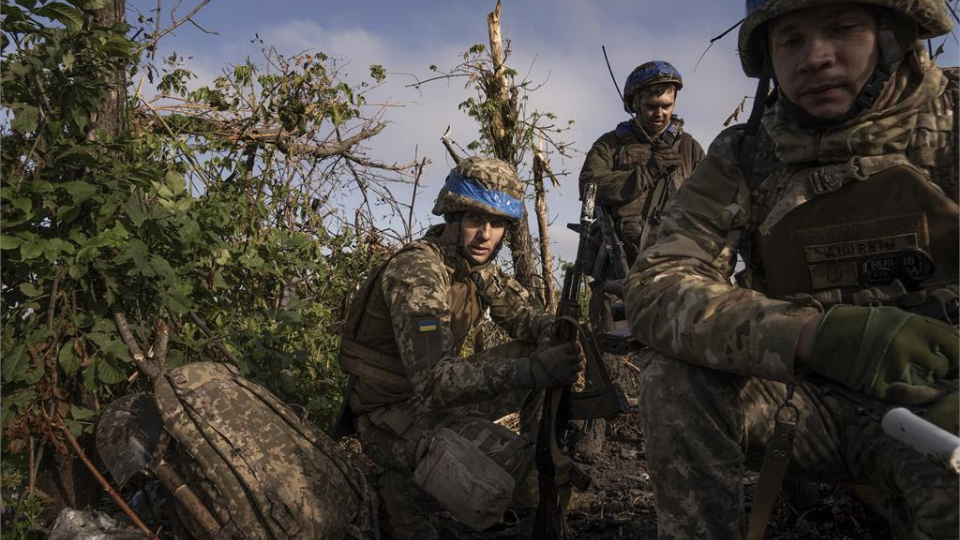
Now the intrepid Kharkiv-born, 40-year-old Chernov is back with another documentary about the war still devastating his Native land. 2000 Meters to Andriivka, which scored a Sundance Film Festival documentary award, is a sort of follow-up to 20 Days in Mariupol. It tells the story of a Ukrainian platoon which, over a period of months in 2023, made its way through a narrow swathe of forest—“no wider than this theater,” Chernov said at a Santa Monica screening, but a bit longer than a mile long—that is flanked on both sides by minefields. At the apex of the woods is the eponymous village of Andriivka, which is occupied by the Russian military, carrying out what Pres. Vladimir Putin calls with Orwellian linguistic sleight of hand a “special military operation,” which most of the world knows as the Russian invasion of Ukraine.
2000 Meters to Andriivka provides a platoon’s eye-view of the campaign to liberate the Ukrainian hamlet. To do so, GoPro cameras were mounted on the infantrymen’s helmets, and about half of the documentary’s footage is composed of this bodycam video. While it’s true that this technique bestows a “you-are-there” sensibility upon the material, much of what was culled from 100 hours of shooting by California-born editor Michelle Mizner (who also cut 20 Days in Mariupol) for the 107-minute 2000 Meters is in the form of close-ups and extreme close-ups. The effect is meant to render fly-on-the-wall verisimilitude coverage of combat, shot by those who actually fought (and in some cases, died).
But unfortunately, in reality, 2000 Meters to Andriivka frequently struck me as disjointed. Shots were strung together supposedly in chronological order, but we just have to take their word for it that they are not playing fast and loose in the editing process. I actually don’t think that’s the case, but recently there has been much hullabaloo about CBS’s editing of a Kamala Harris interview for 60 Minutes, as well as of a Q&A for Fox News about the Jeffrey Epstein files with Trump (who, BTW, true to cowardly form, had declined to be interviewed by 60 Minutes— which didn’t stop him from suing them for millions).
As stated, I haven’t covered combat, and much of my perceptions of the war experience have been shaped by movies, documentaries, and news reportage of armed conflict. I didn’t have a sense that the soldiers in 2000 Meters to Andriivka came across clearly, as they do in conventional Hollywood war movies like, say, Allan Dwan’s 1949 The Sands of Iwo Jima or Oliver Stone’s 1986 Platoon. The constant close-ups were disorienting, and there were some extreme close-ups that I simply couldn’t make heads or tails of, even though they were held onscreen for seconds. I had no idea what I was watching or why this image was onscreen. There’s a lot to be said for trained, skilled cinematographers who can frame a shot properly, as well as for screenwriters who can coherently, passionately tell a story. Sam Slater’s original ominous soundtrack, however, is on point.
Chernov was embedded with the Ukrainian warriors for at least part of the period covered. To be fair, in addition to the bodycam video shot by the soldiers, there is also drone footage (about 50 hours-worth was shot for this film, which the director said had a $400,000 budget), which provides an aerial, spatial perspective upon the onscreen action. Nevertheless, if during our Civil War, General William Tecumseh Sherman said “War is hell,” one could say that based upon 2000 Meters’ visual record of battles in Ukraine that “War is dull.” This film periodically has onscreen titles informing viewers how many meters the Ukrainian fighters are from Andriivka, and the impression I had was that this painstakingly fought military campaign was “the big slog.” It looked similar to the trench warfare from World War I, which D.W. Griffith risked his neck to shoot at the frontlines in his 1918 Hearts of the World propaganda picture starring Lillian and Dorothy Gish.
Some viewers might feel that the documentary imparts a strong sense of the futility of war. But is fighting back against an army invading one’s country “futile”? Or is it heroic? Having said that, Chernov’s film is completely one-sided, the Russians are rarely seen, and their point of view is never presented. Was the U.S. lying to President Mikhail Gorbachev in the last days of the Soviet Union about NATO expansion to the east, to the point where the military alliance created to contain and thwart the USSR is now right at the doorstep of Russia, justified? Not that this, in turn, justifies Putin’s homicidal overreaction, but it does help to explain it. However, you’d never know it from watching this flag-waving (literally) unabashedly pro-Ukraine film.
As this horrific invasion grinds on and as someone descended from Ukrainians from Kiev and Odessa, I wish that I could be more enthusiastic about the second documentary by Chenov, who was interviewed at the screening I attended by Oscar-nominated Michael Clayton screenwriter/ director Tony Gilroy. Alas, to be honest, Chernov’s film was pretty boring, repetitive, and at times hard to decipher. But it did succeed in impressing upon me once again the horrors of war and the hope that Putin’s punishing blitz will come to a halt ASAP.
2000 Meters to Andriivka is in limited theatrical release, from Manhattan’s Film Forum to Laemmle Monica Film Center. The documentary is in English and Ukrainian (with lots of obscenities) with English subtitles.
FUN FACT: The greatest military movie ever made on location in Ukraine was Sergei Eisenstein’s 1925 immortal classic Battleship Potemkin, which turns 100 years old this Dec. 21, 2025. Potemkin’s world premiere was Dec. 21, 1925, at Moscow’s Bolshoi Theater.
We hope you appreciated this article. At People’s World, we believe news and information should be free and accessible to all, but we need your help. Our journalism is free of corporate influence and paywalls because we are totally reader-supported. Only you, our readers and supporters, make this possible. If you enjoy reading People’s World and the stories we bring you, please support our work by donating or becoming a monthly sustainer today. Thank you!
CONTRIBUTOR