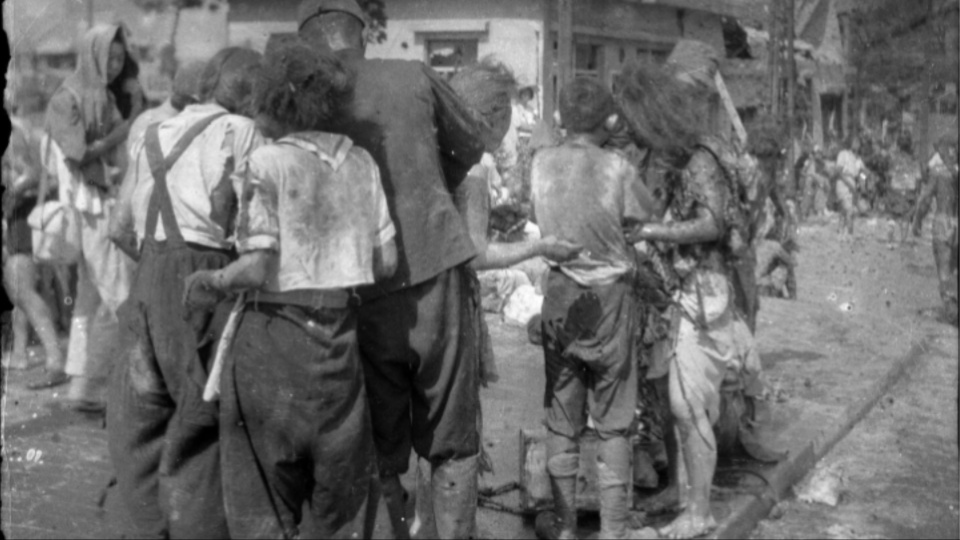
WASHINGTON—On the 80th anniversary of the opening of the Atomic Age, with the dropping of the first atomic bomb on Hiroshima, Japan, on Aug. 6, 1945, new questions are arising about the U.S. government’s decision to initiate that fatal blast and the following one, three days later, over Nagasaki.
Both a scientist writing in the Bulletin of the Atomic Scientists and now-declassified Manhattan Project documents posted by the National Security Archive at George Washington University cite new data both behind the decision to drop the bomb and the health impact of the fallout it produced.
Further doubts occur as anti-nuclear groups plan observances and candlelight vigils on Aug. 6. Back From the Brink will host a vigil in D.C., at the United Methodist Building on Capitol Hill, from 6 pm-7:30 pm.
Other events have been posted so far for East Hampton, Mass., Portland, Ore., and, of course, in Hiroshima, at the Peace Memorial—the bombed-out remnant dome of the city’s industrial arts center.
A Hiroshima-Nagasaki Day vigil and protest will be held at the Manhattan Project National Historic Park in Los Alamos, N.M., on Saturday, Aug. 9, 2025, at 10 a.m. to commemorate the 80th anniversary of the bombing of Nagasaki. That event is organized by N.M. PeaceFest, Veterans for Peace, NukeWatch N.M., Concerned Citizens for Nuclear Safety, and Taos Environmental Film Festival.
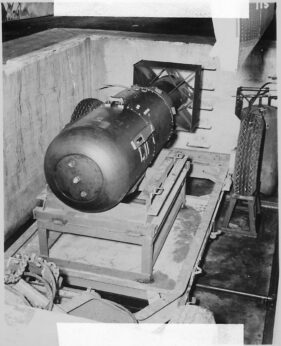
Early August 1945. | U.S. National Archives
There have long been doubts—and they’re disclosed in the documents—about the motives of the U.S. in dropping the bomb. Even one of the top people around FDR involved in the project frankly admits that, with the Nazis practically defeated, the real reason was to emphasize U.S. hegemony in the post-war world—and to send that message to the USSR.
Doubters now number almost a third of the U.S. public, too, down from 85% in favor of dropping the bomb immediately after the blasts over the two Japanese cities occurred, according to a survey published July 28 by the Pew Research Center.
Pew reported 31% of U.S. adults now doubt the need for dropping the bombs, 35% still favor it, and the rest were undecided. The chasm between men and women on the issue makes the gender gap in U.S. elections look small. Men still favor dropping the bombs 51%-25%, as do Republicans by the same ratio. Women oppose the bomb’s use 35%-20% with 43% unsure. Democrats oppose the bomb 42%-23%, with the rest undecided.
Writing in the Bulletin of the Atomic Scientists—the keepers of the Atomic Clock, which is now closer to the midnight mark of earthly annihilation than ever before—Arjun Makhijani, president of the Institute for Energy and Environmental Research, wrote that as early as mid-1943, the original reason for the secret multibillion-dollar Manhattan Project, to win the atomic bomb race against Nazi Germany, was gone.
Allied bombing had destroyed so much of German industrial might that its re-creation would take years, the director of the Manhattan Project, Gen. Leslie Groves, reported. The one fear was that if the bomb was dropped on Germany and didn’t explode, the Nazis still had enough scientific knowhow to leapfrog intermediate steps, such as the nuclear reactor in Chicago and the planned testing in Los Alamos, N.M., to quickly manufacture a bomb.
So, the focus shifted to Japan.
Related stories:
> Daily Worker 1945: Atomic terror unleashed on Hiroshima
> Hiroshima survivor: “We had no idea what happened” when the bomb dropped
“Germany had been de-targeted long before—on May 5, 1943—when the Military Policy Committee, headed by Vannevar Bush, first considered bomb targeting options,” Makhijani elaborated. “The committee decided that it was too risky to target Germany. German scientists might be able to reverse-engineer their own nuclear bomb if the Allied bomb turned out to be a dud.
“Targeting would be in the Pacific region, and it would be kept secret. The target proposed that day was the Japanese fleet at the Truk Lagoon in Micronesia. If the bomb was a dud, it would sink. Preparations for bombing Japan proper were made in 1944.”
Ironically, the U.S. Navy bombed Truk Lagoon and the Japanese fleet there in “Operation Hailstone,” a massive attack with conventional bombs, on Feb. 17-18, 1944. The Truk bombing was part of the Allies’ long drive towards the Japanese home islands.
“Manhattan Project scientists, however, continued to believe their efforts were all about racing against Germany. Bush decided to keep them in the dark about policy. There is no evidence Germany was even considered as a target after May 1943,” Makhijani wrote.
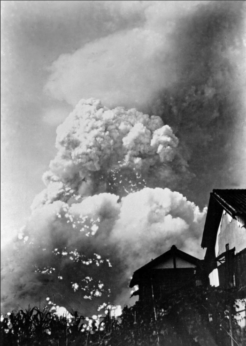
Groves wrote in April 1945, “The target is and was always expected to be Japan.”
“Eighty years later, this important historical fact is little known,” Makhijani reports.
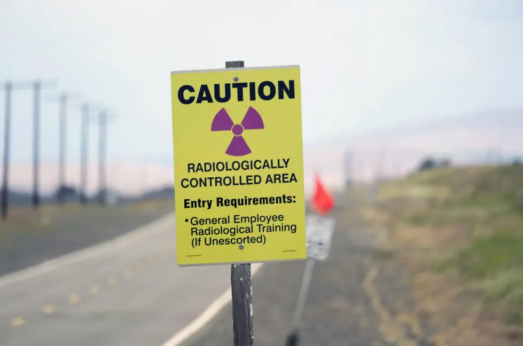
There’s another risk, too, from bomb-making: Extensive groundwater radiation pollution. Makhijani notes the plutonium production plant was nearing completion in Hanford, Wash., in late 1944, and it stored uranium from the reactors, too.
“The process also created vast quantities of highly radioactive liquid waste—far more radioactive even than plutonium itself. Chemical separation started the day after Christmas, and the first plutonium from Hanford was not delivered to J. Robert Oppenheimer and his team at Los Alamos until February 1945. The radioactive mess made at Hanford still sits on a mesa 10 miles from the Columbia River, whose waters are the lifeblood of the Pacific Northwest.”
World-renowned physicist Albert Einstein, a Nazi refugee then at Princeton’s Institute for Advanced Studies, had triggered the Manhattan Project with a 1939 letter to FDR with the Nazi menace and capability in mind. But only the Nazis, he specified.
“Per Einstein’s wisdom, the Manhattan Project should have been stopped in December 1944: The Nazis did not have the bomb. The war was ending. Soviet, American, and British allies were moving fast, through intense battles, to occupy all of Germany. Had the project been stopped, there may have been room for a future without nuclear weapons,” Makhijani writes. “Instead, the U.S. government pressed ahead with the bomb project.
“Only one scientist, Joseph Rotblat, quit the Manhattan Project in December 1944, when it became clear that Hitler did not have a viable atomic bomb program,” Makhijani continues. “None quit when Germany was defeated. Looking back at that moment, another Los Alamos scientist, Richard Feynman, said in a 1981 BBC interview that he ‘immorally’ failed to ‘reconsider’ his continued participation after Germany was defeated. ‘I simply didn’t think, okay?’ he declared.
“That the Manhattan Project continued into 1945 is central to the tragedy of the Hiroshima and Nagasaki bombings. But also tragic is the multigenerational harm that nuclear weapons production, testing, and cleanup have inflicted across the world—to this very day.”
The multigenerational harm from the bomb turns out to be wider than expected, according to the studies released by the National Security Archive. Nuclear radiation, the data shows, spread well beyond the immediate vicinity of Los Alamos, site of the first successful A-bomb test several months before the bombings of the Japanese cities.
To be precise, 28 of New Mexico’s 33 counties still, 80 years later, show elevated levels of radiation in their soil. The levels are above those set for compensation in a 1980 law aiding survivors of U.S. atmospheric A-bomb tests in New Mexico and at the Nevada test site. President John F. Kennedy halted those tests in 1962.
And a map in the documents shows that 248 days after the Los Alamos test, which occurred in May 1945, radiation from it had spread in varying levels over the entire continental U.S., except for the Pacific coasts of Oregon and California, down into Mexico—studies didn’t say how far—and up to Lake Campbell in Canada’s Northwest Territories.
The present fights against the Trump administration over federal funding, including the National Park Service, may intrude into the history of the bomb and its development. The National Parks Conservation Association, a private non-profit group, reports thousands of Park Service workers have either been fired or taken buyouts under GOP Trump regime budget slashes. National Park Service funding has been cut by $1 billion.
Also ominous is a Trump order to rewrite U.S. history at Park Service sites. Specific portions of Hanford, Los Alamos, and Oak Ridge, Tenn., are now a three-site national park discussing the birth of the Atomic Age.
The NPCA is sounding the alarm to its members and the wider public about both the budget cut and the Trump regime’s efforts to “whitewash” U.S. history and remove “negative” descriptions about nuclear weapons and the effects their development had at these sites.
“The choice to create and use these weapons became a pivotal event in human history,” blogger Linda Coutant wrote on NPCA’s website. “To help people reflect on its meaning, the Park Service hosts ‘Days of Peace and Remembrance’ across the three sites each August.
“According to the Park Service, the programming ‘acknowledges and interprets the conflicting viewpoints, both historical and modern, that surround the development and use of the world’s first atomic weapons. These events provide an opportunity to reflect on the historical and emotional traumas of the atomic bombings.’”
When Henry Stimson, the U.S. Secretary of War, briefed new President Harry S. Truman on the Manhattan Project and the bomb in April 1945, just after FDR died, Stimson said that properly controlled and kept under a U.S. monopoly, the bomb could “enforce a type of peace” on the world.
“A nuclear-bomb-tipped world peace is an interesting definition of ‘civilization.’ But the idea of U.S. post-war control of the world had emerged years before, at about the same time that Einstein and Szilard sent their letter to Roosevelt,” Makhijani writes.
There was to be no atomic-guaranteed “peace,” of course. The possession of such destructive weapons in the hands of U.S. imperialism simply prompted other countries—particularly the Soviet Union—to develop their own programs. Within four years, the USSR detonated its own atomic bomb. As for the U.S., by that time, Gen. Douglas MacArthur was musing about dropping the bomb again, this time on North Korea. Luckily for the world, the Soviet bomb acted as a deterrent.
According to the Bulletin of the Atomic Scientists, as many as 210,000 people died in Hiroshima and Nagasaki in the initial months after the bombing; 90% of them were civilians. Generations later, the effects of radiation poisoning continue to be felt, and the world is still full of nuclear weapons.
We hope you appreciated this article. At People’s World, we believe news and information should be free and accessible to all, but we need your help. Our journalism is free of corporate influence and paywalls because we are totally reader-supported. Only you, our readers and supporters, make this possible. If you enjoy reading People’s World and the stories we bring you, please support our work by donating or becoming a monthly sustainer today. Thank you!
CONTRIBUTOR