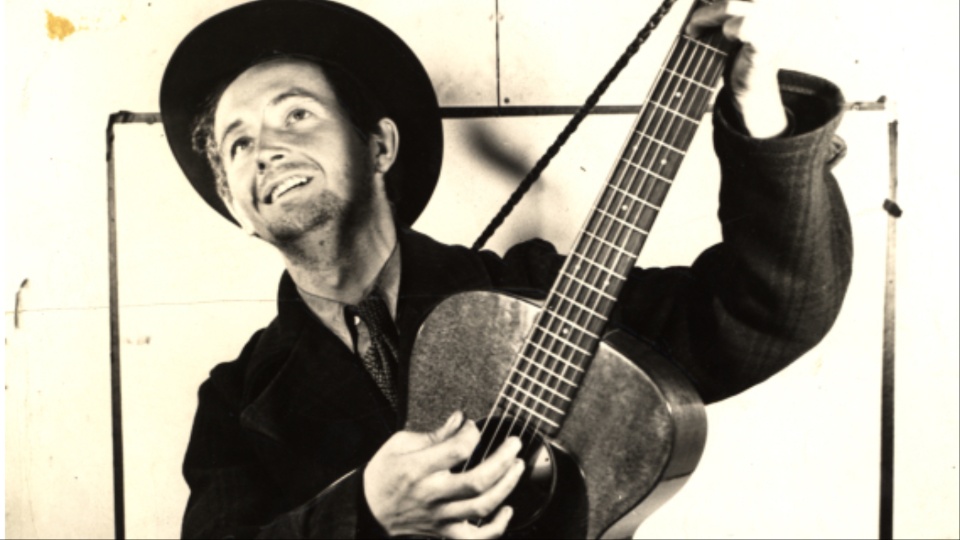
Like a fervid time capsule, this week’s release of Woody Guthrie’s late-in-life home recordings offers a treasure trove of salient songwriting and an intimate portrait of America’s legendary folk troubadour. Recently released by Shamus Records, the two-disc collection Woody at Home features previously unreleased songs and fresh recordings of well-known tracks like “This Land is Your Land.”
Recorded at Guthrie’s family apartment in Beach Haven, Brooklyn, in 1951-1952, the collection shows Guthrie’s unrivaled productivity in full swing shortly before Huntington’s disease left the songwriter without his voice and institutionalized him for his last decade. Guthrie passed away in 1967.
Guthrie, at least, viewed the recordings as definitive. In a spoken commentary (“I Just Want To Tell You Fellers”) accompanying the tapes, he described the recordings as “about the best tape I’ve made so far.” In this message to his publisher, Howie Richmond, Guthrie described the rambunctious recording atmosphere in his apartment, with his “kids all bangin’ themselves together,” as “the place from whence all good folk songs breed and spring.”
These home recordings, captured on an analogue tape recorder given to him by his new producer, show Guthrie in his element: informal, guffawing, and with a moral force that speaks to our own moment of aggravated conflict with race hatred and fascism.
The free-wheeling, humorous, careless side of Guthrie’s persona shines in these recordings, including moments of mid-track laughter, amused at his own lyrics. Background sounds of passing car horns add a sense of the vibrant urban world where the old Okie spent his last years of creative activity, far from the dusty plains and pacific valleys that inspired his earliest albums.
Rather than viewing fascism as dead and gone in the post-war period, tracks like “I’m A Child Ta Fight,” released as a teaser ahead of the full collection, anticipate the challenge of a long-drawn struggle against fascism, sure to be won, even “if it takes a thousand years.” Guthrie, incidentally, picked up on the Trump family’s cruelty well ahead of our time.
The theme of love’s joys and tribulations features in tracks like “Funny Mountain” and “Forsaken Lover.” Guthrie married three times and fathered eight children, including singer-songwriter Arlo Guthrie. Troubled by his ramblings and progressing illness, all of Guthrie’s marriages ended in divorce.
In “My Ego and My Id,” Guthrie toys with Freudian psychological concepts, circulating widely in American society at the time, to animate a charming depiction of passionate love.
Of particular interest to music historians, the posthumous release of the only known recording of “Deportee” gives the set additional weight and salience. Later covered by artists like Odetta, Joan Baez, and Dolly Parton, the solemn ballad roars with indignation against the callous press coverage of the Los Gatos Canyon plane crash in January of 1948, in which dozens of immigrant farm workers on a deportation flight perished in a “great ball of fire,” only to have their names omitted from media reporting.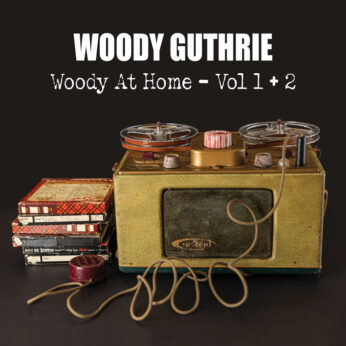
As Stephen Miller and Kristi Noem enforce a policy of mass deportation and indiscriminate ICE terror across the country, the unearthed track helps illustrate our long-running struggle against xenophobia and white chauvinism in the United States.
“Innocent Man” laments a wrongfully convicted soul’s 99-year sentence and chain-gang prison labor at Alcatraz Island, while the “guilty man / got a mansion here in town.” As our contemporary fascists divert billions of dollars from social services to concentration camps like “Alligator Alcatraz,” the ethical clarity of these songs is as topical as ever.
With inexhaustible creativity, Guthrie penned thousands of songs, plus novels, poems, and prose. He also wrote over 170 articles in his column ‘Woody Sez’ for the predecessor of People’s World—the Daily Worker—accompanied by sketches and cartoons.
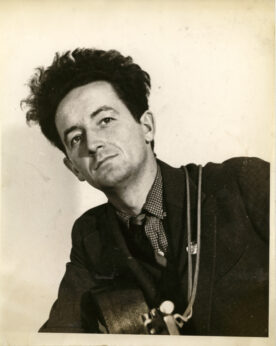
Besides his songwriting, Guthrie fought the anti-fascist war in his own way, serving in the Merchant Marine before being blacklisted by Naval Intelligence for his Communist ties.
Upon viewing the bombed-out ruins of Palmero, Italy, Guthrie was shaken by the devastation: “We did not see… any buildings that had been missed by bombs… Homes gaped open like blasted corpses… a thing of this kind has always been hard for me to describe.”
These harrowing experiences surely inspired tracks like the newly-released “Peace Call,” a spiritual summons and consolation:
“If these war stars fill your heart with a thousand pounds of worry / keep to my road of peace, you’ll never have to fear.”
An imaginary dialogue with Albert Einstein, envisioning the scientist’s new theory that would “do away with race hatin’, and race fightin’s and race bombin’s,” shows the near-utopian, aspirational worldview that motivated Guthrie’s art. Another new track, “One Little Thing An Atom Can’t Do,” speaks to the hopes and anxieties ushered in by the atomic age.
With pungent existential reflection, “Ain’t Afraid to Die” underlines the emotional necessity of collectivity, as Guthrie voices that he isn’t afraid to die, but only “afraid to die by [him]self,” to work by himself, and to dance by himself. Though Huntington’s disease robbed the singer of his voice and mobility, pilgrims to his hospital bedside brought Woody comfort up until the end.
A gem for any folk aficionado, this collection rounds out the comprehensive 1944-1949 Asch Recordings, which compiled the singer’s most well-known tracks in a four-volume anthology. Woody at Home, available for purchase in vinyl and CD, also pairs well with Pastures of Plenty, a collection of Guthrie’s autobiographical sketches, poems, and free verse.
More than 70 years after their recording, these songs and rambling monologues speak to our time in a warm and uncanny manner. Every peace-loving person and folkways friend should add this release to their collection.
Order your copy of Woody At Home
We hope you appreciated this article. At People’s World, we believe news and information should be free and accessible to all, but we need your help. Our journalism is free of corporate influence and paywalls because we are totally reader-supported. Only you, our readers and supporters, make this possible. If you enjoy reading People’s World and the stories we bring you, please support our work by donating or becoming a monthly sustainer today. Thank you!
CONTRIBUTOR