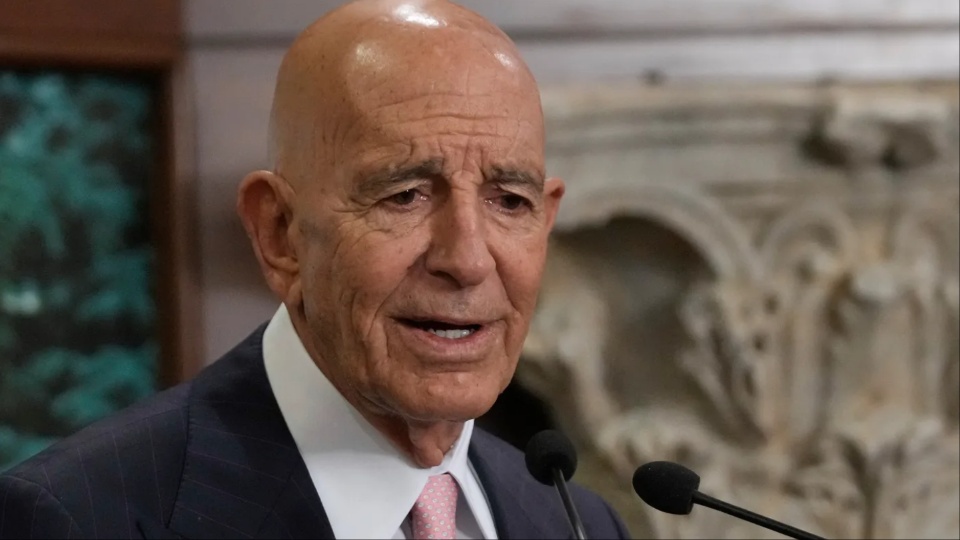
U.S. envoy to Lebanon Tom Barrack sparked outrage across the country this week when he referred to local journalists as “animalistic” and “uncivilized.” The comments came during a press conference at the Presidential Palace, where Lebanese reporters called out their questions in the typical lively fashion of press events.
Barrack’s outburst was not merely undiplomatic, it revealed the colonial arrogance that has long underpinned U.S. policy toward Lebanon.
Calling journalists “animalistic” for doing their job is a stunning act of disrespect anywhere. But when it comes from a representative of a superpower that has spent decades intervening in Lebanon’s politics, supporting invasions, and leveraging economic pain, the insult cuts even deeper.
The U.S. envoy’s remarks were condemned across Lebanon’s fractured political spectrum, uniting voices that seldom stand together. The Lebanese Press Editors Syndicate issued an immediate response, demanding a public apology. They described Barrack’s comments as “completely unacceptable” and “deeply reprehensible,” pointing out the heightened offense of hearing such words from a diplomat of a major world power.
“Failure to issue such a statement could prompt the Lebanese Press Editors Syndicate to call for a boycott of the U.S. envoy’s visits and meetings,” the organization declared. In a country where media outlets are often divided along sectarian lines, the unified response of Lebanese journalists was a powerful signal that an attack on the dignity of the press would not be tolerated.
The Lebanese Communist Party went further in its denunciation. In a statement, the party’s Media Office declared: “What was issued by Barrack cannot be considered a slip or a passing mistake, but rather an explicit expression of an arrogant colonial mindset that has always regarded Lebanon, its people, and its press as tools to be insulted and subordinated to serve American interests.” The statement also called on the Lebanese presidency and government to take immediate steps to defend the dignity of their own journalists from a foreign envoy’s abuse.
The Communist Party’s framing is important because this is not an isolated incident. Barrack’s words fall in line with a long pattern of Washington treating Lebanon not as a sovereign country but as a pawn in its regional chess game.
In 1958, after the rise of a strong pan-Arabist movement inspired by Egyptian leader Gamal Abdel Nasser, President Dwight Eisenhower ordered U.S. Marines into Beirut. The goal was clear: to ensure that Lebanon’s pro-Western president, the right-wing Camille Chamoun, remained in power. That intervention marked the first direct U.S. military incursion into the country, but it was far from being the last.
During the Lebanese Civil War, which broke out in 1975, Washington’s policies again tilted heavily toward pro-Western factions. U.S. support flowed to Christian militias, while Palestinian and leftist forces were targeted as enemies. The war devastated Lebanon, and foreign intervention only deepened the chaos.
Invaded with U.S. backing
Then came 1982. Israel invaded Lebanon with full U.S. backing, unleashing destruction on Beirut and beyond. U.S. weapons, U.S. diplomacy, and U.S. political cover made that invasion possible.
When U.S. Marines later returned as part of a so-called “peacekeeping force,” they were anything but neutral. Their presence aligned with Israel’s occupation and Lebanon’s fragile pro-Western government, turning them into targets. The suicide bombings of the U.S. Embassy and Marine barracks in Beirut in 1983, which killed hundreds, were direct blowback from that interventionist policy. By 1984, U.S. troops were forced to withdraw.
The pattern repeated itself decades later. In 2006, Israel once again launched a devastating war on Lebanon. And once again, Washington offered Israel unconditional financial, diplomatic, and material support. The U.S. blocked international ceasefire calls, allowing the destruction to continue for weeks, while Lebanese civilians bore the brunt of the assault.
More recently, U.S. policy has shifted from military intervention to economic strangulation. Since Lebanon’s financial collapse in 2019, Washington has exploited the crisis to push for harsh austerity measures. These neoliberal “reforms,” often tied to International Monetary Fund (IMF) demands, have slashed subsidies and gutted public services, deepening poverty for ordinary Lebanese families while leaving corrupt elites untouched.
At the same time, U.S. sanctions targeting Hezbollah and its affiliates have had a far wider impact, choking off entire sectors of Lebanon’s banking and trade systems. The stated goal is to weaken Hezbollah, but the actual effect has been to squeeze the entire population, making daily survival more difficult.
The United States has also pressured Lebanese governments to disarm resistance movements, particularly Hezbollah. But for many Lebanese, Hezbollah is not merely a political faction; in their view, it is a force that resisted Israel’s occupations and remains a bulwark against Israeli aggression. For Washington to demand its disarmament is seen by many as an affront to national sovereignty.
Against this backdrop, Barrack’s insult to Lebanese journalists cannot be brushed off as a slip of the tongue. It reflects the deeper reality of how Washington views Lebanon: not as a nation of proud, resilient people, but as a small state to be managed and disciplined.
Lebanese journalists, far from being “uncivilized,” have a long and proud tradition of vibrant, critical reporting. The country’s press is among the most courageous in the Arab world, often exposing corruption, challenging leaders, and giving voice to the public’s frustrations. That a U.S. envoy would attempt to belittle this profession speaks volumes about Washington’s disregard for Lebanon’s democratic life and for journalists everywhere.
The outrage sparked by Barrack’s words has already united diverse Lebanese voices. Press organizations, political parties, and civil society groups are demanding accountability. Calls for boycotts of Barrack’s meetings are growing louder. What is at stake is not only the dignity of journalists, but the principle of sovereignty itself.
The United States has a long history of trampling on that sovereignty, from the Marine landings of 1958 to the IMF dictates of today. Barrack’s insult is simply the latest reminder that U.S. officials still see Lebanon as a country to be pushed around.
We hope you appreciated this article. At People’s World, we believe news and information should be free and accessible to all, but we need your help. Our journalism is free of corporate influence and paywalls because we are totally reader-supported. Only you, our readers and supporters, make this possible. If you enjoy reading People’s World and the stories we bring you, please support our work by donating or becoming a monthly sustainer today. Thank you!
CONTRIBUTOR