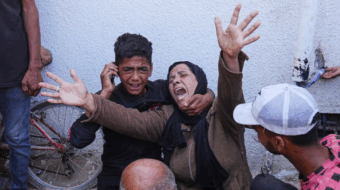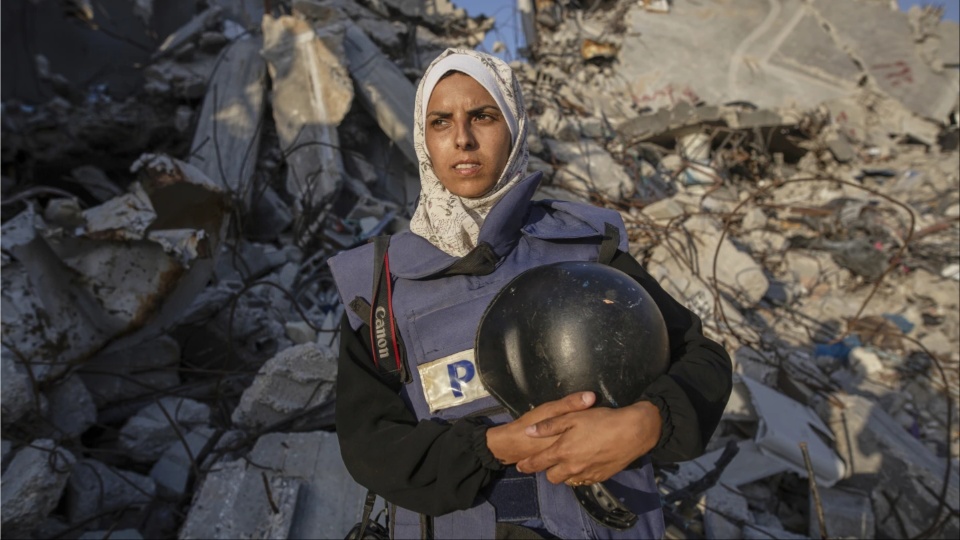
The killing of seven Palestinian journalists and media workers in a single strike in Gaza on Aug. 10 prompted verbal condemnations, yet inspired little to no substantive action. Even more journalists have been killed in the two weeks since. This has become the predictable and horrifying trajectory of the international community’s response to the ongoing Israeli genocide.
By eliminating Palestinian journalists like Anas al-Sharif and Mohammed Qraiqeh, Israel has made a sinister statement that the genocide will spare no one. According to the monitoring website Shireen.ps, Israel has killed nearly 270 journalists since October 2023.
More journalists are likely to die covering the genocide of their own people in Gaza, especially since Israel has manufactured a convenient and easily deployed narrative that every Gazan journalist is simply a “terrorist.” This is the same cruel logic offered by numerous Israeli officials in the past, including Israeli President Isaac Herzog, who declared that “an entire nation” in Gaza “is responsible” for not having rebelled against Hamas, effectively stating that there are no innocent people in Gaza.
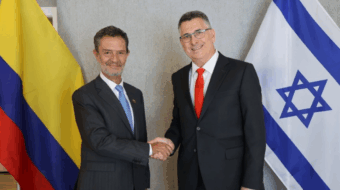
This Israeli discourse, which dehumanizes entire populations based on a vicious logic, is frequently repeated by officials who fear no accountability. Even Israeli diplomats, whose job, in theory, is to improve their country’s image internationally, frequently engage in this brutal ritual.
In comments made in January 2024, Israeli ambassador to the UK Tzipi Hotovely callously argued that “every school, every mosque, every second house has access to tunnels,” implying that all of Gaza is a valid military target.
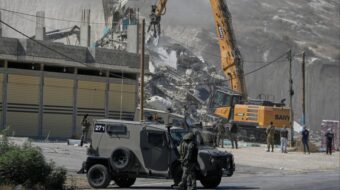
This cruel language would be easily dismissed as mere rhetoric, except that Israel has, in fact, according to Euro-Med Human Rights Monitor reports, destroyed over 70% of Gaza’s infrastructure.
While extremist language is often used by politicians around the world, it is rare for the extremism of the language to so precisely mirror the extremism of the action itself. This makes Israeli political discourse a uniquely dangerous phenomenon.
There can be no military justification for the wholesale annihilation of an entire region. Yet again, the Israelis are not shying away from providing the political discourse that explains this unprecedented destruction. Former Knesset member Moshe Feiglin chillingly said, last May, that “Every child, every baby in Gaza is an enemy… not a single Gazan child will be left there.”
Includes deliberate targeting
But for the systematic destruction of a whole nation to succeed, it must include the deliberate targeting of its scientists, doctors, intellectuals, journalists, artists, and poets. While children and women remain the largest categories of victims, many of those killed in deliberate assassinations appear to be targeted specifically to disorient Palestinian society, deprive it of societal leadership, and render the process of rebuilding Gaza impossible.
These figures powerfully illustrate this point: according to a report released by the United Nations Office for the Coordination of Humanitarian Affairs. Based on the latest satellite damage assessment conducted in July, 97% of Gaza’s educational facilities have been affected, with 91% in need of major repairs or full reconstruction. Additionally, hundreds of teachers and thousands of students have been killed.
But why is Israel so intent on killing those responsible for intellectual production? The answer is twofold: one unique to Gaza, and the other unique to the nature of Israel’s founding ideology, Zionism.
First, regarding Gaza: Since the Nakba in 1948, Palestinian society in Gaza has invested heavily in education, seeing it as a crucial tool for liberation and self-determination. Early footage shows classrooms being held in tents and open spaces, a testament to this community’s tenacious pursuit of knowledge.
This focus on education transformed Gaza into a regional hub for intellectual and cultural production, despite poorly funded UNRWA schools. Israel’s campaign of destruction is a deliberate attempt to erase this generational achievement, a practice known as scholasticide, and Gaza is the most deliberate example of this horrific act.
Second, regarding Zionism: For many years, we were led to believe that Zionism was winning the intellectual war due to the cleverness and refinement of Israeli propaganda, or hasbara. The prevailing narrative, particularly in the Arab world, was that Palestinians and Arabs were simply no match for the savvy Israeli and pro-Israeli public relations machine in Western media. This created a sense of intellectual inferiority, masking the true reason for the imbalance.
Israel was able to “win” in mainstream media discourse due to the intentional marginalization and demonization of Palestinian and pro-Palestinian voices. The latter had no chance of fighting back simply because they were not allowed to and were instead labeled as “terrorist sympathizers” and the like.
Even the late, world-renowned Palestinian scholar Edward Said was called a “Nazi” by the extremist, now-banned Jewish Defense League, who went so far as to set the beloved professor’s university office on fire.
Gaza, however, represented a major problem. With foreign media forbidden by Israel from operating there, the Gazan intellectual rose to the occasion and, in the course of two years, managed to reverse most of Zionism’s gains over the past century.
This forced Israel into a desperate race against time to remove as many Palestinian journalists, intellectuals, academics, and even social media influencers from the scene as quickly as possible—thus, the war on the Palestinian thinker.The Israeli logic, however, is destined to fail, as ideas are not tied to specific individuals, and resilience and resistance are a culture, not a job title.
Gaza shall once more emerge, not only as the culturally thriving place it has always been, but as the cornerstone of a new liberation discourse that is set to inspire the globe regarding the power of intellect to stand firm, to fight for what is right, and to live with purpose for a higher cause.
We hope you appreciated this article. At People’s World, we believe news and information should be free and accessible to all, but we need your help. Our journalism is free of corporate influence and paywalls because we are totally reader-supported. Only you, our readers and supporters, make this possible. If you enjoy reading People’s World and the stories we bring you, please support our work by donating or becoming a monthly sustainer today. Thank you!
CONTRIBUTOR