SEQUIM, Wash.—Dressed in jet-black uniforms, wearing black masks and dark glasses to hide their faces, a team of men and women marched through the Labor Day vigil here in Sequim, Washington, Monday. The woman leading this procession held a placard, “Signs of Fascism,” and those who followed her, looking like ICE goons, carried signs that proclaimed: “Oppression of LGBTQ+ People,” and “Erasing and Faking Government Data,” and “Intertwining Religion & Government,” and “Replacing Science with Ideology.”
It was so effective that many of the nearly 1,000 protesters took photos and videos with their cell phones of this ICE look-a-like goon squad. The warning on those signs is confirmed every day by the bully tactics of would-be fascist dictator Donald Trump.
Yet I would add another to the signs they carried: “Insatiable Greed.”
In fact, I would make this count number one in the criminal indictment of Trump and his MAGA cronies. They just rammed through Trump’s so-called “Big Beautiful” bill containing one trillion dollars in cuts for Medicaid and SNAP food benefits. They inflicted these cuts on poor and hungry children, homeless people, veterans, and senior citizens. They then slashed taxes on the millionaires and billionaires by well over a trillion dollars.
This is Robin Hood-in-reverse, stealing from the poor, giving to the rich.
I learned much of what I know about fascism from reading books by the great Bulgarian anti-fascist, Georgi Dimitrov, and the equally great Italian anti-fascist, Palmiro Togliatti. In his famous report “Against Fascism and War” to the 7th World Congress of the Communist International in Moscow, Aug. 2, 1935, Dimitrov defined fascism as the “Open terrorist dictatorship of the most reactionary, most chauvinist, and most imperialist elements of finance capital.”
Dimitrov warned against the oversimplification of fascism. Fascism emerges from a power struggle between competing factions of the capitalist class. Fascism comes step-by-step, incrementally. I have committed to memory one of Dimitrov’s points: “Whoever does not fight the reactionary measures of the bourgeoisie and the growth of fascism at these preparatory stages is not in a position to prevent the victory of fascism, but on the contrary, facilitates that victory.”
Both Togliatti and Dimitrov are clear that the main target of the fascists is the working class, especially its organized sector, the labor movement. Especially the fascists take aim at the class-conscious forces in the working class, communists, and allied socialists.
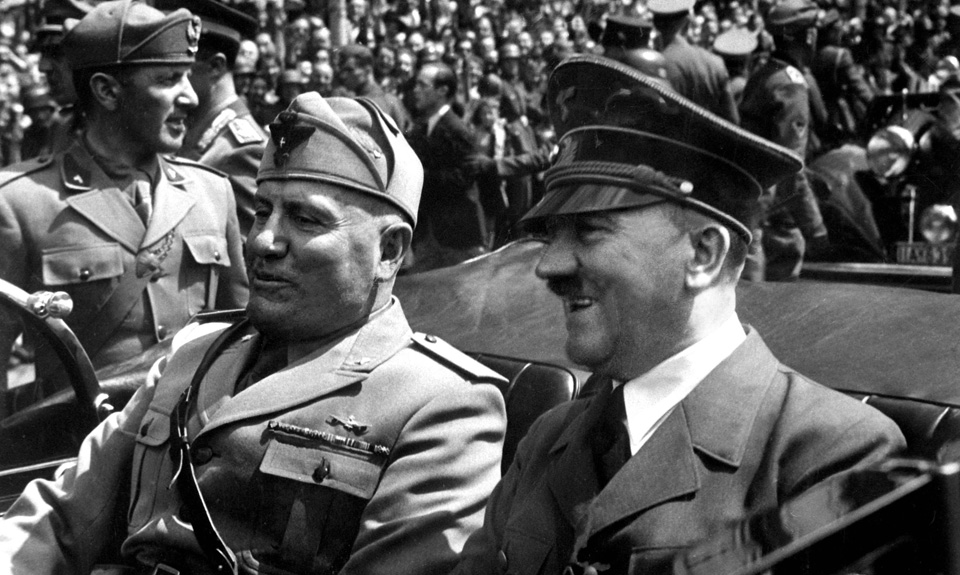
Read Dimitrov’s blast at the torrent of demagogic lies Adolph Hitler, Josef Goebbels, Heinrich Himmler, and other Nazis poured out to hoodwink German workers, even using the term “National Socialist” when fascism is the direct opposite of socialism: “Fascism promised the workers “a fair wage” but actually it has brought them an even lower, a pauper standard of living. It promised work for the unemployed, but it has brought them even more painful torments of starvation and forced servile labor. In practice, it converts the workers and unemployed into pariahs of capitalist society, stripped of rights; destroys their trade unions; deprives them of the right to strike and to have their working class press, forces them into fascist organizations, plunders their social insurance funds, and transforms the mills and factories into barracks where the unbridled arbitrary rule of the capitalists reigns.”
Isn’t this a vivid description of what Trump is imposing every day? Yes, “step-by-step” but also with lightning speed.
Yet, both Dimitrov and Togliatti were writing about fascism in 1935, years before Hitler and the Nazi Third Reich instigated World War II, a scheme to destroy socialism and conquer the world. It was finance capitalism gone berserk, squeezing maximum profits from the labor of unpaid workers—slaves—who were starved and then exterminated in gas chambers.
Construction of the infamous Auschwitz death camp was financed by Deutsche Bank, still one of the biggest and wealthiest banks in the world. The German chemical trust, I.G. Farben, built an enormous plant right adjacent to Auschwitz to produce synthetic rubber—Buna—during World War II. The German Wehrmacht desperately needed the synthetic rubber for the truck tires needed to press forward with its offensive against the Soviet Union.
Where did I.G. Farben obtain the formula to manufacture Buna? From Rockefeller-owned Standard Oil, a corporation that refused to share this secret with the United States government.
And why did I.G. Farben build its Buna plant right beside Auschwitz? Because most able-bodied men who would have worked in that plant were German soldiers fighting Hitler’s crazed war. Auschwitz supplied I.G. Farben with tens of thousands of enslaved inmates, many of them captured Allied soldiers from the USSR, Poland, and other Slavic nations. The slaves also included Jewish inmates, women, children, and men whose unpaid labor made the German capitalists enormously wealthy. Starved, they were then marched into the Auschwitz gas chambers, poisoned with Zyklon-B, a gas manufactured by I.G. Farben. Their bodies were incinerated in the Auschwitz ovens. This arrangement proved so efficient, so profitable, that the Krupp steel trust also built an enormous factory to manufacture artillery shell casings within a short walk of the Auschwitz barracks.
I wrote an exposé headlined “Blood Money,” published by the People’s Weekly World on April 5, 1997, that reported on the skyrocketing profits raked in by I.G. Farben, Kruppstahl, and other German capitalists during World War II. The German Democratic Republic (GDR) published a Brown Book, which I obtained at the Library of Congress: “Almost 20 million people from almost all countries of Europe were dragged by the fascists into Germany as slave labor,” the Brown Book charges. “Hundreds of thousands of them were tortured, beaten to death, shot, and gassed.”
I.G. Farben reported profits of 32 million Reichsmarks in 1932. But in 1943, its bottom line fattened by the unpaid labor of tens of thousands of slaves, it reported 822 million in Reichsmarks. Its profit margin had multiplied more than twenty-five times!
The Krupp “Family Enterprise” alone exploited 97,952 prisoners of war and concentration camp inmates in their Ruhr steel mills. “Already in the first five years of the fascist rearmament drive, Krupp could book a net profit of 500 million Reichsmark,” the East German exposé charged. “In the fifth year of the war, his war criminal family had an accountable profit of over 110 million Reichsmarks—gathered from the exploitation of 250,000 people….of which tens of thousands perished as prisoners in the trust’s own concentration camps.”
The love affair of the German billionaires for Adolph Hitler dated from the Nov. 6, 1932 elections in which the Nazis suffered a disastrous defeat, losing 22 seats in the Reichstag while the Communists increased their vote by 750,000 and gained 11 more deputies. The German working class, desperate and starving from the Great Depression, was turning toward socialism. The “Ruhr Kings,” Krupp, Thyssen, Porsche, Daimler, and I.G. Farben summoned Hitler for a secret meeting. They promised Hitler they would bankroll his seizure of power if he erased the word “socialism” from his vocabulary and doubled down on smashing German labor unions. Hitler obliged, and German high finance was fully Nazified.
Alfried Krupp was found guilty of war crimes at the Nuremberg trials. His steel empire was confiscated, and he was sentenced to twelve years in prison. Five years later, the U.S. and its NATO allies, deep into Cold War witch-hunting, released Krupp from prison and gave his steel mills back to him.
Look at how profits here in the United States have skyrocketed for the giant banks and corporations in the past half-century. The share of that increased wealth won by workers has shrunk, the wealth of the superrich so huge it has created a new strata of the capitalist class, billionaires.
That brings us back to Donald Trump. My late wife and I were doorbelling for a candidate on the west side of Port Angeles years ago. Somehow, I got into a discussion with a guy about Trump. “My dad is a union plumber in New Jersey,” the young worker told me. “He and the other plumbers were installing expensive bathroom fixtures in Trump’s Taj Mahal casino-hotel in Atlantic City. They put in over ten million dollars worth of gold-plated toilets and sinks. When they finished, Trump wouldn’t pay them. Finally, the Plumbers Union told the Trump boys, ‘Either you pay us or we go in and remove all the fixtures.’ Trump finally caved in and paid. Incidentally, a couple of years later, the Taj Mahal went bankrupt. Trump likes slavery.”
As with all op-eds published by People’s World, the opinions expressed here are those of the author.
We hope you appreciated this article. At People’s World, we believe news and information should be free and accessible to all, but we need your help. Our journalism is free of corporate influence and paywalls because we are totally reader-supported. Only you, our readers and supporters, make this possible. If you enjoy reading People’s World and the stories we bring you, please support our work by donating or becoming a monthly sustainer today. Thank you!
CONTRIBUTOR