TRENTON, N.J. and ST. PAUL, Minn.—Three recent pro-worker wins—two laws enacted in New Jersey and a prior one in Minnesota upheld in a federal appeals court—again re-emphasize the importance of state and local laws and lawmakers for workers.
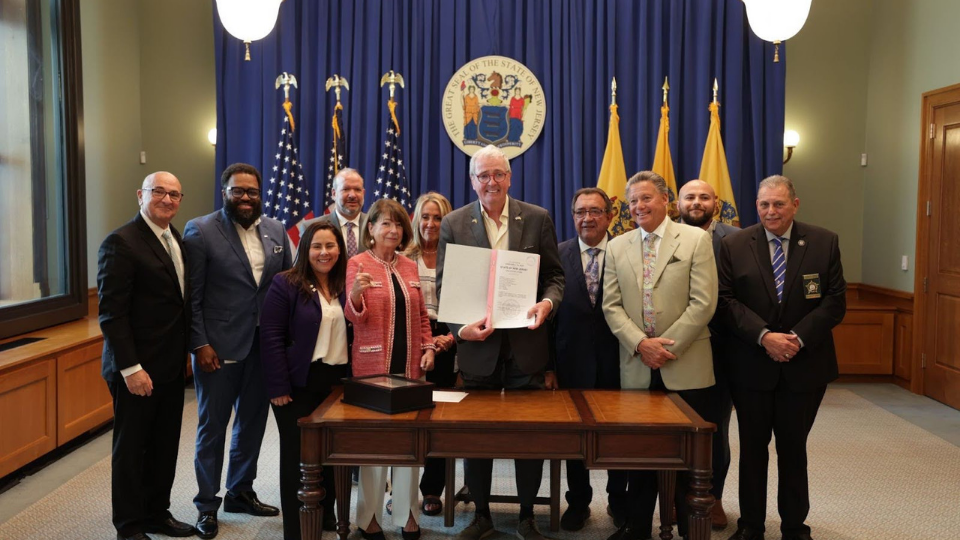
Because it’s safe to say that without Democratic Gov. Phil Murphy and a pro-worker legislature in New Jersey, the law banning firms from forcing workers to attend so-called “captive audience” meetings would never have passed. Murphy signed it on September 4.
In those meetings, bosses and their hired persuaders, aka union-busters, can lie, browbeat, intimidate and threaten workers while campaigning against organizing drives.
Murphy also signed legislation that day mandating social studies courses in grades 6-12 in the Garden State to include “age-appropriate” lessons on labor history. That includes “the history of organized labor, notable strikes throughout history, unionization drives, and the collective bargaining process and existing legal protections in the workplace.”
It’s also safe to say that without Gov. Tim Walz, DFL-Minn., an Education Minnesota teacher/member on leave and without state Attorney General Keith Ellison, DFL-Minn., his strong defense, and a prior narrowly pro-worker state legislative majority, there would be no Minnesota ban on captive audience meetings.
Lawmakers passed it
Instead, lawmakers in St. Paul passed it, Walz signed it, corporate lobbies tried to kill it in the Eighth U.S. Circuit Court of Appeals, Ellison defended it—and workers won.
There, also on September 4, three Republican-named appellate judges in St. Louis voted 2-1 for Minnesota’s law. Anti-worker GOP President Donald Trump named one of the two who voted for it, as well as the dissenter. Ellison and his AG’s office strongly defended the Minnesota law.
“All working people should have the freedom to choose whether to form a union at their workplace without interference or intimidation from their employer,” said Minnesota AFL-CIO President Bernie Burnham in a statement celebrating the circuit court’s decision.
Walz told North America’s Building Trades Unions earlier this year about Minnesota’s captive audience curbs. Like the New Jersey law, the Minnesota law says workers may voluntarily attend captive audience meetings, but can’t be forced to do so or be disciplined if they refuse.
The New Jersey law goes even further. If a boss—and in New Jersey that includes charities, political campaigns, candidates, and non-profit organizations—breaks the law, the boss gets hit with a $1,000 fine plus triple damages for a first offense and a $5,000 fine plus triple damages for following offenses. Plus if New Jersey won’t sue the offender, the worker can, the law says. It’s called “private right of action.”
Walz slightly overstated the Minnesota captive audience ban before the building trades, though. He said, “Those captive, anti-union meetings…You go to jail now if you do that in Minnesota because you can’t intimidate people.” His spokeswoman later explained Walz was just making a point about how strong the law is, but admitted nobody can go to jail for breaking it.
Not all is complete sweetness and light in New Jersey for workers, though. State Senate Majority Leader Vin Gopal, D-Monmouth, reported the state Labor Department’s attempt to curb another corporate dodge, misclassifying workers as “independent contractors,” ran into so much flak from businesses large and small that even he became dubious about the proposed rules. Gopal was the lead sponsor of the two laws Murphy signed.
Businesses use the “independent contractor” dodge to increase profits and exploit workers. Independent contractors, unlike “employees,” cannot unionize, cannot get state-run employer-paid workers’ comp or jobless benefits, and have to pay both the workers’ and employers’ shares of Medicare and Social Security taxes.
“The proposed rule change would limit the availability of independent contractor status. Independent contractors, including freelancers and ride-share drivers, local businesses and business organizations say the rules would take away the flexibility they need to operate,” Gopal explained in a column on his website.
The proposed rule, says “whether a worker is free of their employers’ control, whether the person’s work is performed outside a firm’s regular course or place of business, and whether the worker is engaged in business independent of a given firm,” determines if she’s an independent contractor.
“The DOL says its proposal reflects the department’s ongoing commitment to protecting workers’ rights and ensuring a level playing field for employers across the state,” he said.
But employer groups marshalled a campaign against DOL’s independent contractor rule and “as of last week, approximately 20 state legislators from both parties, including my District 11 partners, Assemblywomen Margie Donlon and Luanne Peterpaul, have come out against the new rule.”
We hope you appreciated this article. At People’s World, we believe news and information should be free and accessible to all, but we need your help. Our journalism is free of corporate influence and paywalls because we are totally reader-supported. Only you, our readers and supporters, make this possible. If you enjoy reading People’s World and the stories we bring you, please support our work by donating or becoming a monthly sustainer today. Thank you!
CONTRIBUTOR