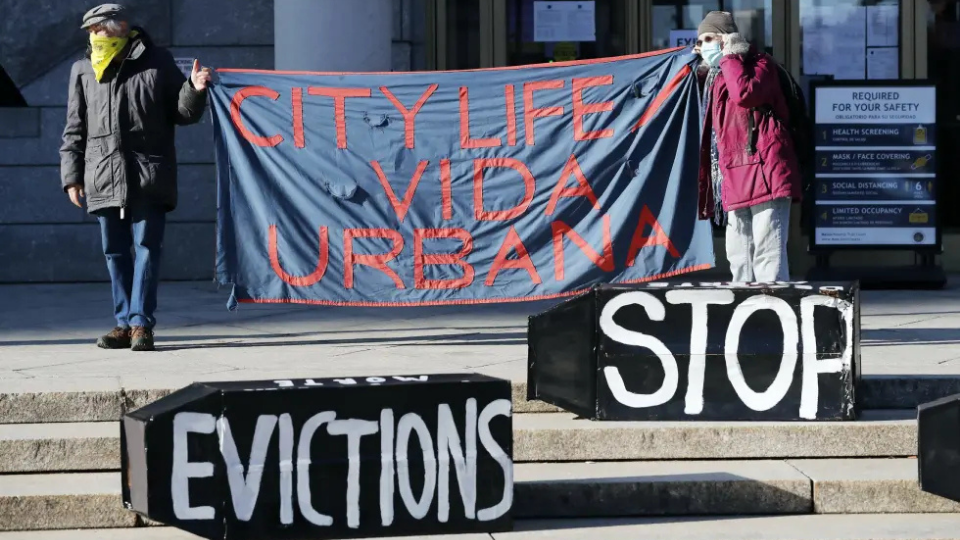
NORTHAMPTON, Mass.—On September 3, Attorney General of Massachusetts, Andrea Campbell, certified the constitutional legality of 44 potential ballot questions for the 2026 election. The ballot initiatives are wide-ranging, from petitions to increase transparency in utility billing to regulating Marijuana consumption, from requiring voter identification to reforming zoning processes.
The most debated ballot measure, however, is “An Initiative Petition to Protect Tenants by Limiting Rent Increases.” If placed on the ballot and passed by Massachusetts voters, the initiative would cap the rental increase of residential dwelling units by 5% or the inflation rate, whichever is lower, per year. Importantly, the measure would exclude dwelling units in owner-occupied buildings with four or fewer units as well as dwelling units that are less than 10 years old.
Homes for All Massachusetts, the organization behind the ballot petition, has argued that passing the rent control measure would be an important step in resolving the housing crisis that the state faces. After all, according to some analysis, Massachusetts has the highest rents in the country ($2,914 per month on average compared to $1,754 national average). And earlier this year, Gov. Maura Healey’s administration released the state’s first comprehensive housing plan to outline the housing challenges in Massachusetts. The plan suggests the construction/restoration of over 220,000 homes across the next 10 years to alleviate the housing crisis.
Some groups, however, have come out against the ballot measure. The Greater Boston Real Estate Board and similar groups have stated that rent control would “be a disaster for Massachusetts.” They argue that such a law was punitive, would push developers out of the market, decrease the number of homes in the state, and ultimately exacerbate the housing crisis. Similarly, the Massachusetts Housing Coalition created a website claiming that rent control would exacerbate gentrification, disproportionally benefit the wealthy, and make housing quality worse.
But, in order to discuss how rent control would impact the state, it is necessary to first understand how rent control has been used in the past, both in Massachusetts and across the country.
How did we get here?
Rent control proposals were first enshrined in law in Massachusetts and New York in the 1920s. With a housing shortage caused by World War I, rising rental costs forced the Massachusetts legislature to put a cap on year-over-year rent increases to 25%. Landlords were able to skirt around the law, and three years later, it was repealed. A similar law was passed during World War II, and likewise lasted only a few years.
During the 1970s, downturns in the rental market, coupled with high inflation, compelled another attempt at rent control. While New York introduced new legislation each decade to increase or decrease rent control, California cities began implementing their own forms of rent control. Los Angeles issued a temporary rent freeze in 1978, while San Francisco passed a rent control ordinance.
In Massachusetts, the state legislature passed the Enabling Act of 1970, which allowed large cities to limit rent increases. Initially, the cities of Cambridge, Boston, Brookline, Somerville, and Lynn passed rent control measures. However, over the next two decades, four of the cities passed legislation repealing or phasing out rent control, with only Cambridge continuing to have a strong rent control ordinance.
In 1994, a statewide ballot initiative saw the repeal and ban of rent control across the state. The ballot passed 51% to 49%. Nearly 60% of residents in Cambridge voted to maintain rent control. Since then, Massachusetts has not had any form of rent control.
Just because rent control was repealed in Massachusetts did not mean that the idea was forgotten. Over the coming years, rent control initiatives continued to spring up with varying levels of success. In 2022, Boston Mayor Michelle Wu introduced an optional program that would allow landlords to follow rent control guidelines in exchange for tax breaks. This year has also seen the proposal of the state legislature repealing the 1994 ban and allowing cities to enact rent control as they see fit.
The proposal at the state legislature is similar but importantly distinct from the ballot initiative. Although both proposals would tie rent increase caps to 5% or the rate of inflation (whichever is lower), the state legislature would require cities to voluntarily opt-in to rent control. Meanwhile, the ballot initiative, if it passes, would impose rent control on all towns and cities across Massachusetts.
The landscape of rent control has likewise shifted across the country. Four states allow for cities to determine their own rent control ordinance: New York, New Jersey, Maryland in 2023, and Minnesota in 2021. Three states have state-wide rent control: California in 2019 (5% + inflation, or 10%, whichever is lower), Oregon in 2019 (7% + inflation), and Washington in 2025 (7% + inflation, or 10%, whichever is lower). Washington D.C. has also had rent control since 1975. 36 states have laws preventing any form of rent control, with the remaining 7 states allowing for rent control but having no local ordinance or statewide law in place.
The debate around rent control
Many opponents to the Massachusetts ballot petition cite the failures of the 1970-1994 rent control as evidence of the future failure of the ballot measure. However, these opponents fail to make a crucial distinction: the 1970-94 rent control allowed for individual cities to enact rent control as they see fit, while the 2025 ballot initiative would mandate all cities have the same rent control. Once this fact is taken into account, the arguments against rent control fall flat.
For example, some opponents argued that the 20th-century rent control favored the wealthy at the expense of marginalized communities. 20% of renters in rent-controlled units were “rich” (although it is unclear if college students should have been counted amongst the “rich”), they state. This argument vanishes when looking at the 2025 ballot initiative; when everything is rent-controlled, everyone benefits.
Another objection commonly raised around rent control is that rent controls in one community would ultimately be paid for by another community. The argument goes as follows: rent control lowers property values, which lowers the tax base that cities can levy. With lower taxes, cities with rent control would require a larger portion of state aid to fund services. And this state aid would ultimately come from the taxes of other communities. While this argument might hold true for 20th-century rent control, it does not hold for the 21st-century version. If rent control is applied uniformly state-wide, again the argument evaporates.
Detractors of state-wide rent control still have other arguments to make. Rent control leads to gentrification, they argue. As evidence, they point to San Francisco. To skirt around rent control laws, landlords opted to convert their apartments into condominiums, which were not rent-controlled. This attracted wealthier households that moved into previously lower-income neighborhoods.
Likewise, opponents of rent control also state that rent control makes housing quality worse. With lessened income for landlords due to rent control, they will be unable to complete routine maintenance or major renovations. This would lead to urban blight and dilapidated buildings. Evidence for all this is seen in the repeal of rent control in Massachusetts. It is estimated that the value of Cambridge residential housing stock increased by $1.8 billion across the next 10 years due to the repeal of rent control.
It may seem strange that rent control may both increase gentrification while simultaneously decreasing housing quality. And we should therefore be careful about using examples from different contexts to argue a point. For in fact, the repeal of rent control, not rent control itself, led to gentrification in Cambridge. The same academic paper that explained the $1.8 billion increase stated in its conclusion, “Under any reasonable set of assumptions, increases in residential investment stimulated by rent decontrol can explain only a small fraction of these spillover effects. Thus, we conclude that decontrol led to changes in the attributes of Cambridge residents and the production of other localized amenities that made Cambridge a more desirable place to live.” In other words, the repeal of rent control and the subsequent rent hikes changed the makeup of local households as higher-income households moved in. And it was due to the presence of high-income households that neighborhood amenities sprang up and thereby added value to the neighborhood.
The paper concludes by stating, “A key issue in the evaluation of price controls is the tradeoff between the surplus transferred from landlords to renters and the deadweight loss from quality or quantity undersupply. Viewed in this light, a significant portion of the price gains we measure at decontrolled properties are transfers from renters back to landlords.” This analysis gets right to the heart of the matter: in the renter-landlord relationship, who should be the one accumulating wealth? Should the landlord make uninhibited profits from renters, or should renters hold on to more of the money they earn? Rent control favors renters, and no rent control favors landlords.
Where to go from here
One last argument in the toolbelt of the anti-rent-control crowd is that rent control does nothing to address the foundation of the housing crisis: the lack of affordable housing. Yes, this is true. If one is already struggling to pay for rent, rent control will not help make the rent more affordable. Limited housing supply likewise increases rents in the neighborhood.
But these are not arguments against rent control; they are arguments to do more than just rent control. Rent control is a tool to be used to slow the increase in rent—that is, to decrease the amount of people at risk of being cost-burdened by rent from actually becoming cost-burdened by rent. As history has shown us, rent control can be used as a tool to counter cost increases from rising inflation and limited housing supply.
What is important is that, along with rent control, legislation must be passed to increase housing development. The Massachusetts ballot initiative exempts newly constructed units from rent control for 10 years. Yet there needs to be further incentives to increase housing production beyond this.
The rent control ballot initiative is still an uphill battle; 70,000 registered voter signatures must be gathered before the Dec. 3rd deadline. And if the signatures are gathered, there will still be a year of debate before the question is put before voters in November 2026.
We hope you appreciated this article. At People’s World, we believe news and information should be free and accessible to all, but we need your help. Our journalism is free of corporate influence and paywalls because we are totally reader-supported. Only you, our readers and supporters, make this possible. If you enjoy reading People’s World and the stories we bring you, please support our work by donating or becoming a monthly sustainer today. Thank you!
CONTRIBUTOR