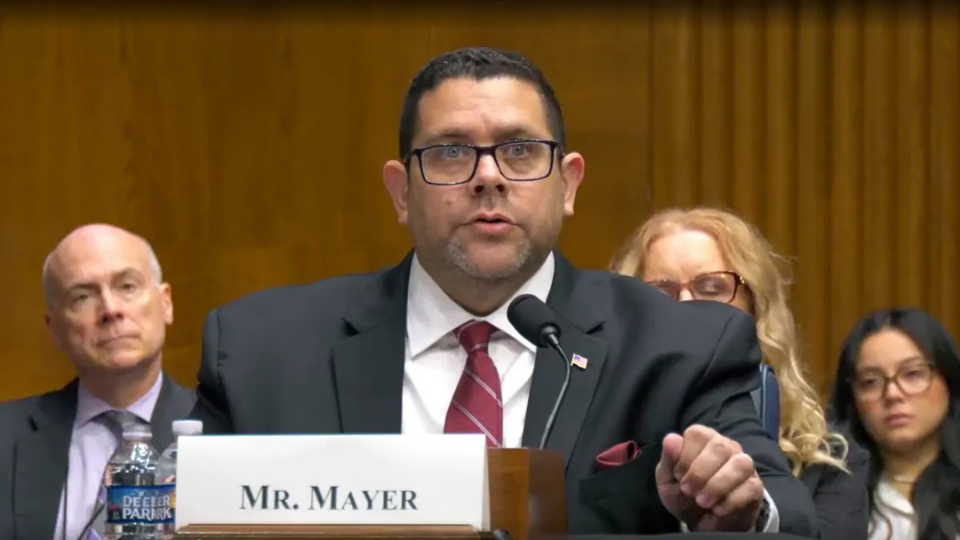
WASHINGTON—Anti-worker President Donald Trump’s drive to control the National Labor Relations Board—part of his overall drive to smash the nation’s workers and unions—hit a roadblock on October 9 when one of his two Republican nominees, Boeing Chief Counsel Scott Mayer, withdrew his nomination for a board seat.
That left the Senate Labor Committee voting on career NLRB attorney James Murphy for a board seat, plus Trump nominee Crystal Carey, as the board’s General Counsel and its chief enforcement officer. The GOP-run panel OKd both on 12-11 party-line votes.
Committee Chair Bill Cassidy, R-La., offered no explanation for Mayer’s withdrawal, but Sen. Bernie Sanders, Ind-Vt., who leads the panel’s minority bloc, did. Mayer, he said, was unfit for the NLRB post because he refuses to get Boeing to settle an ongoing strike by 3,200 Machinists in three St. Louis and Southern Illinois plants.
Trump’s nominees—including Carey and Murphy—“will further President Trump’s anti-worker agenda,” said Sanders, the Senate’s longest backer of workers and unions. “But if Boeing cannot agree to a fair labor contract in St. Louis, I don’t believe Boeing’s chief lawyer should become a member of the NLRB.”
If, or when, the full Senate OKs Murphy, he’d join the NLRB’s current sole board member, Democrat David Prouty. But the five-member board needs a minimum of three to conduct any business, such as ruling on labor-management cases or issuing regulations. Murphy and Prouty alone aren’t enough.
That would leave Carey, if she’s confirmed, free to roll back Biden-era pro-worker General Counsel rulings, though not board decisions. The AFL-CIO and other unions oppose Carey and Murphy, too.
The Communications Workers called Murphy and Mayer “anti-worker men, who elevated corporate interests above workers’ rights for decades.”
Neutering the NLRB by taking complete control of it is part of Trump’s wide-ranging campaign to destroy unions and retaliate against what he calls “enemies” and “the left.” His key tools in that drive have been the so-called Department of Government Efficiency and, even more, Russell Vought, a worker rights opponent and Trump’s Office of Management and Budget Director.
Vought crafted the anti-federal worker sections of Project 2025, Trump’s campaign platform, calling for the outlawing of government worker unions, among other demands. As OMB chief, he’s put them into effect.
His memos, at Trump’s behest, order agencies to RIF (reductions in force)—governmentese for “fire without cause”—hundreds of thousands of federal workers, not just during the current partial government shutdown, but afterward.
Unions contesting those memos, and Trump’s anti-worker executive orders, win in lower courts, but lose in the Supreme Court, on partisan 6-3 votes, with the six GOP-named justices, including three Trump appointees, voting against workers. Another Trump firing led to the NLRB’s lack of a quorum, bringing the board to a halt.
Trump arbitrarily fired Democratic board member Gwynne Wilcox, the board’s first African-American female to serve as its chair, without cause. Her term expires in August 2028, and Trump didn’t nominate anyone for that seat. She sued to get her job back and won temporarily in the lower courts. But Chief Justice John Roberts overturned her win.
Even as the brouhaha over the NLRB unfolded, the Senate Labor panel tackled labor law reform ideas, with mandatory first-contract mediation and arbitration at the fore, in an October 8 hearing.
The AFL-CIO endorsed that proposal in a letter to lawmakers. But the federation admitted it’s only a start, and not enough. The NLRB still needs a quorum, and labor law needs a pro-worker overhaul, AFL-CIO President Liz Shuler, witness Jennifer Abruzzo, and Democratic senators said.
The panel’s labor law session took place against the backdrop of what Shuler’s letter called the greatest act of union-busting in U.S. history: The Trump regime’s elimination of more than 30 union contracts covering at least a million federal workers. Several Democratic senators slammed it.
The cancellations are “illegal and unconstitutional, targeting workers and their unions for exercising First Amendment rights to challenge unlawful personnel policies like mass firings,” Shuler wrote.
The Senate panel’s three-hour hearing featured Teamsters President Sean O’Brien–invited by Sen. Josh Hawley, R-Mo., as a Republican-named witness—and former NLRB General Counsel Abruzzo, now a top Communications Workers advisor.
Hawley and O’Brien champion a bipartisan bill, the Faster Labor Contracts Act, S844, which the Missourian and Sen. Cory Booker, D-N.J., authored. It mandates the first-contract mediation and then binding arbitration if that fails. That’s one part of the Protect The Right To Organize (PRO) Act, S852, labor’s top legislative priority. The PRO Act’s going nowhere in the GOP-run Congress.
Both the PRO Act and Hawley’s bill “provide a timeline for bargaining a first contract,” Shuler wrote senators. “With the prospects of an arbitrated contract down the line, both parties are incentivized to reach an agreement in good faith ahead of such outcome, finding common ground on their terms.”
That’s not the case now, said both Shuler in her letter and O’Brien in his testimony. Labor law problems have been identified “under both Democratic and Republican administrations, but we’ve seen zero solutions,” he testified. Trump had invited O’Brien to speak at last year’s GOP convention, to the disgust of many in his union. On September 8, O’Brien called the Hawley-Booker bill “a positive change.”
“Democrats have played politics with massive reform bills and Republicans have offered business-friendly solutions,” O’Brien stated. Sen. Rand Paul, R-Ky., gave some truth to that by using his entire question time to campaign for his national right-to-work bill. In past years, that’s gone nowhere, too.
Abruzzo argued for comprehensive pro-worker labor law reform, specifically the PRO Act, and a companion bill, the Public Service Freedom To Negotiate Act, ordering all states and cities to give public workers the right to unionize and bargain, too. “Red” states restrict that right. North Carolina has an outright ban. Texas lets unions “meet and confer” with bosses.
“The power dynamics are skewed” between workers and management, Abruzzo explained. “Corporate power dominates,” despite the goal of the 1935 National Labor Relations Act, to level the playing field.
Abruzzo added that the PRO Act “could be a floor” for states to enact even more pro-worker legislation. She specifically mentioned legalizing sectoral bargaining, a common concept in Europe. Several states, including New York and California, are considering legislation to take over the NLRB’s job as long as the federal board can’t function. And with only one—Prouty—or two members, it can’t.
Part of the problem is the law itself. Subsequent court decisions and weakening GOP-passed laws have shot it full of holes, turning organizing drives and bargaining first contracts into an obstacle course. And labor law has no teeth—enforceable penalties which mean something and cost firms real money—while the NLRB is understaffed and underfunded, she added.
“Cases languish for years,” Abruzzo said. Management-side labor lawyer Marvin Kaplan, a former NLRB member, denied that, but produced no data for his claim. “Employers feel emboldened to violate the law because there’s no bad side” to doing so, Abruzzo retorted.
Steve Cochran, the UAW’s lead bargainer for the Volkswagen workers in Chattanooga, Tenn., who voted for the union 18 months ago, brought practical on-the-ground knowledge of how justice delayed is justice denied for workers who want to unionize. “We’ve had no contract because the company has repeatedly violated the law,” he said.
When VW finally did come up with a “last, best and final offer,” Cochran noted, it had no health care coverage, low wages, and no protection from sudden and arbitrary layoffs. “Health care costs put us [workers] into bankruptcy. Members of Congress are silent, and working-class people on Tennessee pay the price.”
“It also intimidates the workers. Why does VW break the law? We show up and do our job” at the VW plant. “Why doesn’t Congress show up and do its job?” by strengthening labor law, he asked.
The one witness who opposed reforms was Rachel Greszler, a labor expert for the right-wing Heritage Foundation—the think-tank that produced Project 2025, with Vought, now Trump’s chief chainsaw wielder against workers, as a top author. He called for abolishing all public sector unions.
Abruzzo closed her opening remarks with a warning: If there isn’t comprehensive pro-worker labor law reform—and that will occur only if voters elect pro-worker lawmakers next fall—protests will hit the streets. That’s what happened as workers marched and fought vicious bosses, before Congress passed and FDR signed the National Labor Relations Act.
“We’ll return to the situation that existed pre-1935, with strikes and police violence,” Abruzzo warned. But if there’s that political change, “we can be a country of the people, by the people and for the people.”
We hope you appreciated this article. At People’s World, we believe news and information should be free and accessible to all, but we need your help. Our journalism is free of corporate influence and paywalls because we are totally reader-supported. Only you, our readers and supporters, make this possible. If you enjoy reading People’s World and the stories we bring you, please support our work by donating or becoming a monthly sustainer today. Thank you!
CONTRIBUTOR