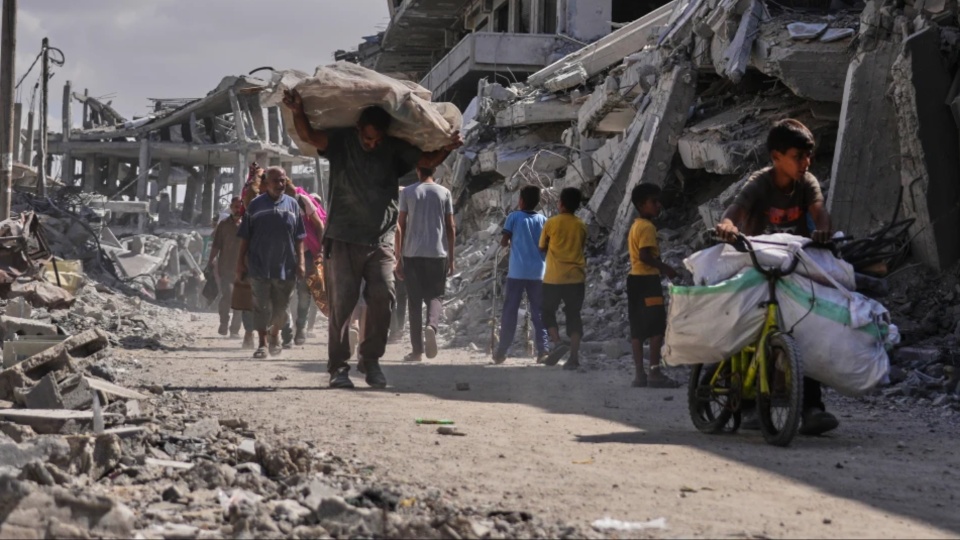
The people of Gaza have begun their long march home from the concentration camps in the southern part of the besieged strip, as a ceasefire agreement finally appears to be taking hold and Israeli troops have partially pulled back from cities in the north.
The more than 70,000 Gazans killed by U.S.-supplied Israeli bombs and bullets since October 2023 won’t be among them, of course, and thanks to two years of non-stop bombardment and demolition, those still alive have little to return to.
Regardless, in Palestine, Israel, and the U.S., many welcome a halt of Israel’s war even as they remain apprehensive over the prospects of winning a lasting peace, especially given that Israel continued to carry out airstrikes in Gaza even as the deal was supposedly being implemented. More than 40 people were killed or buried alive in an Israeli bombing on the eve of the deal taking effect.
Over the next few days, hostage exchanges are planned which will see the release of the remaining Israeli captives held by Hamas and thousands of the Palestinians who’ve disappeared into Israeli prisons. The Israeli military, however, still occupies over half the territory of the Gaza Strip and remains poised to resume its attack at any time.
In Washington, President Donald Trump is hailing himself as the great peacemaker, basking in the praise of the right-wing media in both the U.S. and Israel. He will be greeted by Israeli Prime Minister Benjamin Netanyahu in Tel Aviv this weekend with a red-carpet welcome and will address the Knesset on Monday.
It’s true that Palestinian and Israeli commentators alike are giving him credit for personally pressuring Netanyahu to accept the deal and providing assurances to Hamas. But it was also Trump who gave Netanyahu the green light to break a previous ceasefire in March, supported and abetted the bombing of Iran, and supplied the weapons that have enabled the continued siege of Gaza ever since he returned to the White House.
Despite Trump’s self-praise, the central role he played in securing a ceasefire now is an indirect admission that it was always within the U.S. government’s power to end the genocide in Gaza—under both Trump himself and his predecessor, Joe Biden.

Although Gazans and pro-peace forces everywhere are hopeful that this latest ceasefire will hold, the situation remains extremely fragile. Agreement between Israel and Hamas has only been reached on the first phase of a multi-stage process, and previous negotiations have been torpedoed before ever making it to a second phase.
Under the current framework, phase two would see the establishment of a new government in Gaza without Hamas, the formation of an international security force made up of Palestinians along with soldiers from Arab and Islamic countries, and the full disarmament of Hamas. None of the details for these components have been agreed to yet.
In praise of peace
In the West Bank, the Palestine Liberation Organization welcomed the achievement of a ceasefire. Weary of a repeat of Israel’s past sinking of deals, however, the PLO stressed the “importance of expediting the implementation of all provisions and phases of the agreement”—especially the withdrawal of Israeli occupation forces from all areas of the Gaza Strip and the immediate flow of humanitarian aid to stop the famine caused by Israel’s aggression.
The Palestine People’s Party, which is a member of the PLO, has for months been stressing the need for unity among all the Palestinian factions to “confront the expected challenges, especially from the Israeli side, during the negotiations to implement any agreement.”
The PPP has emphasized the “need to fortify the core issues…which are the complete cessation of Israeli aggression, the withdrawal of enemy forces, and the organization of a mechanism for the entry and distribution of aid through the United Nations and its various agencies.” Some of those points make up part of the current ceasefire deal.
The Communist Party of Israel and the Democratic Front for Peace and Equality coalition (Hadash) issued a joint statement welcoming the ceasefire and giving credit for its achievement to the Palestinian people rather than Trump.
“The end of the war was made possible thanks to the heroic and steadfast stand of the Palestinian people in Gaza, which thwarted the expulsion and extermination plan initiated by the Israeli government, and with the help of the international solidarity that is sweeping the world demanding justice and independence for the Palestinian people,” the statement read.
The Communist Party and Hadash also praised conscientious objectors inside Israel who refused to participate “in the occupation army” and “all the peace forces—Jewish and Arab—who bravely stood against this criminal war.” The two organizations declared that the attacks carried out by illegal settlers and the Israeli army against Palestinians in the occupied West Bank must also stop—attacks which have escalated while the world is focused on Gaza.

Lawmaker Ayman Odeh, chairman of Hadash, told Zo Haderekh newspaper: “I am very happy for the mothers who will hug their sons tightly, and for the children who will hug their parents tightly. No war has proven more than this war that there can be no military solution. Hence, we must free both peoples—the Palestinian and the Israeli—from the yoke of occupation.”
Ofer Cassif, a Communist member of the Knesset who has been repeatedly targeted for his anti-war stance by Netanyahu and his allies, praised the release of those kidnapped on both sides. “The tormented families, Israeli and Palestinian, deserve to receive their loved ones into their arms,” he said, “but the happiness is mixed with terrible pain and rage over the loss of tens of thousands of innocent people.”
Cassif emphasized that a ceasefire could have been reached long ago if not for the Israeli government’s intransigence and the backing of the U.S. He said the achievement of a ceasefire does not mean the end of the struggle against the current regime in Tel Aviv. “We will not rest or be silent until the agreement is fully completed, but more importantly,” Cassif said, “we will not stop the struggle to end the occupation and defeat fascism in Israel.”
In the U.S., too, consensus opinion among opponents of the war is that while a ceasefire is welcome news, accountability will be necessary to ensure long term peace—a peace that must eventually include the establishment of a Palestinian state.
The Council on American Islamic Relations said a ceasefire was overdue but that the crimes committed during the war must be investigated and that tribunals should prosecute the perpetrators. “Ending the genocide does not erase the genocide,” CAIR said in a statement. It also condemned Israeli military attacks that were still killing people even as the ceasefire was set to take effect. “No one else should die in a war that is already supposed to be over,” the organization said.
IfNotNow, one of the main U.S. Jewish activist groups against the war, said in a statement on X: “Any deal that stops the bombs from falling and saves lives is cause for relief and celebration.” Like others, it also put stress on the fact that this is just the first step of a long process.
“True safety will come only when there is freedom and equality for all who live between the Jordan River and the Mediterranean Sea—Palestinians and Israelis alike,” IfNotNow said, and “that requires a real political process, led by Palestinians and Israelis, that dismantles Israel’s system of apartheid and occupation, and invests in a shared future rooted in justice and self-determination.”
Roberta Wood, a member of the National Committee of the Communist Party USA, discussed the ceasefire deal on a Friday broadcast of the CPUSA’s YouTube program, Good Morning Revolution.

Wood pushed back against the media’s propensity to give the U.S. president all the credit for the ceasefire. “This is not a victory for Trump, it’s a victory for people in the movements worldwide, the Palestinian people to begin with,” she said.
She argued that in the U.S. there is a “coming-together of many democratic forces and the peace movement,” of people who see that the ones profiting from the war in both Israel and the U.S.—“the military contractors, the weapons makers, the tech companies, the energy interests”—are intertwined.
“They have an interest in keeping the region destabilized,” Wood said, “and that isn’t going to stop.” Indeed, the Israeli military officials are already telling the press that Netanyahu may soon order a fresh bombing campaign against Iran.
What next for Gaza?
While everyone holds their breath in hopes that the ceasefire holds, attention is already turning to questions about what the future holds for Gaza.
The Palestinian Authority is talking about clearing rubble, an infusion of food and health aid, and eventual reconstruction. Zionist ideologues in the Israeli cabinet, meanwhile, continue to hold tight to schemes that envision the complete expulsion of the Palestinian people from Gaza and the territory’s annexation into a “Greater Israel.”
Netanyahu’s finance minister, Bezalel Smotrich from the Religious Zionism Party, called the ceasefire a “resounding diplomatic failure.” He declared that Israel should “continue to strive with all its might for the real eradication of Hamas and the real demilitarization of Gaza.” Smotrich and National Security Minister Itamar Ben Gvir both voted against the ceasefire when the Israeli cabinet took up the matter.
As for Trump, he is still pushing his “20-point peace plan,” which sees Gaza as a piece of real estate to be redeveloped under his personal control. A “Board of Directors,” with former British Prime Minister Tony Blair as point-man, would have broad powers over life in the Gaza Strip, including security authority.
A “Gaza Investment and Economic Development Promotion Authority” is to be established, which would coordinate investment from the private sector to oversee reconstruction. It would be headed by “professional business people, tasked with creating investable projects with real financial returns,” according the U.S. and Israeli government-backed Gaza Humanitarian Foundation.
In other words, Gaza’s future would be privatized and handed over to the whims of for-profit interests. It’s an idea that the CPUSA’s Wood called “horrific.” She said, “The idea that Trump will be the head of a board to control the future of Palestine, along with people like Jared Kushner, just epitomizes the capitalist interests that have supported and benefitted from this war from the start.”
Opponents of the war in the region have a similar perspective. As Odeh of Hadash and Cassif of the CPI put it: “This war has unequivocally proven that without the realization of the Palestinian people’s rights to freedom, independence, and the establishment of an independent Palestinian state…with its capital in East Jerusalem alongside Israel, the conflict will continue.”
For the moment, though, joy and grief mix among the rubble and cratered streets of Gaza. The PLO captured the moment in statement Friday morning: “The sounds of bombs have fallen silent. In their place: cries of relief, laughter, and the rhythm of life returning.”
We hope you appreciated this article. At People’s World, we believe news and information should be free and accessible to all, but we need your help. Our journalism is free of corporate influence and paywalls because we are totally reader-supported. Only you, our readers and supporters, make this possible. If you enjoy reading People’s World and the stories we bring you, please support our work by donating or becoming a monthly sustainer today. Thank you!
CONTRIBUTOR