All eyes have been on New York City since the historic Democratic primary victory of 33-year-old democratic socialist Zohran Mamdani over corporate Democrat juggernaut Andrew Cuomo’s $25 million campaign. Mamdani, a Muslim State Assembly Member from Queens and an open member of Democratic Socialists of America (DSA), ran on a pro-working-class platform centered around the themes of “affordability” and economic justice for all New Yorkers. His policy agenda included proposals to freeze the rent, provide free childcare, and ensure fast and free buses for working families who are struggling to survive and thrive in a city increasingly dominated by corporate real-estate developers. His campaign has generated a social-media-powered progressive upsurge among diverse young voters, the likes of which have not been seen since the 2016 and 2020 Bernie Sanders campaigns.
As is to be expected, Mamdani is being aggressively derided by the entire political class— conservatives and corporate Democrats alike—as a pro-Hamas, Marxist “lunatic” who will destroy the city and turn it into a North American Havana. It is no surprise that mainstream Democrats have dismissed Mamdani’s proposed policies to benefit working families as socialist pipe dreams. These are the same corporate Democrats who cut all $565 billion worth of family benefit programs from the Inflation Reduction Act, desperately needed programs that had been promised in the failed Build Back Better bill. They included a universal preschool and childcare program, as well as federal paid family and medical leave. In reality, Mamdani is running on a very sensible, social democratic agenda, consisting of tried-and-true programs, many of which have already proven quite successful in New York and other cities across the country.
As exciting as Mamdani’s victory is, it is not unprecedented. Indeed, Mamdani’s overturning of the law-and-order agenda of conservative Democrat incumbent Mayor Eric Adams mirrors an electoral battle from a little over a decade ago.
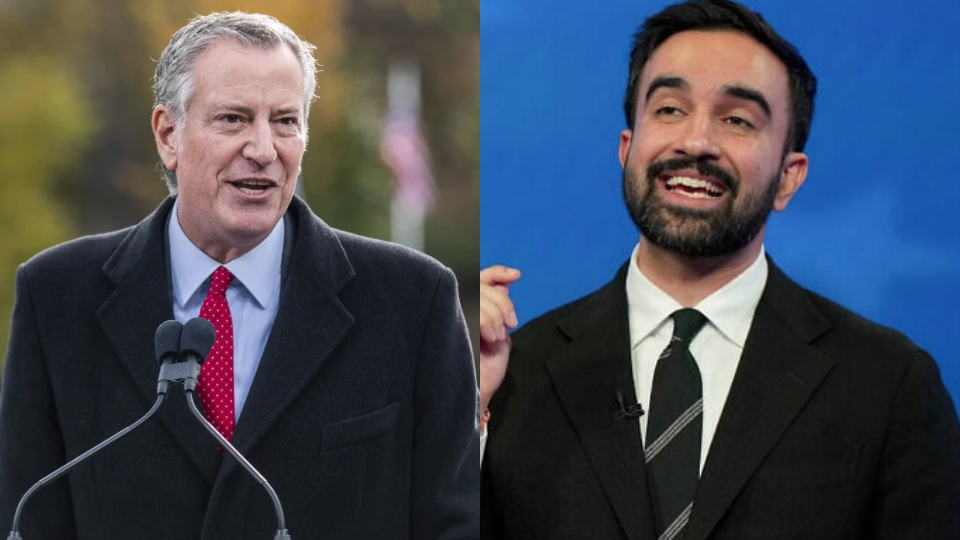
In 2014, a broad, multiracial community coalition emerged around Bill de Blasio’s mayoral campaign to reject Mayor Michael Bloomberg’s corporate neoliberal agenda and the obscene economic inequality it had engendered. Former Mayor de Blasio’s (2014-2022) campaign evoked a “tale of two cities” and the need to combat the stark economic and racial inequality that was pushing ordinary New Yorkers out of the city. It’s no wonder that, in a June interview with the New York Times, Mamdani said that de Blasio was the “best New York City Mayor in his lifetime”. Unbeknownst to many of today’s young activists, de Blasio’s government laid a blueprint for radically progressive city governance that Mamdani would do well to emulate.
Consider education. Bloomberg was a national champion of the school privatization movement: he closed over 160 public schools in low-income communities of color and opened 183 charter schools. At the behest of grassroots organizers, de Blasio replaced Bloomberg’s neoliberal agenda with an equity-centered “whole child” approach to education, establishing Pre-K For All, the country’s largest free, universal pre-kindergarten system for 3- and 4-year-olds. In 2014, when he took office, there were only 19,000 students enrolled in full-day pre-k. Two years later, there were 70,000 4-year-olds enrolled in the Pre-K for All initiative.
Research has shown that the New York City program has improved student outcomes and reduced racial achievement gaps, along with extensive literature demonstrating that attending pre-k leads to higher adult earnings and better health later in life, as well as reductions in future social and economic costs of crime and incarceration.
Furthermore, the program has “put $1.4 billion back in the pocket of New Yorkers who do not have to pay for childcare.” The de Blasio administration created over 250 community schools (on which this author conducted his dissertation research), which provide wrap-around social, health, and educational services to meet the needs of students and families living in poverty. A rigorous RAND evaluation found the initiative has had numerous positive impacts on the city’s students, including improved attendance, graduation rates, and test scores.
Mayor Eric Adams sought to bring back Bloomberg’s notorious, unconstitutional Stop-and-Frisk program in which police, in 2011 alone, stopped 685,000 New Yorkers, 85 percent of whom were Black and Latino; nine out of ten of these humiliating stops led to no arrests or summons. De Blasio ended the program, leading to a 93% reduction in police stops between 2013 and 2019. Small quantity marijuana arrests, which had saddled thousands of young men of color with criminal records, were cut in half, along with “use of force” complaints against the NYPD.
De Blasio lobbied Albany to pass the NYC $15 minimum wage, more than doubling what it was in 2013, which helped lift 521,000 New Yorkers out of poverty by 2019, a 12.7% reduction. The largest decreases in poverty rates were among Black people and Latinos, and the 20th percentile real hourly wage for the City’s Black workers and Latino workers grew by 15% and 24% respectively, during de Blasio’s tenure. His government also extended paid sick leave to over 500,000 New Yorkers and implemented a Paid Family Leave program, extending existing leave from six to 12 weeks of paid time off at 100% of salary for thousands of City employees.
Many on today’s left have an ambiguous relationship with the state and the actual wielding of governing power. It is one thing to lead a symbolic protest campaign. It is another to govern and implement far-reaching policies and programs that improve the lives of ordinary people. De Blasio’s government, though far from perfect, showed us that transformative social policies were possible in 21st-century urban America. If elected Mayor, Mamdani should build off de Blasio’s blueprint.
As with all op-eds published by People’s World, the views reflected here are those of the author.
We hope you appreciated this article. At People’s World, we believe news and information should be free and accessible to all, but we need your help. Our journalism is free of corporate influence and paywalls because we are totally reader-supported. Only you, our readers and supporters, make this possible. If you enjoy reading People’s World and the stories we bring you, please support our work by donating or becoming a monthly sustainer today. Thank you!
CONTRIBUTOR