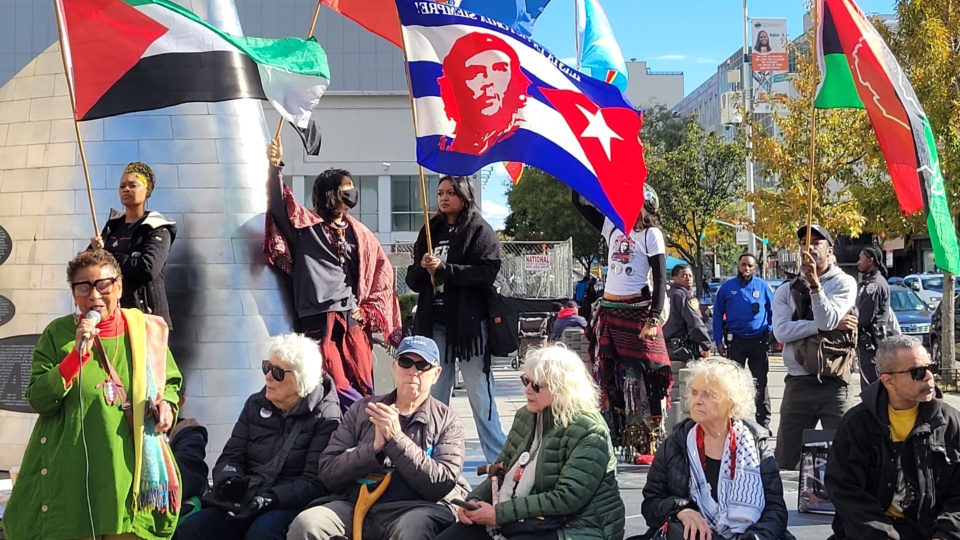
NEW YORK—Every year the world community of nations, operating through the United Nations, rejects and condemns the U.S. blockade of Cuba aimed at strangling that country’s socialist revolution and economy. This year, the vote will happen on Oct. 28 and 29, and in the leadup to it, there were spirited rallies in support in New York.
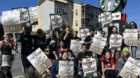
An Oct. 26 rally was in Harlem featured attendance by community leaders, state senators, and Cuba solidarity activists.
Last year year’s vote saw 187 nations in favor of ending the blockade and only two—the United States and Israel—voting to keep it. This year’s vote comes at a time where the world has seen escalating U.S. aggression against other nations, including a possible attack on Venezuela. The action in Harlem demonstrated that people in the U.S. are challenging the U.S. government’s intention to intervene and control the autonomy of both Venezuela and Cuba.
Organizations present at the rally represented numerous political and community groups, but all were aligned in the intention to end the blockade on Cuba and to stop U.S aggression toward other Latin American nations. Present at the event were various organizations, including the Cuba Sí Coalition, the National Network on Cuba (NNOC), Juventud Unida por la Independencia (JUPI, a Puerto Rican youth organization), and others. Some members of the New York State Assembly were also in attendance.
Today, the world continues to witness the effect of the 60-plus year Cuban blockade, seeing disastrous results for the people of Cuba. Dr. Rosemari Mealy, member of the Harlem-Cuba Welcome Committee, emphasized, “Six days under the blockade is equal to the funding required to import a year’s worth of consumables such as cotton gauze sutures, catheters, and IV equipment, among other health supplies.”
Tee Iriarte, a member of the Cuba Sí Coalition, described how the blockade aims to limit Cuba’s ability to provide for its people, saying, “This economic blockade on Cuba is an impediment that prevents people from accessing life-saving medical equipment, fuel to generate sustainable power, and other essential services.”
Example for rest of the world

Despite these U.S. action, the Cuban government continues to provide its people with care, including free medical clinics, as it fights toward autonomy and a better future.
The event detailed the important connections between Cuba and the world, demonstrating that in many instances Cuba has been a lifeline for various struggles against oppression. Mealy spoke about how, for Black people in the U.S, Cuba represents an essential progressive force and an example of solidarity. She emphasized that even when the U.S pressured Cuba to extradite Black political prisoner Assata Shakur, the country did not go along with the demand.
She said: “Her name was Assata Shakur. Assata Shakur died free while in Cuba. Cuba has paid an enormous price for that because in all of the negotiations between the U.S. and Cuba, her name was put up as a negotiating tool, and Cuba refused to use Assata as a negotiating tool even when their people were suffering from the 60-year blockade. This is support and solidarity.”
What U.S. citizens can do

As Cesar Omar Sanchez, one of the co-chairs of the NNOC, an coalition of over 60 organizations, emphasized, U.S. citizens should use every opportunity to defend Cuba:
“We got to stand unified. We must continue the fight…. Get involved and speak to your colleagues and friends about what’s going on in Cuba and in Latin America who don’t understand the history.”
New York State Sen. Cordell Cleare, who signed a 2023 letter urging President Joe Biden to take Cuba off the U.S.’ State Sponsor of Terrorism list (SSOT) said: “It is not fair that just because the U.S. [government] doesn’t like what I do it means you can tell me what to do or what freedoms I have. It’s time for the blockade to end.”
We hope you appreciated this article. At People’s World, we believe news and information should be free and accessible to all, but we need your help. Our journalism is free of corporate influence and paywalls because we are totally reader-supported. Only you, our readers and supporters, make this possible. If you enjoy reading People’s World and the stories we bring you, please support our work by donating or becoming a monthly sustainer today. Thank you!
CONTRIBUTOR