ALBUQUERQUE, N.M.—It’s a depressing feeling, nurse Adrienne Enghouse says, when you love your job, work yourself to the bone, but go home each night wondering if you did enough and caught enough problems to ensure your patients’ health—all because of short-staffing.
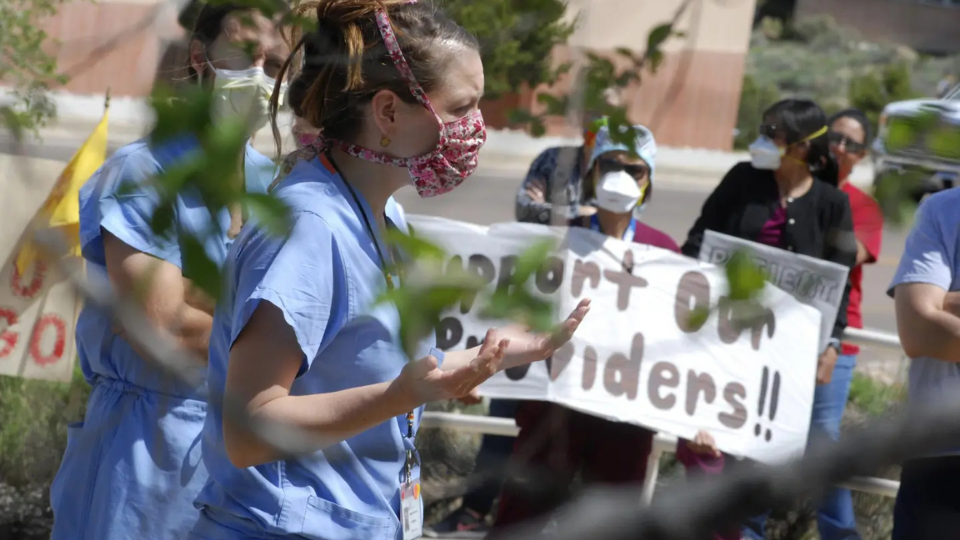
That worry and that cause pushed Enghouse and her colleagues at the United Health Professionals of New Mexico, a Teachers/AFT local, and support staffers from the National Union of Hospital and Health Care Employees, out on an informational picket line all day on October 30 at the University of New Mexico’s main hospital complex in Albuquerque.
The picketing drew public attention to the working conditions at the hospital complex, New Mexico’s largest, just before bargaining resumed in November on new contracts for the two groups of workers.
It’s no surprise that short-staffing looms large in the coming negotiations. Nurses and other hospital workers have agitated about it for years, both in unions and out. It’s been a major issue in organizing drives among RNs, other nurses, and other hospital workers by National Nurses United, the Teachers/AFT, AFSCME, the Service Employees, and other unions.
And NNU has, with their help, pushed safe-staffing bills through legislatures in New York, California, Minnesota, Illinois, and other states. But it’s run up against a brick wall in the U.S. Capitol, where the insurers ‘lobby holds sway. Safe staffing would cut into insurers’ profits. The industry won’t admit that.
At the University of New Mexico hospitals, pay is an issue, Enghouse told People’s World in a telephone interview. But for the 29-year veteran nurse, who worked at UNM for years and in its Sandoval building in particular, pay is tied to other priorities.
“Put patient care, safe staffing, and worker retention ahead of executive pay,” that union statement declares.
The unions are right about the top pay. Paul Roth, an MD who is chancellor not just of the hospital complex but of the university’s medical school, earned $656,434 last year, according to public records unearthed by The Candle, an independent medical publication website. That’s been roughly his yearly pay since at least 2020, according to a prior story.
And Kathleen Becker, an MD and the hospital’s executive director—and, with a law degree, its chief bargainer—earned $632,403 in 2024. The Candle reported five years ago that 1,270 UNM hospital workers, or 18% of the total, earned less than the living wage of $15 an hour.
“Fight for 15 and a union,” of course, was a rallying cry of low-wage workers for more than a decade. Now, federal figures show, $15 is too little in New Mexico, or anywhere in the U.S.
Enghouse, who now works at a private clinic, explained that the low pay affects patient care and leaves nurses and staff frustrated and tossing and turning at night about whether they did enough and caught everything.
“That’s the moral issue that comes up,” she said. “When you’re at the end of your shift, and you know you missed something, and that there’s nobody there” to check or fill in the gaps, “you’re caught with the weight of that.
“We go home asking ‘What did I forget?’”
And as a result, patients who should be recovering sometimes linger. The reasons nobody’s there to help? “When things get messed up, nine times out of ten it’s because of short-staffing.”
In a pre-picketing statement, Joanna Avila-Ulmer, president of the staff’s local of the National Union of Hospital and Health Care Employees, an AFSCME affiliate, sounded many of those same themes.
“Health care workers deserve respect, fair pay and a real commitment from management to [worker] retention,” Avila-Ulmer said. “We’ve continued to show up for our patients through every challenge.
“Now it is time for the University of New Mexico Hospitals management to show up for us. Respect us, pay us fairly, and invest in keeping skilled caregivers at the bedside.”
Short-staffing also produces long waits for care, in the hospital wards and especially in the hospital complex’s emergency rooms, Enghouse elaborated. Many times, those “four-hour waits” for service aren’t for lack of beds—the hospital complex has plenty and a new critical care center, opened in September, added 98 more—but for lack of nurses and orderlies to serve patients occupying them.
“And surgeries have been cancelled all the time because of short-staffing.”
All these are issues the two unions will bring to the bargaining table when talks open in November with hospital bosses, headed by Becker.
Management has taken the position that it can’t hire more people because of pressure from insurers to keep costs down, so those firms can make more money. Enghouse scoffs at that, especially given the hospital’s high pay for Becker and other executives while its nurses and staffers are lower-paid than colleagues elsewhere.
The result of that lower pay is high turnover, she adds. And hiring problems. And it doesn’t affect just the nurses and the patients. Studies show 32 of New Mexico’s 34 counties suffer doctor shortages.
At the same time, the hospital’s board approved 26% raises for Becker and other executives, Enghouse said. There’s been recent high turnover among top hospital leaders, too, according to the hospital’s own public relations releases.
“We’re trying to require staffing charts” in talks with the hospital management, Enghouse added. “People don’t realize that short-staffing” affects patient care. It affects something else, too, which riles the nurses and the support staff: Mid-managers’ pay. The more money they save by treating more people with fewer workers, the higher their bonuses are, Enghouse explained.
The situation is so bad within the hospital complex that it only gets a “C”—a three-star rating–from the federal Center for Medicare and Medicaid Services. The rating “combines data on patient safety, mortality, readmissions, patient experience–based on surveys–and other aspects of care to give consumers an easy way to compare hospitals nationwide,” a CMMS summary on Wikipedia says.
And in that five-year-old news series, UNM hospital executives admitted the hospital complex had a high rate of sepsis—blood infections—after surgery. To hospital overseers, that’s supposed to be a warning signal of management problems. Another warning: High turnover in staff and managers.
The five-year-old Candle series faulted management, too, plus a lack of oversight by the hospital board and state officials. “Becker’s been here long enough to show she isn’t competent,” says Enghouse.
News stories indicate the GOP Donald Trump regime’s cuts to Medicaid and Medicare reimbursements to hospitals may only make a bad situation worse at the UNM Hospital complex.
The Albuquerque Journal reported in late April that, anticipating the later enactment of massive Medicaid and Medicare cuts from Trump’s “big, beautiful” budget bill, UNM cut 53 administrative positions in the hospitals. Some had been vacant anyway. Communications Director Chris Ramirez emphasized that no nurses and other patient care staffers were cut.
“To be sure we are operating as efficiently as possible, and are as prepared as possible for federal funding changes which may lie ahead, we have implemented a number of financial improvement initiatives,” Ramirez said then.
We hope you appreciated this article. At People’s World, we believe news and information should be free and accessible to all, but we need your help. Our journalism is free of corporate influence and paywalls because we are totally reader-supported. Only you, our readers and supporters, make this possible. If you enjoy reading People’s World and the stories we bring you, please support our work by donating or becoming a monthly sustainer today.
CONTRIBUTOR