WASHINGTON—By a 60-40 vote, the bare minimum required, the Senate took the first step Republicans have been demanding in order to end the longest government shutdown in U.S. history. Seven Democrats, plus Independent Angus King of Maine, who caucuses with the Dems, joined 52 of the 53 Senate Republicans on a vote to limit debate on a temporary money bill to keep the government going through Jan. 30.
The Democrats who caved were Dick Durbin of Illinois, who also serves as the Democratic whip; John Fetterman of Pennsylvania, who has continuously sided with Republicans on previous shutdown votes; Tim Kaine of Virginia, who has 150,000 federal workers in his district; Catherine Cortez Masto and Jacky Rosen, both of Nevada; and Jeane Shaheen and Maggie Hassan of New Hampshire.
The vote ends the effort by Democratic Senators to prevent a vote until Republicans agree to extend Obamacare subsidies, without which millions will lose health care. The rollcall on Nov. 9 cleared the way for two separate future votes: One on the MAGA money bill, called a continuing resolution (CR), possibly by Nov. 14, and the other, supposedly sometime in December, on a one-year extension of a federal tax credit for millions of people who get health insurance via the Affordable Care Act, also known as Obamacare.
Traded their votes for nothing
The catch to that deal, as Sen. Bernie Sanders, Ind-Vt., pointed out, is that simply holding a vote on extending the tax credit doesn’t mean lawmakers will approve it, thus saving millions of people from a financial catastrophe.
“The Majority Leader says Democrats can put together their own bill for a vote. Well, as everybody here knows, that is a totally meaningless gesture,” Sanders declared. “You can get 100 votes here in the Senate, but the House will not take it up, and the president of the United States certainly will not sign it.”
“The American people want us to stand and fight for health care,” added Sen. Elizabeth Warren, D-Mass. She and others point out that the overwhelming wins by Democrats in off-year elections last week are proof that the people backed the fight by Senate Dems to save health care for millions and oppose the sellout supported by the group of dissenting Democratic senators.
The government has been shut, and two million workers have been without pay, since Oct. 1 because the ruling Republicans didn’t have enough votes to break a Senate Democratic filibuster against the original House-passed GOP-written CR.
The Democrats’ price for providing the needed votes was to reverse the earlier Republican-enacted massive cuts in Medicaid ($880 billion over 10 years) and the ACA tax credit. Opinion polls, and the Nov. 4 election returns, show voters by and large support the Democratic position.
Those two cuts, combined, would affect 36 million people directly—14 million on Medicaid and 22 million who use the ACA—and everybody else with private insurance indirectly, as health insurance premiums would skyrocket to pay for uncompensated care.
Rep. Ro Khanna, D-Calif., took to X to show the details of what those premium hikes will mean for working-class Americans. He posted an image of an insurance quote received by taxi driver in Arizona who has cancer and buys insurance via the ACA marketplace from private insurer Centene. 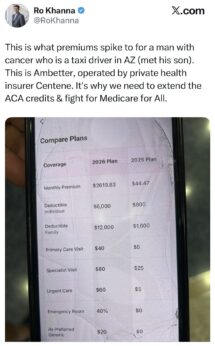
The man’s 2025 insurance plan featured a monthly premium of $44.47 with a $1,600 annual deductible for his family. After the GOP’s kill-off of the ACA subsidies, the man’s 2026 plan soars, with a monthly premium of $2,619.83 and a deductible of $12,000.
The AFL-CIO estimates that ACA users would see their premiums rise by 114%. It is lobbying and urging members to e-mail senators to tell them “federal workers aren’t your pawns.
“The federal government has shut down because the Trump administration chose chaos and pain over responsible governing,” the AFL-CIO’s message says.
“Countless jobs, the essential government services we all rely on, and the economy are in jeopardy right now—all because the administration wants to take one more swing at wrecking the Affordable Care Act (ACA) and throwing working people off our health care.”
One union, the Government Employees (AFGE), broke from the consensus. It’s the largest union of federal workers. Its position, now, is to fund the government, provide back pay for the workers, and deal with the health care issue later. But there’s dissension within AFGE: The president of its local for Environmental Protection Agency workers says preserving health care and keeping it affordable must be part of the solution.
The government is still shutdown, for now
The Senate’s compromise CR still has a long way to go. That’s because it includes extra provisions the ruling Republican hardliners in the House have previously rejected. House Speaker Mike Johnson, R-La., pulled the House out of session in mid-September and refuses to call lawmakers back.
His position, kowtowing to Trump, is “take it or leave it”: Accept the original House-passed temporary money bill, without the health care fixes, or let the shutdown continue.
Meanwhile, some 700,000 essential workers, such as air traffic controllers, have been working without pay since Oct. 1. So have hundreds of thousands of workers for government contractors, such as those in call centers handling phone inquiries about Social Security. The other 1.4 million federal workers have been sent home, also without pay.
The Senate’s extra provisions in the “compromise” would guarantee back pay for all the federal workers—but not the workers for the contractors—roll back the Trump regime’s arbitrary firings, called Reductions In Force (RIFs), of at least 4,000 of the federal workers, and ban Trump from imposing more RIFs until after Jan. 31.
The Senate compromise CR would also fund several federal Cabinet departments, including Agriculture—which handles food stamps—and Veterans Affairs, and Congress itself for the full fiscal year, which ends next Sept. 30.
The House cut $230 billion over a decade from food stamps in its CR. The Senate version of the full-year money bill, which was inserted into the “compromise,” reverses that cut. Meanwhile, the impasse stopped food stamp payments on Oct. 1. That hit 42 million people, one of every eight in the U.S. The administration is still resisting court orders to fully fund food stamps.
The eight members of the Democratic caucus who gave their votes to the Republicans will likely manage to reopen the government, halt some layoffs, and secure back pay for at least some workers. But in surrendering on the health care fight, they may have also given up much of the political leverage won over the past several weeks and in the Nov. 4 elections.
John Wojcik and C.J. Atkins contributed to this article.
We hope you appreciated this article. At People’s World, we believe news and information should be free and accessible to all, but we need your help. Our journalism is free of corporate influence and paywalls because we are totally reader-supported. Only you, our readers and supporters, make this possible. If you enjoy reading People’s World and the stories we bring you, please support our work by donating or becoming a monthly sustainer today.
CONTRIBUTOR