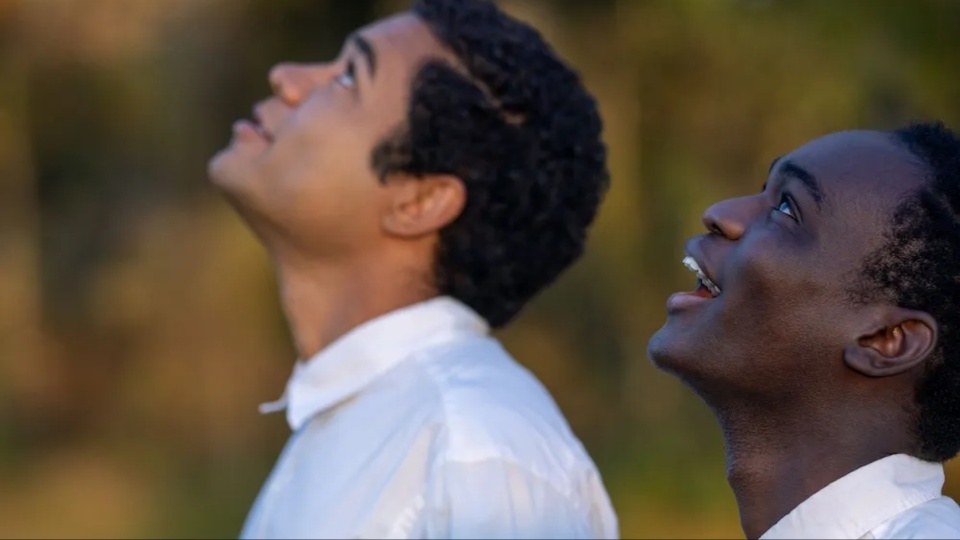
In an era when many films often serve as background noise to the smartphones held in our hands, Nickel Boys dares the viewer to step into the shoes of its protagonists. The film, beautifully shot through a first-person perspective, places the audience into a coming-of-age story that is not for the faint of heart. The drama explores systemic racial trauma with cinematic grace and beauty despite the ugly history it boldly explores.
Directed by RaMell Ross, who co-wrote the screenplay with Joslyn Barnes, the film is an adaptation of Colson Whitehead’s novel, The Nickel Boys. The story follows two young Black American boys, Elwood and Turner, who are sent to a reform school in 1960s Florida. While there, they experience—along with witnessing—physical and emotional abuse by those in charge, racial discrimination, and corruption.
The film is inspired by the Dozier School for Boys, a now-closed Florida reform school notorious for its abusive treatment of students. Dozier has made headlines in recent years with the discovery of dozens of unmarked graves on the school’s property, thought to hold the bodies of boys who were killed or died at the school and buried there—essentially disappeared. Most of the graves discovered held the remains of Black boys.
Nickel Boys is a story about trauma and hope, as well as the exploration of idealism versus pragmatism. While the story is fictional, the main characters, Elwood and Turner, represent the many boys who passed through the Dozier school during its 111-year history. They represent the countless Black boys lost in a system defined by corruption, trauma, and oppression.
The fictional school of Nickel Academy is a historic representation of the many forms systemic oppression and trauma can take in relation to the infamous school-to-prison pipeline that youth from marginalized communities, often Black and Latino, find themselves in. It’s an ugly history—but it is also a haunting present, as what the characters in the story experience is unfortunately alive and well in contemporary society. This is why the unique way Nickel Boys was filmed is a powerful choice in itself.
It’s easy for viewers to become passive when watching stories on screen, even those as heartfelt and poignant as the one explored in Nickel Boys. The first-person perspective, however, allows for a unique and intimate approach; it connects us with the main characters before a word is ever spoken. They are our (literal) eyes throughout the story. We focus on what they do, and we experience a moment the way they do.
Room is left for interpretation, but the connection to their view remains paramount. It also allows for some beautiful cinematic moments, as characters become fixated on certain things, as many of us do, such as the sway of the leaves on a tree, oranges bouncing from the vines, and the blue sky, even in the most intense emotional moments. This allows for a sharp contrast between the beauty and the rougher parts of the story.
This can also make you nervous during the darker parts of the movie, as you wonder what potential horrors director Ross may subject us to through the eyes of the boys. Yet the filmmakers carry out this task masterfully, as we witness allusions to abuse, despair, and fear in a way that focuses on the emotions and anxiety of the character, rather than the events themselves.
We experience the emotional terror, the anxiety, and at times the confusion through interesting angles of the camera and extreme focus on bouncing legs, quivering lips, and downtrodden eyes. Nickel Boys understands that it is exploring systemic racial trauma, but it does well not to fall into the visually graphic and at times exploitative methods directors often portray on screen. Ross clearly doesn’t want to shock you but rather make you witness and understand
Taking place during a pivotal time in history—the 1960s Civil Rights Movement—the film uses its story to explore the debate over strategy and tactics that occurred during that time as Black people fought for freedom and equality for all.
Elwood, played with quiet strength by Ethan Herisse, is inspired by the words of Rev. Martin Luther King, Jr., and even participates in acts of protest before he is swept up in the system due to an unfortunate incident of being in the wrong place at the wrong time. Elwood has dreams of a future in which he will make a difference in the world despite the odds. He believes in rules and the idea that justice prevails when brave people take a stand.
This is contrasted with Turner, played with sly charm by Brandon Wilson, who holds a more cynical view of the world, believing in survival above all and certain that most people in charge are corrupt and/or complacent. Yet, despite their initially different life philosophies, they form a strong and transformative bond of friendship with each other that is the heart of the film.
The showcase of this friendship is important, given that another theme of the film deals with alienation. The boys who are placed into the academy live among each other, but the fear and anxiety that is instilled in them makes it hard for them to form connections with one another that don’t continue the cycle of violence and intimidation that the reform school breeds. Nickel Boys isn’t overt in showcasing this, but if you keep your eyes fixed on the screen, it is there, another way of imploring the audience to be cognizant as the story of Elwood and Turner unfolds.
Aunjanue Ellis-Taylor as Hattie, Elwood’s grandmother, delivers a powerful performance as a woman grappling with her own trauma and tragedies yet striving to find the will to provide for her grandson. Her presence is important because far too often, when speaking about racial oppression, particularly of Black people, the faces seen are often only those of Black men. Yet, with tragedies such as Breonna Taylor, Sandra Bland, and far too many others to count—not to mention the often-overlooked leadership of Black women during the Civil Rights Movement—we know that this systemic oppression is equally felt by Black women.
The oppression displayed in the film, of boys being swept up in the system, is a heavy one. The film conveys how the trauma of that experience leaves a lasting imprint on those who go through it, even if they didn’t experience all of the abuses directly themselves. This can manifest in the decisions the they make, the relationships they form, and their overall approach to navigating the world.
Nickel Boys showcases the reality that experiences such as these are not ones that people can simply “get over” or “move on” from, as some who would rather forget history would have the world believe. The physical scars that we see inflicted on some of the boys may fade, but it is clear that the mental and emotional wounds remain. Thus, the movie reflects on how systemic oppression is wide-reaching and deeply-rooted, breeding a vicious cycle of trauma and stress that can manifest in so many ways in the lives of those affected.
As mentioned, this is not just a film about the past. Its story is very relevant today, as the school-to-prison pipeline is still in play. Many youths, particularly Black youth and other young people of color, are more likely to be in environments where they are subjected to disciplinary actions that can result in law enforcement being involved. For example, according to stats compiled by the American Bar Association, Black students are 2.2 times as likely to receive a referral to law enforcement or be subject to a school-related arrest as white students.
Nickel Boys is an experience. And while that may seem like an obvious sentiment for any movie, as one would think anything you do, you experience, but the film is effective in a deeper way than others because, through watching it, we are literally living in the minds of the protagonists. We see the world as they do.
It isn’t an easy watch, but it manages to be an emotionally beautiful one. And if nothing else, it will hopefully inspire those who watch it to look at the history of the Dozier School, and others like it, both past and present, that claim to be about reform and rehabilitation but are often tainted by greed, corruption, and prejudice.
We hope you appreciated this article. At People’s World, we believe news and information should be free and accessible to all, but we need your help. Our journalism is free of corporate influence and paywalls because we are totally reader-supported. Only you, our readers and supporters, make this possible. If you enjoy reading People’s World and the stories we bring you, please support our work by donating or becoming a monthly sustainer today
CONTRIBUTOR