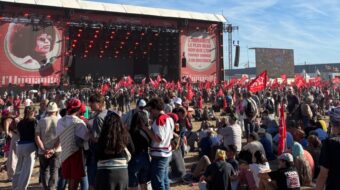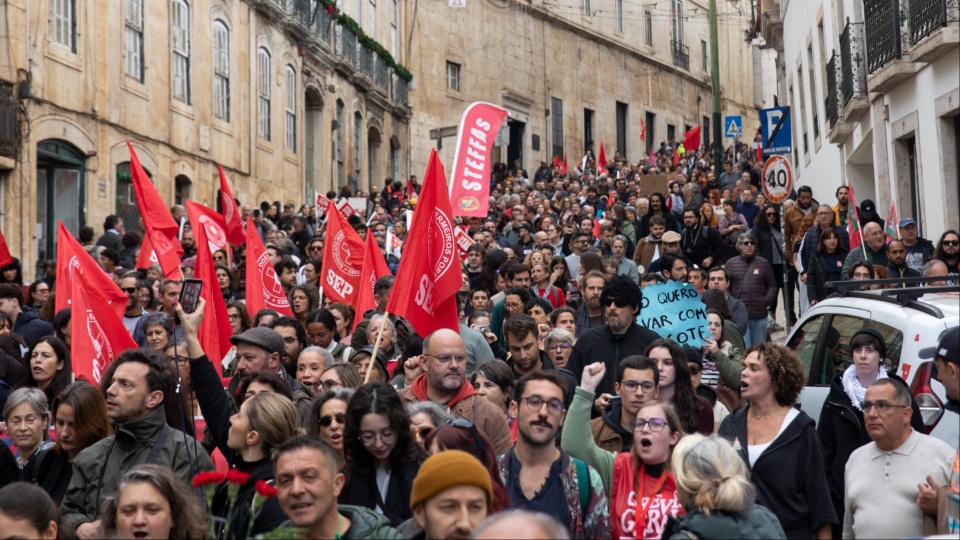
Tens of thousands of Portuguese workers walked off the job this week, dressed in workers’ red, in the country’s first general strike in 12 years. This massive show of force is a direct challenge to the right-wing government’s aggressive assault on labor rights, wages, and collective bargaining.
The nationwide strike action halted ports, grounded flights, shuttered schools, and stalled public transport. Workers from every sector said they will no longer accept a return to deeper exploitation and austerity.
The General Confederation of the Portuguese Workers (CGTP-IN) underscored that the attack on workers’ living standards comes not during an economic crisis but amidst growth and steep rises in corporate profits. The union federation said the government’s labor package is “an assault on the rights of all workers.”
“The great and expressive scale of today’s General Strike is an enormous statement of the workers’ strength and unity,” declared the Portuguese Communist Party (PCP), which hailed the mobilization. The party condemned the legislative package as a direct weapon at the service of capital designed to suppress wages, normalize precarious work, dismantle collective contracts, and restrict the right to strike.
The PCP saluted the CGTP-IN for its initiative and the thousands of union leaders and rank-and-file workers who organized the historic general strike.
“The path that is needed is one that increases wages, that fights against precariousness, that values collective bargaining, that defends and strengthens public services,” the party said. “This path is in the hands of the workers, of the people and of the youth, with the immense strength that was on display today.”
The impact of the strike has been immediate and widespread. Autoeuropa, the country’s largest automotive plant, now stands idle. Lisbon’s public transit system ceased operations. Major ports closed. Airlines canceled most flights. Hospitals functioned with skeleton crews, and trash went uncollected in cities nationwide.
From the Panasqueira Mines to the fisheries, from Coca-Cola bottlers to the Super Bock brewery, the work stoppages demonstrated the economy’s total reliance on the very workers the government now seeks to devalue.
“We do not accept unjust laws,” said Conceição Lobo, who has worked 44 years at the Lameirinho textile mill. She voiced widespread rejection of the proposed plan to force workers to work until age 70 before retirement. “We are in the street, together, defending dignity, respect, and a future for those who work,” she said.
At a Lisbon Metro picket line, PCP General Secretary Paulo Raimundo addressed the strikers. “Do not underestimate the workers,” he stated. “When this force unites, as will happen, around their objectives, they are capable of standing up to everything.”
The World Federation of Trade Unions (WFTU), which represents 110 million workers across 134 countries, expressed its “undivided solidarity” with the strikers. The WFTU condemned the “brutal attacks” in Portugal that “undermine essential social and labor rights,” and demanded the immediate withdrawal of the anti-worker policies.
The Portuguese government attempted to minimize the strike’s impact through legally imposed “minimum services” and a media campaign to downplay and discourage broad participation. Their tactics failed. The streets of cities like Braga and Porto filled with demonstrations, while picket lines at factories and depots showed a resilient, multi-generational fightback that included strong participation from women, young workers, and migrant laborers.
For workers in the United States who face similar corporate-driven attacks on their standards of living, the Portuguese struggle offers a valuable lesson. The necessity for unity across sectors and militant mass action remains the most effective weapon against the endless greed of the capitalist class.
As calls for general strikes gain steam in the U.S., particularly after the No Kings protests and the revival of May Day, workers and their unions should pay close attention to their siblings in Portugal. In the end, it is working-class unity and collective action that delivers the goods.
We hope you appreciated this article. At People’s World, we believe news and information should be free and accessible to all, but we need your help. Our journalism is free of corporate influence and paywalls because we are totally reader-supported. Only you, our readers and supporters, make this possible. If you enjoy reading People’s World and the stories we bring you, please support our work by donating or becoming a monthly sustainer today. Thank you!
CONTRIBUTOR