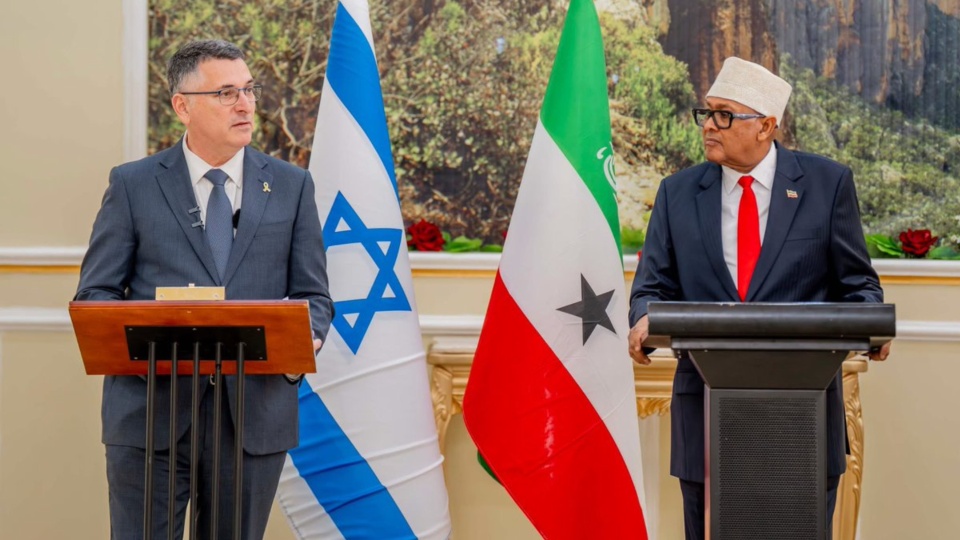
Late last month, Israel became the first country in the world to recognize the independence of Somaliland, the breakaway region of northern Somalia. In 1991, Somaliland unilaterally declared independence from Somalia in a move that was condemned by Somalia and the African Union and rejected by the international community.
Israel’s sudden recognition sent shockwaves across the international community. Somalia and the African Union rejected Israel’s diplomatic move, calling it destabilizing and illegal. The Israeli government claims that its goal is to expand diplomatic relations in the spirit of the so-called Abraham Accords, the diplomatic initiative started by U.S. President Donald Trump to normalize relations between Israel and Arab states.
There is a deep irony in the fact that Israel, a country that has occupied the Palestinian people and suppressed their independence movement—an independence movement recognized by the vast majority of countries in the world—would be the first country to recognize a breakaway state from another country. The sheer absurdity of this act set off alarm bells across the world, leading governments and analysts to the motive for Israel’s decision.
So what really is behind this shocking diplomatic move?
Most analysts and many diplomats agree that Israel’s primary interest in Somaliland lies in its close proximity to Yemen.
Since the so-called Arab Spring of 2011 and the associated uprisings in Yemen, the country has been divided by various warring factions. One of the most powerful factions is known as Ansar Allah, more commonly called the Houthis. The Houthis, backed by Iran—a country Israel and the U.S. recently fought a short but fierce conflict with—have repeatedly launched ballistic missiles at Israel and disrupted shipping headed to Israel via the Red Sea, claiming these attacks are meant to support the Palestinian resistance to Israel’s genocide in Gaza.
Somaliland lies very close to Yemen, sitting on the opposite coast of the Red Sea. According to the Israel Institute for National Security Studies (INSS), this proximity significantly improves Israel’s military position for operations against Yemen. While Israel has managed to directly attack Houthi-held cities and bases, these have been expensive, complicated, long-distance operations.
By contrast, Israel is roughly 1,000 miles away from Yemen, while Somaliland is approximately 200 miles away. INSS analysts have argued that a foothold in Somaliland would allow Israel to shorten response times, expand surveillance, and operate at far lower cost—framing the territory as a strategic asset rather than a purely diplomatic partner.
Somaliland’s position on the Red Sea also upgrades Israel’s ability to secure its shipping routes and resist Houthi attempts to disrupt this vital economic lifeline.
Beyond the direct military advantages vis-à-vis Yemen, a number of diplomats have raised other concerns about the motives behind Israel’s recognition of Somaliland.
Since Israel’s genocidal war in Gaza began in October 2023, more extreme elements in Netanyahu’s cabinet have openly spoken about emptying Gaza of its Palestinian population. To do this, they have reached out to a number of countries—primarily in Africa—to see which would be willing to take in expelled Palestinians.
Many members of the international community are concerned that Somaliland and Israel may have come to a quid-pro-quo agreement in which Israel recognizes Somaliland’s independence in exchange for Somaliland’s agreement to take in forcibly displaced residents of the Gaza Strip.
According to Reuters, several diplomats raised concerns at the United Nations that Israel’s recognition of Somaliland could be linked to efforts to find destinations for forcibly displaced Gazans, a claim Israel denies.
Taken together, Israel’s recognition of Somaliland appears less like an act of diplomatic principle and more like a cold exercise in power politics. Whether as a potential military foothold near Yemen, a means of tightening control over Red Sea shipping lanes, or a bargaining chip in Israel’s broader regional strategy amid its war on Gaza, the move reflects a familiar pattern: International law and national sovereignty are invoked when convenient and discarded when they stand in the way.
For much of the world, the question is no longer why Israel recognized Somaliland—but what price the region will pay for it.
We hope you appreciated this article. At People’s World, we believe news and information should be free and accessible to all, but we need your help. Our journalism is free of corporate influence and paywalls because we are totally reader-supported. Only you, our readers and supporters, make this possible. If you enjoy reading People’s World and the stories we bring you, please support our work by donating or becoming a monthly sustainer today. Thank you!
CONTRIBUTOR