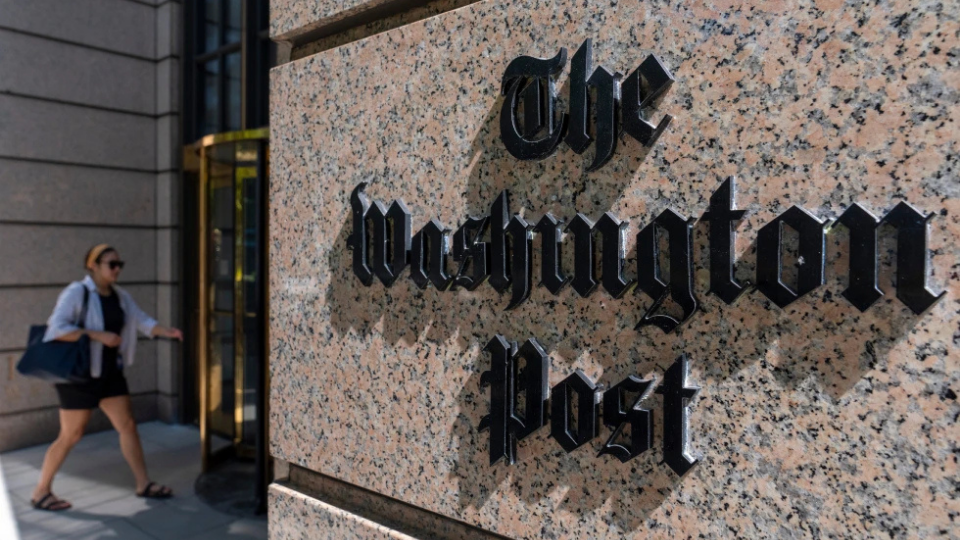
WASHINGTON —All of a sudden, there are a lot of empty desks at the Washington Post. Multibillionaire Jeff Bezos, reported to be the fourth-richest person in the world, fired a third of the newsroom staff.
The sports section is gone. The Style section, known for its bright and sometimes edgy writing, is gone. Book World, a longtime mainstay, is gone. The Metro section covering Washington D.C.—never a strong point at the paper—may be going. Nobody’s covering the Winter Olympics.
And the entire Middle East staff, including the Cairo-based editor, covering Israel’s scorched-earth war on Gaza and Gazans, is gone. So is the staff covering the Russia-Ukraine War, and a host of other developments around the world.
That’s some of the carnage Bezos inflicted on the Post newsroom on February 3, with a mass meeting, then one-line e-mails to everyone. Two-thirds were told they could “stay.” The rest were told to go.
Bezos’s newsroom hatchet is his latest ax at the leading paper in the nation’s capital. But for the last two years, danger signals that this was coming were already apparent.
The Post has been losing readers and staff, upset, disgusted, and dismayed when Bezos overruled his own editorial board in 2024 and spiked its endorsement of Democratic presidential nominee Kamala Harris. He turned its editorial and op-ed pages sharply to the right. He insisted that the opinion pages encourage “free market” economics rather than many of the social democratic, liberal, and progressive positions it had previously covered.
He is claiming that the paper is losing money, unable to keep up with rising expenses.
That claim is being challenged at mass demonstrations here today and by other news networks and lawmakers.
Commentators on MSNBC noted that just one half of one percent of his annual earnings could allow Bezos to keep the paper running for five years. Massachusetts Sen. Elizabeth Warren emphasized the financial issue in her comments on social media: “Jeff Bezos just fired hundreds of reporters at the Washington Post—including the Amazon reporter covering his own company’s accountability. Billionaire Jeff Bezos is worth $250 billion dollars.”
Other lawmakers have made comments that the move reflects decisions by Bezos and top billionaires in the country to shift their policies to strongly favor the goals of the Trump administration. Bezos no longer seems to hold to his claim that he intended to encourage freedom of the press when he first bought the paper. Underlining this, Texas Democratic Rep. Greg Casar said: “After paying $40 million for Melania’s movie, Bezos is firing Washington Post reporters who tell us actual facts all the while turning the editorial board into a voice for billionaires.”
Advocates for freedom of expression, not just in news publications, and at television and radio outlets, but on the Internet generally, see the destruction of the Washington Post as a problem across the board. In a discussion about this on MSNBC on January 4, commentators agreed that, regardless of whether one agrees with the opinions they express, outlets like the Washington Post and the New York Times generate much of the content that is discussed all over the Internet.
The Washington Post editor’s chair was once occupied by Ben Bradlee, the paper’s major-domo in its Watergate heyday of All The President’s Men 52-plus years ago. It’s seen a merry-go-round of occupants. The newsroom has had a notable exodus to other places, especially to the paper’s top competitor, the New York Times.
The impact has resulted in a skimpier paper. January 20 was typical.
The “A” section of national and international news, plus editorials and op-eds, was 18 pages in the print version. The 18-page “B” section had Style, Sports, and Metro, including a page each for weather and obits. The 6-page “C” section was all classified ads for trustee sales. And there was a weekly Local Living insert. That was all.
The Washington-Baltimore News Guild, which represents the news staff, and the Post Tech Guild, which speaks for its online group, both say Bezos’s team had “no organized recovery plan but cut-cut-cut.”
So they took to the streets in front of the paper’s current rented office in downtown D.C. at noon on February 5 for a “Save The Post” rally “in defense of both journalism and the jobs of workers.” They invited readers and former readers to join.
The demonstrations reflect the strong belief that catering to the wishes of billionaires regarding news coverage ends up as an assault on both journalists and on democracy: “The Washington Post has long been a pillar of accountability journalism,” said the Washington Post Guild. “Decisions that weaken its workforce weaken its mission. This rally is about protecting jobs, protecting journalism, and protecting the public’s right to know.”
“Strong journalism and democracy depends on strong technology,” said the Tech Guild. “Layoffs undermine the systems that support The Post’s reporting and erode the trust of readers who depend on it.”
Martin Baron, the Post’s first editor under Bezos, after a distinguished career elsewhere, told the Associated Press his former boss created “a case study in near-instant, self-inflicted brand destruction.”
The Washington Post Guild represents hundreds of journalists, designers, copy editors, ad reps, and audio and video producers. The Tech Guild’s members are software engineers, product designers, and other technology workers.
The two Guild unions urge Post leaders—Bezos especially—”to stop relying on staff cuts in lieu of a cogent business strategy.
“Post leaders must commit to transparency, invest in staff and outline a clear and sustainable plan for the future,” the Guild states.
“The future of The Washington Post is vital to readers, to democracy, and to everyone who believes facts still matter. If Jeff Bezos no longer supports that mission, then The Post and its readers deserve a steward who does.”
We hope you appreciated this article. At People’s World, we believe news and information should be free and accessible to all, but we need your help. Our journalism is free of corporate influence and paywalls because we are totally reader-supported. Only you, our readers and supporters, make this possible. If you enjoy reading People’s World and the stories we bring you, please support our work by donating or becoming a monthly sustainer today. Thank you!
CONTRIBUTOR