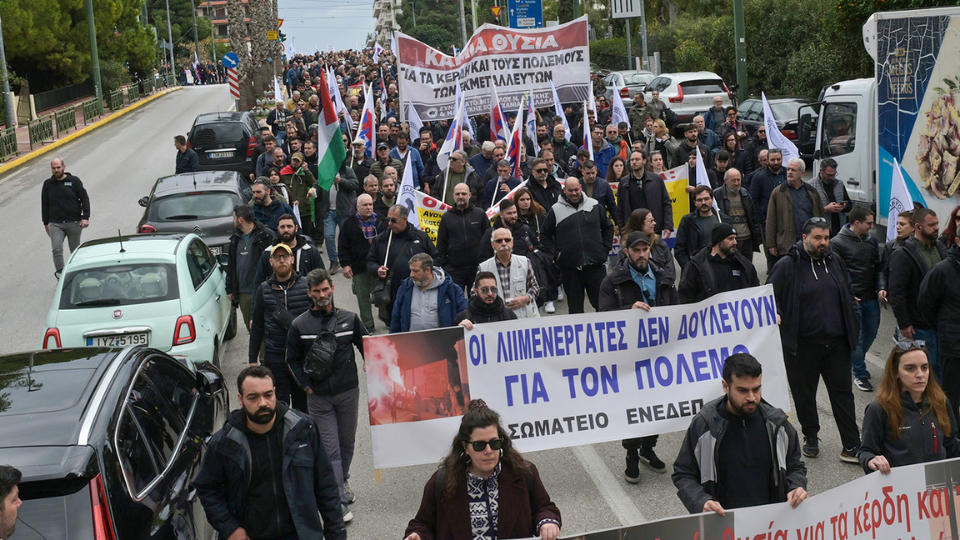
Dockworkers at 21 major ports across Europe and the Mediterranean shut down operations on Friday under the slogan “Port Workers Do Not Work for War.” The coordinated day of action, which blocked arms shipments and demanded a full trade and arms embargo on Israel, represents a significant escalation of the labor movement’s direct intervention against imperialism and genocide.
The joint action, supported by the World Federation of Trade Unions (WFTU), positioned the struggle squarely against the war economy, which the federation stated “devastates countries and their people, putting global peace at risk while eroding wages, rights, and health-and-safety protections, and worsening working conditions.” The WFTU framed the dockworkers’ strike as a rejection of complicity in the transport of weapons and a broader opposition to the militarization of society.
The demands include an immediate end to the Israeli genocide in Palestine, supported by the U.S., NATO, and the EU; the blocking of all arms shipments from their ports to Palestine and other war zones; the establishment of a stable humanitarian aid corridor; the rejection of the EU’s Re-Arm initiative; and an end to plans to militarize ports and strategic infrastructure.
According to the unions, their ultimate goal is “ensuring that European and Mediterranean ports remain places of peace, free from any involvement in war.”
The strike saw its most comprehensive expression in Greece, where the All-Workers Militant Front (PAME) and the Piraeus Regional Union called a militant 24-hour citywide strike. Their demonstration connected the fight against war directly to the class war in Greece. They marched and declared there shall be “No sacrifice for profits and the wars of the exploiters.”
The Greek unions condemned the anti-worker policies of the New Democracy government, which they hold responsible for a record year of workplace “accidents”—termed “employer crimes”—that left over 200 workers dead in 2025. They linked the domestic crisis to the global drive toward conflict, stating, “The New Democracy government, together with the other EU and NATO parties, is dragging our people into imperialist war fronts so that business groups, shipowners, bankers, in short, capital can continue to profit, calling on us to get used to coffins.”
Highlighting local dangers, the PAME pointed to the deadly fuel tanks in Perama and Drapetsona that create an “asphyxiating and extremely dangerous mix” next to homes, and connected their strike to the ongoing 50-day struggle of Greek farmers.
“Enough is enough! No more policies that gamble our lives for the profits of the few!” they said.
The transformation into a war economy, they argued, using funds stolen from workers’ insurance, “will be used for imperialist rivalries.” For workers, this means “greater intensification of labor, deeper exploitation, flexible contracts, 13-hour workdays, injured workers, and people deprived of access to health care and education,” they said.
In Italy, the Unione Sindacale di Base (USB) reported that the international day of action achieved concrete results, blocking four cargo ships bound for Israel from docking.
“This event demonstrates how international solidarity and mobilization among workers can block the logistics of war and genocide,” the union stated. They emphasized that the fight against war is inseparable from defending “dockworkers’ wages, working conditions, health and safety, and pension rights.”
The union celebrated the participation of tens of thousands across ports from Bilbao to Hamburg and in 12 Italian cities, stating, “We have chosen to emphasize the role that labor and workers can play in order not to be complicit in this infernal mechanism and to halt the militaristic drift of our continent.”
The USB marked the February 6 joint actions as a historic starting point. The fact that so many workers demonstrated and demanded that their labor would not be weaponized for genocide and imperialist profit across the Mediterranean ports in such a demonstrable way was seen as a victory for working peoples’ struggles.
“Power lies with the workers,” the PAME said. “The solution lies in organized struggle, solidarity, and confrontation with employers and their state. For us to win, they must lose.”
We hope you appreciated this article. At People’s World, we believe news and information should be free and accessible to all, but we need your help. Our journalism is free of corporate influence and paywalls because we are totally reader-supported. Only you, our readers and supporters, make this possible. If you enjoy reading People’s World and the stories we bring you, please support our work by donating or becoming a monthly sustainer today. Thank you!
CONTRIBUTOR