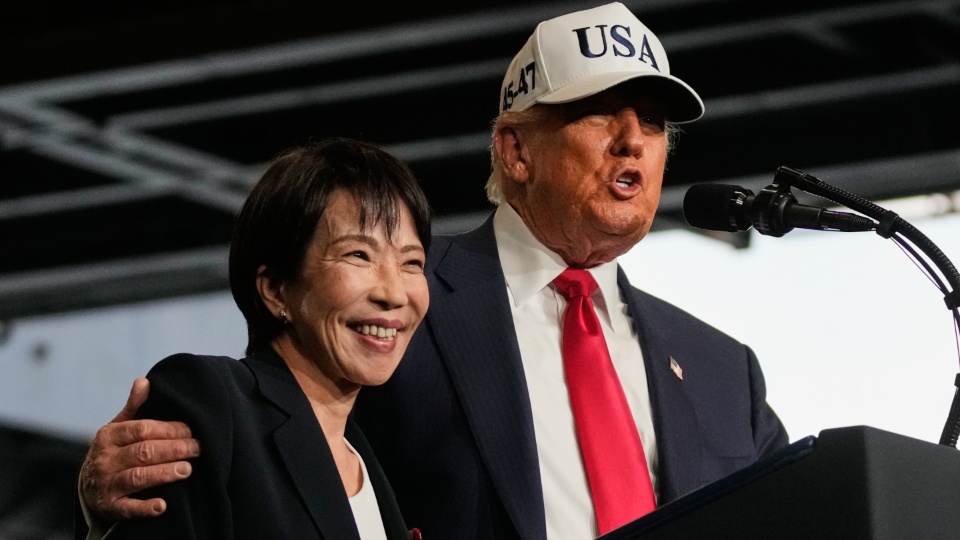
A day after scoring a landslide victory in parliamentary elections, Japanese Prime Minister Sanae Takaichi made clear her intention to move ahead with revising the country’s constitution to clear the way for a large-scale military buildup.
Takaichi has Article 9 in her sights, a clause which outlaws war as a means to settle international disputes. Adopted after Japanese imperialism was defeated in World War II, Article 9 has long limited the size of the nation’s armed forces and restricted them to a self-defense role.
The Feb. 8 snap election was called by Takaichi just three months after she became leader of the Liberal Democratic Party (LDP), which captured 316 out of 465 seats in the House of Representatives. This gives the LDP control of the national agenda and returns the country to its status as a de facto one-party state.
Combined with the 36 seats won by her allies in the far-right Japan Innovation Party, Takaichi now commands a 352-seat supermajority—a margin that will make it difficult for opposition parties to restrain her.
Militarist revival
At a press conference the morning after the vote, Takaichi said she will hold “a national referendum to amend the constitution as soon as possible.” During the election campaign, she expressed her personal support for revising Article 9, but the scale of her win emboldened the LDP leader to openly declare her goal.
The prime minister also indicated her intention to completely overhaul the security apparatus of the state “to establish a system to strategically protect national interests.” That includes establishing a new spy outfit, the National Intelligence Agency, and initiating a massive increase in military spending.
Her policies have the backing of U.S. President Donald Trump, who congratulated Takaichi and wished her “Great Success in passing your Conservative, Peace Through Strength Agenda.” His administration is happy to have a solid ally in its Cold War against China. Treasury Secretary Scott Bessent hailed the election outcome as a win for the U.S., saying, “When Japan is strong, the U.S. is strong in Asia.”

In her press conference, Takaichi said Japan will “prepare for a long-term war” and explore “new ways of fighting, including the mass deployment of drones.” The aggressive posturing continues the confrontational stances she adopted upon taking office late last year. She threatened Japanese intervention in November if China ever takes steps to reunify with Taiwan by military means.
Her remarks sparked a diplomatic crisis, prompting China’s government to pledge it would “resolutely prevent the resurgence of Japanese militarism.” From 1895 to the end of World War II, Japan colonized Taiwan as part of its effort to build an empire stretching across East Asia.
Takaichi and others in the LDP have long sought to rewrite the history of Japanese imperialism in order to make rearmament more feasible among the public. Over 30 million people were killed by Japanese forces from 1931 to 1945, the bulk of those in China, but LDP leaders have regularly downplayed atrocities and rehabilitated war criminals. These acts of historical revisionism have angered countries across the region.
Japanese capitalism’s long slump
Promises of a massive military stimulus weren’t necessarily what propelled Takaichi to office, though. Rather, it was voters’ hopes that she will be able to turn around the Japanese economy’s decades-long stagnation.
After the bubble of Japanese expansion burst in the 1980s, capitalism in the country went into sharp decline, with profits from the real economy no longer able to prop up the accumulation of fictitious values in real estate and stock prices.
Over the next 30-plus years, Japanese corporate profits—and workers’ wages—struggled. During this period, successive LDP governments tried reviving the economy through neoliberal approaches (like suppressing wage levels and cutting social benefits) while also subsidizing so-called “zombie” corporations through multiple bailouts.
The stable employment that defined the postwar reconstruction years was replaced by precarious, low-wage work and scaled-back health care. This underinvestment in the working class helped fuel a demographic collapse, with the Japanese birthrate declining to one of the world’s lowest.
All of this was presided over by the LDP, which makes its overwhelming victory appear perplexing at first glance. But Takaichi—the first woman to lead the party—has been able to successfully cast herself as a break from the “old men of the past” who have led the country.

Her promises of restoring economic growth particularly won over the support of younger voters, who are fearful for their future. They pay ever-higher taxes and social insurance to support an aging population but have little expectation that there will be any financial security for themselves.
That’s why Takaichi’s pledges to cut taxes on necessities like food, raise income tax threshold levels, and expand cost-of-living tax deductions appealed to both young families strapped for cash as well as retirees who see their own children facing a bleaker future than what they themselves experienced during their working life.
How long the public optimism will last is unclear, however. Much of Takaichi’s agenda will require Japan’s heavily-indebted government to borrow even more money from international bond-holders, and the bulk of her promised tax cuts will accrue to Japan’s wealthiest. Meanwhile, her Trump-like obsession with lowering interest rates will only further fuel inflation and put a tighter squeeze on working-class paychecks. And the spinoff benefits of militarization for the average Japanese family are unlikely to materialize, although weapons makers could see a windfall.
Furthermore, despite the LDP’s promises to invest in AI and boost exports, the longstanding problems faced by Japanese capitalism are not fundamentally addressed by her agenda.
Voter desperation
But for now, Japanese voters are desperate for relief, and among the options available, more than half chose Takaichi or her far-right coalition partners. That leaves the few working-class and progressive opposition parties that are still standing to face an uphill battle.
The ideologically eclectic and populist left-liberal Reiwa Shinsengumi party holds a single seat in the new House, down from the nine it held before the election. It was essentially obliterated, recording its worst result ever.
The Japanese Communist Party (JCP) also suffered a steep decline. Its caucus was cut in half, leaving a foothold of only four members in the House of Representatives. According to data released by the party’s Executive Committee, the JCP vote count fell from 3,362,000 in the last election to 2,519,000 this time around.

The party centered its campaign on what it called the “two distortions” of LDP politics: subservience to the United States and catering to the desires of big business. JCP Chairperson Tomoko Tamura, who was re-elected to her Tokyo Diet seat, said the election results should “not be read as a vote of confidence from the public in the content of Takaichi and the LDP’s politics.”
She said that the LDP, corporate media, and other far-right parties created a “Takaichi whirlwind” in the press and online that kept people focused on her economic promises and boosted her anti-immigrant rhetoric but left the true intent of her policies unexamined. The centrist parties, meanwhile, contributed to this by tailing Takaichi with right-wing platforms of their own.
At the same time, Tamura said the JCP must also examine itself to explain its serious setback at the polls. “We will listen carefully and learn from the voices of those both inside and outside the party and will conduct a thorough self-examination in all aspects,” she said.
The JCP Executive Committee said that the party must return to its “founding principle of alleviating the suffering of the people” and intensify members’ study of “scientific socialism,” or Marxism.
Takichi’s war-footing has already given the Communists their first assignment, though, which Tamura acknowledged. She recalled the 2001 election, when constitutional revision was the primary goal of another LDP prime minister, Junichiro Koizumi. In the wake of that vote, Article 9 Associations were formed across Japan to defend the anti-war constitution.
It’s time to revive them, Tomoko said. “We will do our utmost to expand the movement to save Article 9 and not allow the destruction of the people’s lives.”
We hope you appreciated this article. At People’s World, we believe news and information should be free and accessible to all, but we need your help. Our journalism is free of corporate influence and paywalls because we are totally reader-supported. Only you, our readers and supporters, make this possible. If you enjoy reading People’s World and the stories we bring you, please support our work by donating or becoming a monthly sustainer today. Thank you!
CONTRIBUTOR