Located in the North Atlantic, Iceland is one of the Nordic nations. So, a Yankee Doodle Dandy moviegoer could be forgiven for (stereotypically) expecting Icelandic cinema to be in the probing, dour tradition of that Swedish master, Ingmar Bergman. For the most part, the Swedish auteur’s films, like 1974’s searing Scenes from a Marriage, starring Liv Ullmann, were shot in a naturalistic style. Bergman’s brooding movies could also be full of metaphors, such as his masterpiece, 1957’s metaphysical The Seventh Seal, about a medieval knight (Max von Sydow) playing chess with the Grim Reaper in order to forestall his death.
The contents of Hlynur Pálmason’s The Love That Remains are certainly Bergmanesque, with its philosophical focus on existential angst and the conflict between alienated men and women. Indeed, this109-minute film, mostly in Icelandic with some spoken English and English subtitles, could be called “Scenes from a Separation.”
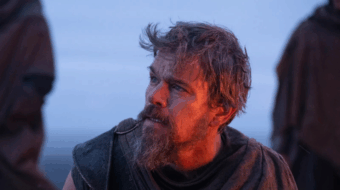
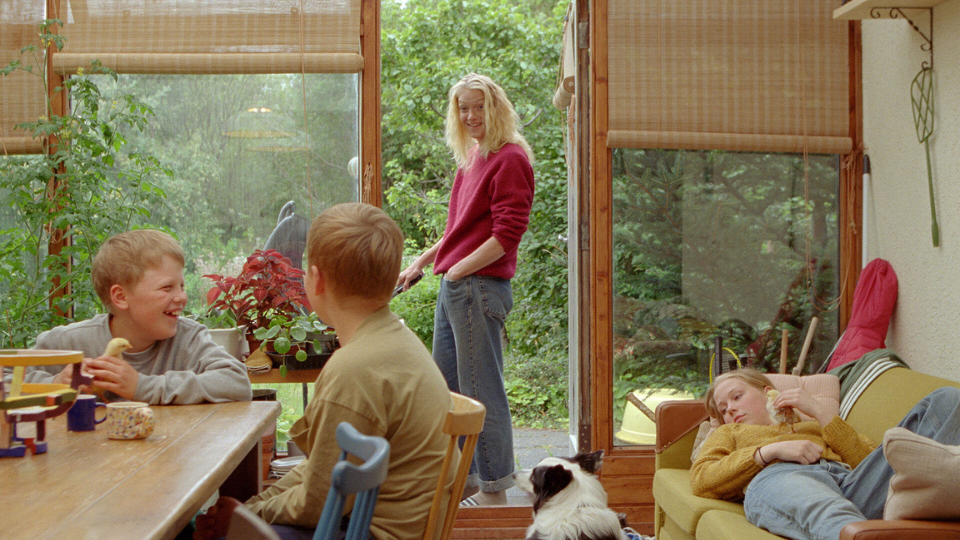
Magnús (Sverir Gudnason) is a fisherman who works on a trawler that fishes on an industrial scale (with nets that dredge up more herrings in one plunge than have ever been served at Canter’s Deli). Maggi (as he’s called) is estranged from his wife, Anna (Saga Garðarsdóttir), an aspiring painter. They are the parents of a teenage daughter and two sons around 10 years old (who may be twins), who live with their mother and Panda (a sheepdog so named, presumably, because like the eponymous bear he is black, white and adorable; the cute canine won the “Palm Dog” at the Cannes Film Festival) in a rustic house at what appears to be a rural, remote part of Iceland. 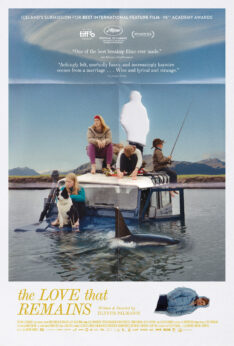
Whenever Maggi returns to shore, he visits his family as much as possible. The deep-sea fisherman clearly wants to get back together with Anna, but she always declines his sexual overtures, as she does with another would-be suitor. Why Maggi and Anna split up is never explained, nor is her refusal to be reunited with her onetime husband. It’s also a mystery as to what the nature of their relationship is: Were they ever actually legally wed? If so, are they now divorced or separated? Inquiring minds may want to know, but like Anna, Pálmason doesn’t kiss and tell.
This ambiguity organically ties into the movie’s mode. Although much of the award-winning The Love That Remains is realistic, like Bergman’s films formally are, Pálmason also pursues a whimsical, cinematic style akin to that of Luis Buñuel, the Spanish maestro known for his surrealist approach, from his early films co-made with Salvador Dali like 1929’s An Andalusian Dog to 1967’s Belle de Jour to 1972’s The Discreet Charm of the Bourgeoisie. And it is the often dreamlike tack Pálmason takes that enlivens this account of a frayed relationship, and which I enjoyed most about this offbeat film.
Pálmason’s symbolism ranges from the Freudian to the Jungian. One scene features a gigantic rooster, an obvious reference to an overbearing male libido. In another sequence, while the parents are picnicking with their children in the Icelandic outback, Anna walks over Maggi’s head. Still filled with desire for his wife (or ex-wife or whatever), he looks up at her panties, and blinding sunlight fills the screen. I don’t recall ever seeing a better symbolic evocation of heterosexual males’ longing for and worship of female sexuality on the silver screen.
Another scene depicts a character (perhaps it’s Anna?) wearing a suit of armor, which may be a symbolic reference to psychoanalyst Wilhelm Reich’s theory of body and character armor. In another surreal vignette, the forlorn fisherman Maggi, who yearns to be reunited with his wife and children, remains unfulfilled, and he’s quite literally adrift. Unlike Anna, Maggi can’t let go.
Anna, who is in her late thirties, is a resourceful, outdoorsy person, independent, and also a loving mother (if not mate, for whatever reason). In my opinion, she is by far the most interesting character in The Love That Remains. In addition to mothering her children, she creates a unique, elemental art form that incorporates sculptural shapes on canvas that seem to reflect Iceland’s indelible landscape, which is an organic part of this film’s dramatis personae. An undiscovered talent, at one point, a Swedish art dealer flies to her distant, almost arctic outpost in a puddle jumper (that gives him pause), but after she reveals her original artwork to the gallery owner, all this weeny can whine about is wine, not her singular oeuvre. This encounter encapsulates what artistes have to endure when contending with the philistine forces of commerce.
The Love That Remains poses more questions than it answers and is for the more adventurous moviegoer, who enjoys his/her cinema to take a walk on the wild side. I enjoyed riding the surreal surf and seeing eye-popping Iceland—which I’d only previously glimpsed from afar, ensconced in the seat of a jet—close-up and personal. Pálmason’s picaresque picture is filled with whimsy, sly wit, and surrealistic panache.
We hope you appreciated this article. At People’s World, we believe news and information should be free and accessible to all, but we need your help. Our journalism is free of corporate influence and paywalls because we are totally reader-supported. Only you, our readers and supporters, make this possible. If you enjoy reading People’s World and the stories we bring you, please support our work by donating or becoming a monthly sustainer today. Thank you!
CONTRIBUTOR