

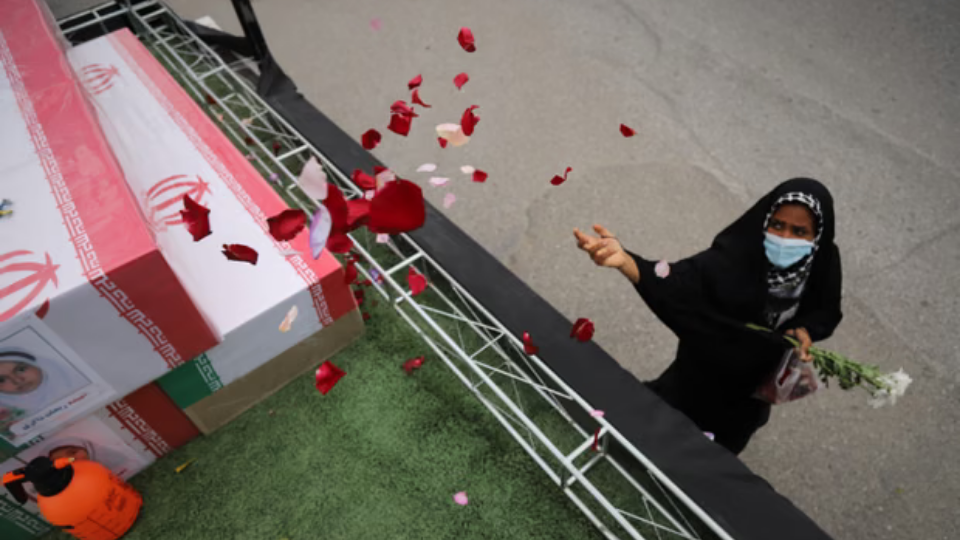
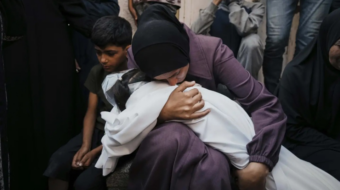
In an era when images can circle the globe in seconds, and newsrooms claim to uphold universal humanitarian principles, one might expect the killing of 165 children inside a primary school to dominate international headlines. One would expect emergency debates, moral outrage, and relentless coverage. Yet in the southeastern Iranian city of Minab—where Israeli-American strikes obliterated classrooms filled with children—the world’s most influential media institutions have responded with something far more revealing than condemnation: they have responded with silence.
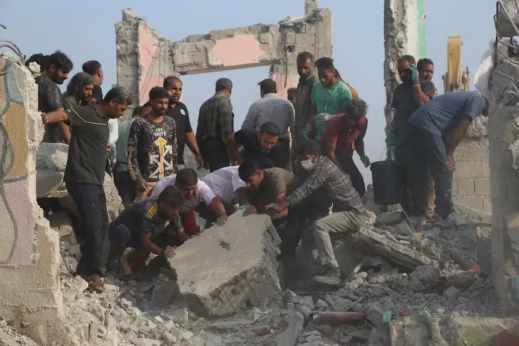
These were not combatants. They were not militants. They were children seated at their desks, pens in their hands, notebooks open before them, studying, whispering to classmates, and imagining futures that stretched decades ahead. In seconds, that ordinary school day turned into a massacre. Desks became splintered wreckage, classrooms collapsed into dust, and rows of coffins replaced rows of pupils.
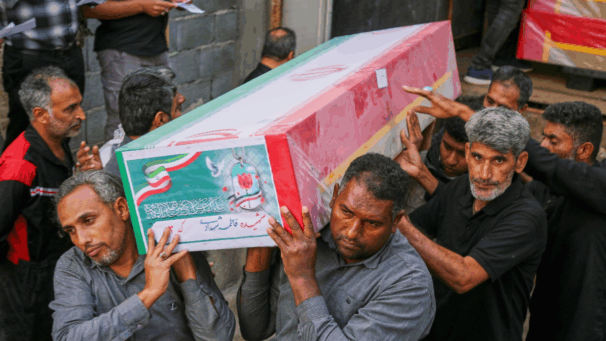
Yet the names of these girls—165 lives extinguished before they truly began—barely entered the global conversation.
This omission is not the product of oversight. It reflects something far more structural: the hierarchy of victims that governs much of the contemporary information order. In theory, modern Western media institutions present themselves as defenders of human rights and guardians of moral accountability. In practice, their editorial priorities often mirror geopolitical interests with striking precision.
When tragedies reinforce established narratives about adversarial states, they are amplified, dramatized, and transformed into global moral spectacles. But when tragedies expose the human cost of the military actions carried out by Western powers or their closest allies, they are quietly displaced from the front page—if they appear at all.
The massacre in Minab illustrates this logic with devastating clarity.
The deaths of 165 Iranian schoolgirls do not fit comfortably within the dominant geopolitical storyline that portrays Israel and its strategic partners as defenders of stability and order in a turbulent region. Acknowledging such an atrocity would inevitably raise difficult questions: about the legality of strikes on civilian infrastructure, about the ethics of military escalation, and about the widening humanitarian toll of ongoing Israeli-American attacks across the region.
It is therefore far easier to look away.
But Minab is not an isolated tragedy. Across Lebanon, relentless bombardments have repeatedly struck civilian neighborhoods, reducing homes and streets to rubble. Across Palestine, entire communities have endured cycles of destruction that claim the lives of children whose only battlefield was the ground beneath their feet. Hospitals, schools, and residential blocks have all entered the expanding geography of devastation.

These events do not occur in a vacuum. They form part of a broader pattern in which military power operates alongside narrative power. Missiles shape the physical battlefield, while selective reporting shapes the battlefield of perception.
What emerges is not merely a media bias but a form of narrative engineering. Certain victims are elevated as symbols of universal suffering, while others—often far more numerous—are rendered invisible. Compassion itself becomes curated, distributed unevenly according to political convenience.
For Western audiences accustomed to believing in the neutrality of their information systems, this selective visibility should provoke serious reflection. The credibility of humanitarian discourse depends on consistency. When the deaths of children generate outrage in one context but indifference in another, the moral language surrounding human rights begins to lose its integrity.
The girls of Minab deserved the same recognition afforded to any victims of violence anywhere in the world. They deserved to have their stories told, their lives acknowledged, and their deaths confronted with the seriousness such an atrocity demands. Instead, they encountered a second form of erasure.
First came the missiles that ended their lives. Then came the silence that followed.
In the contemporary information age, propaganda rarely announces itself openly. It often operates through absence—through the stories that never reach the front page, the victims whose names remain unspoken, and the tragedies that disappear before the world has time to notice.
The massacre in Minab, therefore, stands as more than a local catastrophe. It exposes a deeper crisis in the global information order—one in which the value of human life appears disturbingly contingent on political context. And if the deaths of 165 schoolgirls in their classrooms fail to trigger universal outrage, the question is no longer about geopolitics alone.
It becomes a question about the credibility of the moral system that claims to defend humanity itself.
As with all news-analysis and op-ed articles published by People’s World, the views reflected here are those of the author.
We hope you appreciated this article. At People’s World, we believe news and information should be free and accessible to all, but we need your help. Our journalism is free of corporate influence and paywalls because we are totally reader-supported. Only you, our readers and supporters, make this possible. If you enjoy reading People’s World and the stories we bring you, please support our work by donating or becoming a monthly sustainer today. Thank you!
CONTRIBUTOR


MOST POPULAR TODAY

Warnings sound: Trump ready to stage what amounts to a full-fledged coup

Redistricting leader Louise Lucas indicted as Trump’s revenge campaign widens


NEA, AFT, SEIU join Colorado to fight discrimination against LGBTQ people

Cuba solidarity: HotHouse delegation to combine cultural exchange with humanitarian aid