

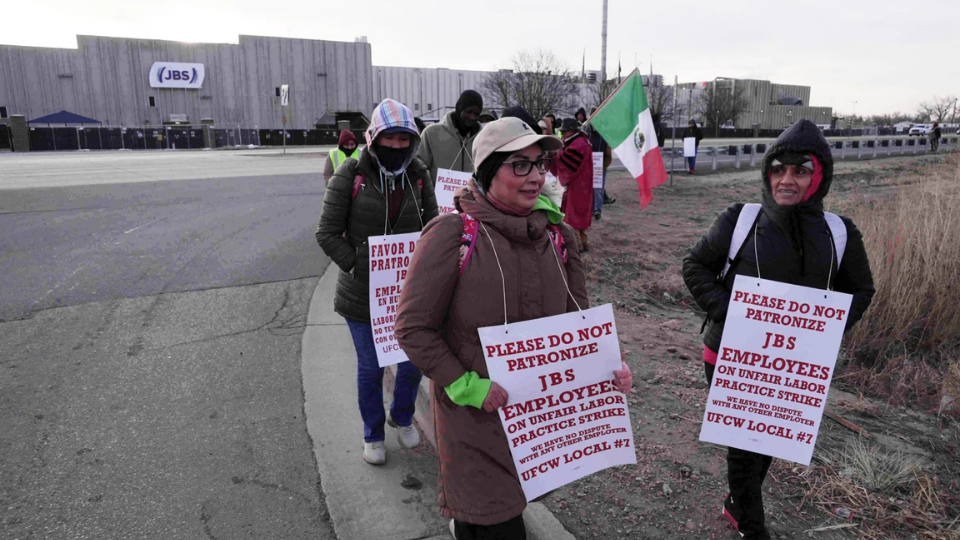
GREELEY, Colo.—In the first major strike in 40 years, meatpacking workers are walking off the job after voting 99% to authorize strike action against JBS Foods. By Monday, nearly 4,000 members of United Food and Commercial Workers (UFCW) Local 7 were out on strike.
JBS is the largest meat monopoly on the planet with 132 processing facilities, 109,000 workers, and plants in nine countries, including over 72,000 workers in the U.S. In June 2025, the company went public on Wall Street with an opening valuation of roughly $30 billion, which outpaced its rival, Tyson Foods.
“This is an historic moment in time to see workers come out like this,” said Kim Cordova, president of UFCW Local 7. “It’s a real showing of worker power.”
Workers at JBS’s U.S. beef plant had enough after months of what the union called bad-faith bargaining and poor working conditions by the global meat monopoly. They have continued working on an expired contract since last July and have met with the company more than two dozen times, the union said, only to watch negotiations collapse over safety, wage theft, and living wage issues.
“This strike authorization is the direct result of JBS’s unlawful and bad-faith conduct,” Cordova said. Over the course of bargaining, the union has filed multiple Unfair Labor Practice (ULP) charges against JBS, saying the company retaliated against workers who stood up for their rights and threatened to withhold bonuses and pension payments if workers went on strike.
“The industry hasn’t had a labor dispute for a very long time, and it’s because they hire a very vulnerable workforce and the expectations are they keep their heads down,” Cordova told the Guardian. “They’re doing the work frankly no one in this country wants to do.”
The union said JBS has even been charging many workers $1,100 or more for their own protective equipment required to perform their jobs safely. Meanwhile, the company’s proposed wage increases for its workers who generate its profits come in at less than 2% per year on average. On health care costs, they increased 22 cents an hour, Cordova said.
“Those folks got an 8-cent increase. That’s not going to work for us.”
“The difference between the union’s wage offer and the company’s last, best, and final offer was an average of approximately $30,000 per week for the entire plant over the life of the agreement,” the union noted, which is a paltry amount compared to the massive profits generated at this one plant alone.
They also said the company has severely increased speed-up at the plant—processing 430 animals per hour, up from 390—which is pushing workers to their breaking point and increasing exploitation. For instance, the line now runs at “unprecedented speeds,” said workers there, a large number of them Haitian, with cattle coming down the line every ten seconds for 10 hours straight. It’s reminiscent of Upton Sinclair’s The Jungle in the 21st century.
That’s why in late 2024, a Haitian worker sued the company, saying on shifts where Haitian workers were concentrated, they were denied bathroom breaks while the line ran at breakneck speed.
The worker, who, like hundreds of other Haitian workers at the facility, is responsible for removing fat from beef as it moves along the production line, said he was forced to work at such extreme speeds that he couldn’t even release his hand from his hook for a single moment during his shift. Due to the stress injury, his left hand is now locked in a clawed position.
Furthermore, the U.S. Department of Labor ordered JBS to pay $4 million after investigations revealed the company’s contractors employed children as young as 13 performing dangerous overnight cleaning shifts at their plants in multiple states. The children worked with potent chemicals and hazardous tools, including head splitters. Some showed up to school with chemical burns.
Essential Workers for Democracy (EW4D), the union’s reform caucus, is supporting the strike by encouraging UFCW members around the country to show solidarity with the meatpacking workers with signs at grocery stores across the country. In a recent newsletter mailing to union members, the reform group detailed just how corrupt JBS actually is:
“Over the years, JBS has paid out millions of dollars in court settlements over illegal price fixing,” EW4D said. “In just the last year, JBS has paid a collective $100 million in settlements for breaking federal antitrust laws, creating higher beef prices for consumers.
“On top of that, JBS just paid $55 million in a $200 million meatpacking industry settlement over employer collusion to illegally repress worker wages.”
UFCW Local 7 was firm that the workers remain ready to negotiate, but they will not cave. They’ll be on the picket lines fighting for as long as it takes to secure their just demands and dignity, they said.
The strike is the first at a U.S. meatpacking plant since workers walked out at a Hormel plant in Minnesota in 1985. That strike was a bitter fight that included the National Guard being sent in to protect the strikebreakers. Whether JBS workers will face similar repression remains to be seen.
We hope you appreciated this article. At People’s World, we believe news and information should be free and accessible to all, but we need your help. Our journalism is free of corporate influence and paywalls because we are totally reader-supported. Only you, our readers and supporters, make this possible. If you enjoy reading People’s World and the stories we bring you, please support our work by donating or becoming a monthly sustainer today. Thank you!
CONTRIBUTOR

MOST POPULAR TODAY
Warnings sound: Trump ready to stage what amounts to a full-fledged coup
Workers walk: Almost 100K California employees struck for a day
Grenada marks 40 years since the assassination of revolutionary leader Maurice Bishop

Cuba solidarity: HotHouse delegation to combine cultural exchange with humanitarian aid