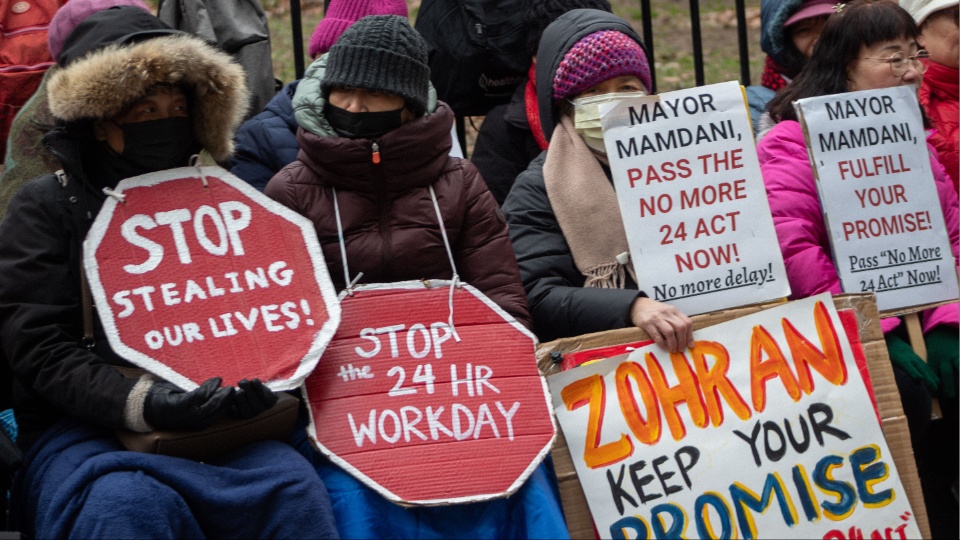
NEW YORK—Home care workers launched a sit-in at City Hall on March 18 demanding that Mayor Zohran Mamdani uphold his campaign promise to support the passage of Int 0615-2024, known as the “No More 24” bill, which would abolish 24-hour workdays they toil under. The sit-in was announced on International Women’s Day when home care workers rallied at City Hall to pressure the City Council to put the bill to a vote before the budget season.
The home care workers, organizing with the Chinese Staff and Workers’ Association, began seating themselves outside the black metal fences of the City Hall courtyard at 9am. All came with the warmest jacket or coat they own; most covered themselves in extra sleeping bags and blankets as the wind became harsh. Between chants and speeches, some Chinese women would sing general strike songs in Mandarin. Other Latine women thanked allied organizers in Spanish as coffee and bagels arrived. Underneath the excitement was a tense air. They were all waiting.
That Wednesday, they waited for news of the “No More 24” bill’s submission to the council for a vote, as they planned to continue the sit-in until it was passed. The next day, they waited for a visit from City Council Speaker Julie Menin to explain herself—the bill was never submitted.
One battle after another
The “No More 24” bill, and its preceding variations, was repeatedly blocked from the council floor each time it was brought forward in the last four years. With legislative hostility from former Speaker Adrienne Adams, lobbying from SEIU 1199, and a multi-front opposition from the Chinese American Planning Council (CPC), home care workers were left with no means of meaningful restitution apart from a $30 million settlement, a concession won by SEIU 1199 but which fell short of the $90 million in stolen wages owed to both union and non-union home care workers.
SEIU 1199, which represents unionized workers in the sector, has said it agrees with the intention of the No More 24 bill but believes that fully implementing it would require at least $460 million in further Medicaid funding, a problem it says only the state legislature can address. Otherwise, ending the current 24-hour shift system without paying for more workers to cover the gap would leave patients without care.

Zohran Mamdani’s mayoral inauguration earlier this year signaled a possible opportunity for movement on the bill. In 2024, Mamdani spoke at a home care workers’ picket as an assemblyman and promised to pass the No More 24 bill, sponsored by his colleague, Councilmember Christopher Marte, if elected mayor. Mamdani also co-sponsored an assembly bill which sought to abolish the 24-hour workday on a state level, though the bill ultimately died in committee in 2022.
Another breakthrough came when SEIU 1199 agreed to support an amended version of the bill which increased the cap on weekly hours from 50 to 56, a compromise made so that home care workers are “not working back-to-back 12-hour shifts, and [are also] not working 12-hour shifts seven days a week.” Everything seemed to fall into place when Marte spoke with home care workers and organizers before the sit-in, assuring them of Julie Menin’s newly won support for the bill.
Save the amendments agreed to with SEIU 1199, the No More 24 bill remains the same. Weekly hours (56 maximum) would be “limited to 12 hours for any shift,” abolishing the 24-hour workday. It would allow additional hours during emergencies, “but no more than 2 per day or 10 per week.” For a worker to be assigned more than 56 hours in a week, an employer would have to provide two weeks’ advance notice and obtain written consent from the worker in question. The act would “impose a notice requirement,” requiring employers to provide workers with “a copy of a form notice of rights.”
However, on the first day of the sit-in, Documented published an article which revealed—through anonymous sources—that Mamdani decided to oppose the No More 24 bill. The mayor’s office has reportedly now moved to block the bill’s passage due to a concern for “significant legal challenges, “negative implications for workers and patients,” and a potential conflict between state and city law.
First impressions
Menin and Marte walked through the City Hall gates as organizers with Youth Against Sweatshops (YAS) prepared the crowd, still spread out along the sidewalk. The workers were restless for answers and quickly came toward the platform when Marte began to speak. He gave a brief introduction and allowed Menin to explain the situation to the working women, now shoulder-to-shoulder with each other.
Menin’s announcement did little to quell their frustration, however. After a few usual proclamations of recognition for the home care workers’ struggle and a desire for collaboration, she said that the bill would be presented soon and stepped off the platform.
The crowd was quiet for a few seconds. A few hesitantly shouted “When?” The rest immediately followed. Menin grew visibly anxious and seemed unprepared for this outcome. The home care workers quickly moved from the platform and began to gather around her. With several cameras and phones pointed toward her, Menin tried to repeat similar lines from her platform speech given moments earlier. The crowd continued to ask for clarification: “But when?” “What does that mean?” “You’re being too vague!”
Menin responded, “Very soon! Very soon.” She and Marte tried to assure those workers closest to them, saying “We’re almost past the finish line.” Menin didn’t seem to understand when one of the workers tried to speak directly. The woman, though with an accent, spoke with an intonation characteristic of a question. Menin kept her smile and instinctively replied, “Very good, very good.”

Marte tried to interject again. “We’re working on it, we’re working,” he said, but the people still appeared dissatisfied. Marte moved toward Menin and told her something unintelligible to bystanders. Menin then announced to the crowd that the bill would be submitted “with no changes.”
The women became ecstatic. They shook Menin’s hand as Marte began a chant they enthusiastically followed, “Menin! Menin! Menin! Menin!” The air lightened; the home care workers had just heard, face-to-face from a city council member, that they would finally have victory.
“Zohran Mamdani, keep your promise!”
The news spread to the others further away in the crowd. They told each other about the promise that there would be “no changes,” and the additional assurance given by Marte soon after that the bill would be submitted in April. A possible neutering of the bill was among the worst possibilities in the minds of organizers and home care workers alike, however. Now that SEIU 1199 and Menin had officially vocalized their support, one obstacle remained: former ally Zohran Mamdani.

The crowd’s reinvigoration only exacerbated their now sharpened focus on the mayor. Loud chants returned to the sit-in as home care workers shouted in unison: “Mayor Mamdani, keep your promise,” and later shouted the same chant translated to Mandarin. Someone took the stage and demanded: “Come out, Mamdani! Don’t do this behind the scenes. Mamdani is trying to play a trick. He doesn’t want to come out and say anything, but he’s playing a dirty game.”
To the end
In conversation with People’s World, Marte expressed optimism for the weeks ahead:
“I’m feeling optimistic. I think it shows the difference between the previous speaker and this speaker. Adrienne Adams refused to meet with the workers when they did their hunger strike. So, it made me optimistic that our speaker, Julie Menin, came out, talked to the workers, and engaged with the workers.”
On Mamdani and his apparentdeparture from his campaign promise to support the No More 24 bill, Marte spoke with similar hope, briefly saying: “I think he cares about the worker. I know he understands the issue, and it would be great to have his support.”
Ultimately, the outcome of the home care workers’ struggle rests on the workers themselves. It only took one day to compel the speaker of the council to address their presence. Such a victory now manifests as a rejuvenation of the workers’ organizing longevity, noticeably common among the working women as they packed up and returned home in the afternoon.
“I think we can all see [that] the light at the end of the tunnel is making sure that we just punch through. It’s great that the speaker said we’re going to get this to the finish line. I think we have to keep on working, don’t take it for granted. There’s still going to be a lot of special interests that want to stop this, but we can’t let that happen,” Marte affirmed.

Marte’s concern for “special interests” is not uncommon in the effort to pass the No More 24 bill. Just a few weeks ago, Mamdani attended the Chinese American Planning Council’s (CPC) Lunar New Year Gala despite a picket outside. The CPC, along with the Museum of Chinese in America (MOCA) and the United Jewish Council (UJC), has been a target of weekly informational pickets by home care workers due to what they see as its unmatched exploitation over more than two decades of as an employer.
To these women, almost all of whom are immigrants whose bodies face routine and traumatic deterioration from 24-hour work days, Mamdani’s attendance decisively cancelled out his attendance at another more than two years ago. The home care workers of New York City, organized workers both inside and outside the traditional unions, decisively demonstrated their resolve to maintain the struggle against if Mamdani does not return to Chinatown’s patch of the grassroots. Thus follows the mayor’s second chance to decide: Which side are you on?
We hope you appreciated this article. At People’s World, we believe news and information should be free and accessible to all, but we need your help. Our journalism is free of corporate influence and paywalls because we are totally reader-supported. Only you, our readers and supporters, make this possible. If you enjoy reading People’s World and the stories we bring you, please support our work by donating or becoming a monthly sustainer today. Thank you!
CONTRIBUTOR