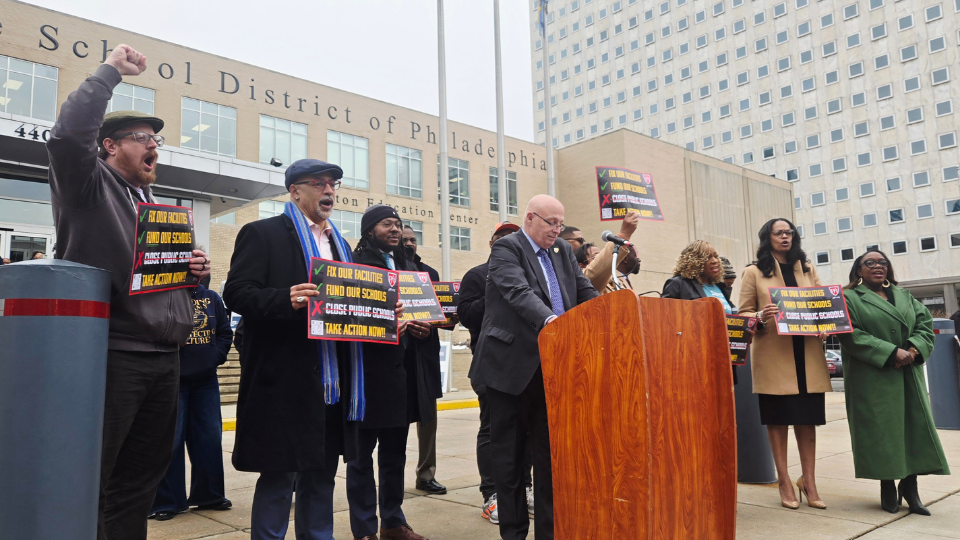
PHILADELPHIA—Outside the February Monthly Action Meeting of the Philadelphia School Board, unions representing Philadelphia School District employees rallied in opposition to a proposed plan that would see more than a dozen school closures.
Philadelphia Federation of Teachers (PFT3), Unite Here Local 634, Teamsters Local 502 (CASA), SEIU 32 BJ, and School Police Association of Philadelphia (SPAP) outside of the meeting condemned the 10-year Facilities Master Plan (FMP) presented by Superintendent Dr. Tony Watlington Sr. The previous iterations of the proposal presented a closure of 20 schools. By the end of the evening, the final version of the FMP proposed 18 schools instead, with Russell Conwell Middle School and Motivation High School removed from the closure list.
The coalition of unions supporting the rally represents a wide diversity of school employees. PFT3 represents teachers and counselors; Unite Here Local 634 represents school cafeteria employees and climate staff; CASA represents administrators; 32 BJ represents maintenance and operations; and SPAP represents school safety officers.
Unlike many surrounding school districts, the Philadelphia School Board is appointed, not elected. Philadelphia is one of only two school boards in Pennsylvania that are appointed without elections. This adds another layer of struggle to the battle between the FMP and the people of Philadelphia, who appear to have no semblance of democratic representation on the board.
At the following School Board meeting—a Town Hall meeting on March 12—the headquarters became so packed that overflow spaces were required. The struggle for fair educational plans only heightened with Mayor Cherelle Parker’s announcement of the FY2027 budget. Though PFT3 voiced support of Mayor Parker’s proposal to use rideshare fees to fund millions for public schools annually, President Arthur G. Steinberg brought the focus back to the FMP, stating, “The Facilities Master Plan as currently constituted will drive students and educators out of the District… As the City is poised to rename a street for a giant of education equity—the late Superintendent Dr. Constance E. Clayton—we are called to remember that ‘every school’s a good school.’”
Superintendent Watlington Sr.’s solution to the school budget challenges, which include a $300 million structural deficit, is to cut $225 million in operating costs in the 2026-27 school year as the first step toward eliminating the deficit by 2029-2030. However, his plan relies on cutting over 200 building-substitute positions and 340 school-based positions, amid a national teacher shortage that has already left Philadelphia public school students teacherless.
PFT3 President Arthur G. Steinberg responded to the district’s announcement of school-based cuts by reorienting to the reality that teaching conditions are learning conditions, and the students of Philadelphia public schools have long been underserved as a result of an unconstitutional funding system.
“Philly public school students deserve more of everything that all students need to learn and thrive—NOT less… Based on our track record of offering real solutions to the educator staffing crisis—from Pathways to Teaching to the Special Education Teacher Certification Assistance Program—we expect to propose alternatives to the unimaginative administrative go-to of cuts to school programming and services.”
Mayor Parker, on the other hand, took Watlington’s announcement of school-based cuts as an opportunity to double down on her rideshare fee proposal, which was originally a 20-cent per ride fee to a $1 per ride fee. The mayor stated at her March 23 press conference that, “We have to keep these staff members in schools where they’re very much needed.” The $1-per-ride fee would fund 240 of the school-based positions that Watlington proposed eliminating and generate $48 million annually for the school district. The day after Parker’s announcement, the City Council met for the first hearing on the proposed budget. Parker’s proposal requires City Council approval, but did not seem well received by many council members. There are also questions to be addressed about the logistics of this tax. While the mayor’s administration says rideshare companies can absorb the tax, Uber states that the cost will be passed onto riders.
Addressing the motivations for school closures head-on, Jamie Gauthier–Working Families Party-endorsed City Council member representing City Council District 3 in West Philadelphia–has introduced rezoning legislation. Her plan requires that five schools be rezoned for “civic use,” not “multifamily housing use,” as she believes these schools were placed on the closure list because of their value to redevelopers.
Gauthier explained that “this conversation needs to be about students and communities and the well-being of the people in West Philadelphia.” One school in her district that is slated for closure is Paul Robeson High. The school has a 96% graduation rate and is in the heart of UPenn and Drexel’s “University City.” The council member asserted, “I think it’s highly inappropriate to be having this closure conversation at the same time we’re having a discussion about what land we like to give over to developers. So I’m removing that from the equation.”
We hope you appreciated this article. At People’s World, we believe news and information should be free and accessible to all, but we need your help. Our journalism is free of corporate influence and paywalls because we are totally reader-supported. Only you, our readers and supporters, make this possible. If you enjoy reading People’s World and the stories we bring you, please support our work by donating or becoming a monthly sustainer today. Thank you!
CONTRIBUTOR