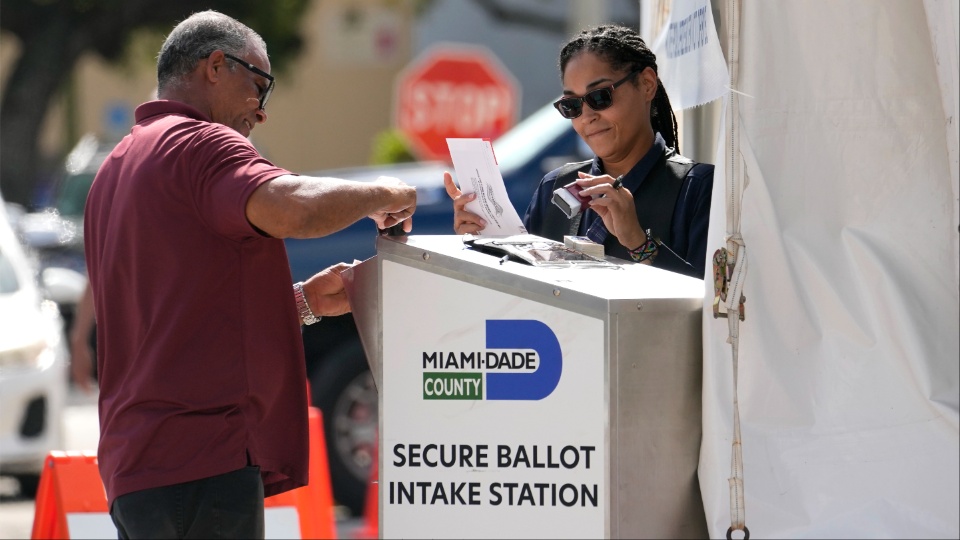
In roughly seven months, tens of millions of Americans will vote in the midterm elections. This election will be a referendum on the future of our democracy. This isn’t hyperbole. It’s a demonstrable fact.
Of course, during every election cycle, pundits and candidates say: “This is the most important election in my lifetime.” Some mean it; others know it’s bluster.
Hell, I’ve been around long enough to have heard politicians tell me “This is the most important election in my lifetime” since at least the 2000 presidential elections, when “hanging chads” in Florida decided the fate of our country. Then, it was a contest between Al Gore and George W. Bush.
Sure, there were miles of differences between Gore and Bush, especially on the environment. But I’m not going to rehash what might have been or speculate about whether Gore’s response to 9/11 would have been drastically different than Bush’s. Who knows?
What I do know is this: Donald J. Trump—and the vile network of racist, sexist sycophants that make up his administration—are a creature of fundamentally different stripes. In a manner unmatched by any prior administration, they are actively working to undermine the very foundations of our (albeit limited) bourgeois democracy.
Their agenda is an open and aggressive disdain for democratic norms. Their agenda is fascist. It is an attack on our basic rights and freedoms—especially, the rights and freedoms of women, immigrants, African Americans, and LGBTQ+ folks. It is an attack on higher education, freedom of the press, and the right to assemble and protest. It is an attack on workers everywhere. It’s all about sham prosecutions of “political enemies” and the “disappearing” of immigrants by masked agents.
Again, this isn’t hyperbole. It is an overt, unmistakable attack on the Bill of Rights.
Now, I won’t say, “This is the most important election in my lifetime.” But what I will say is this: If we don’t stop the right-wing, fascist assault on our democracy, we may not have elections—at least, not as we currently know them—in the very near future.
Make no mistake about it: While elections aren’t our only tool, they are one of the most important tools in our democratic, collective toolbox. They frame political discourse. They challenge the political balance of power. They can help stop the drive towards right-wing authoritarianism.
A democratic landslide—the defeat of MAGA and all the Trump-supported Republican candidates up and down the ballot—will send a clear, resounding message.
Imagine setting the Trump agenda back on its heels. Imagine Democratic control of the House and Senate making the impeachment of Trump possible—for a third time! Imagine a progressive majority defunding ICE and prosecuting those who murdered Renee Good and Alex Pretti.
Imagine Democratic and progressive majorities in state legislatures, county councils, aldermanic seats, and school boards. Imagine more progressives, socialists, and communists running for office.
Not so long ago, few would have imagined a socialist mayor of New York City. Now socialists and communists hold elected offices across the country—and more are running this fall.
Collectively, we can turn the Trump agenda into an anchor that sinks the far-right, while simultaneously offering an alternative—a socialist alternative. But we must think of this as a collective act,not an individual one.
Some people will say, “What’s the point? Democrats and Republicans are the same.” But this formulation is wrong-headed and individualistic. It frames elections and voting as an individual act, rather than a collective one—rather than something we do as a class.
On a philosophical level, they confuse the substance of struggle with its form. This is equally wrong-headed. Struggle can take a multiplicity of forms—a strike, boycott, rally, an election, etc, While all of these forms are important and have tactical and strategic purposes during specific political moments, they should not and cannot be confused with the substance of struggle. The substance, or content that constitutes the social relations of struggle, is an entirely different matter. And we must ask ourselves: What are the substantive social relations that need to be activated, organized, mobilized, and united to defeat the far-right, fascist agenda of the Trump administration?
This question strikes at the heart of how we should think about the midterm elections. A resounding defeat of the far-right this November is part of the answer. Their defeat could signal a substantive realignment of social relations. It can potentially alter the balance of power and put this long Trump nightmare behind us—of course, we’ll still have to contend with MAGA forces for years to come (under capitalism, these forces will continue to exist), and Trump will still have two more years as a dangerous lame-duck.
However, the correlation of forces coming together to defeat Trump this November is, without a doubt, the most important, biggest, and broadest coalition I’ve seen in my lifetime (the “No Kings!” marches have been the biggest in U.S. history). And that tells me something. It tells me: If I believe in democracy—which I do—then I should also see this election as a referendum on the future of our democracy.
I hope you’ll see it that way, too.
As with all op-eds published by People’s World, the views expressed above are those of the author.
We hope you appreciated this article. At People’s World, we believe news and information should be free and accessible to all, but we need your help. Our journalism is free of corporate influence and paywalls because we are totally reader-supported. Only you, our readers and supporters, make this possible. If you enjoy reading People’s World and the stories we bring you, please support our work by donating or becoming a monthly sustainer today. Thank you!
CONTRIBUTOR