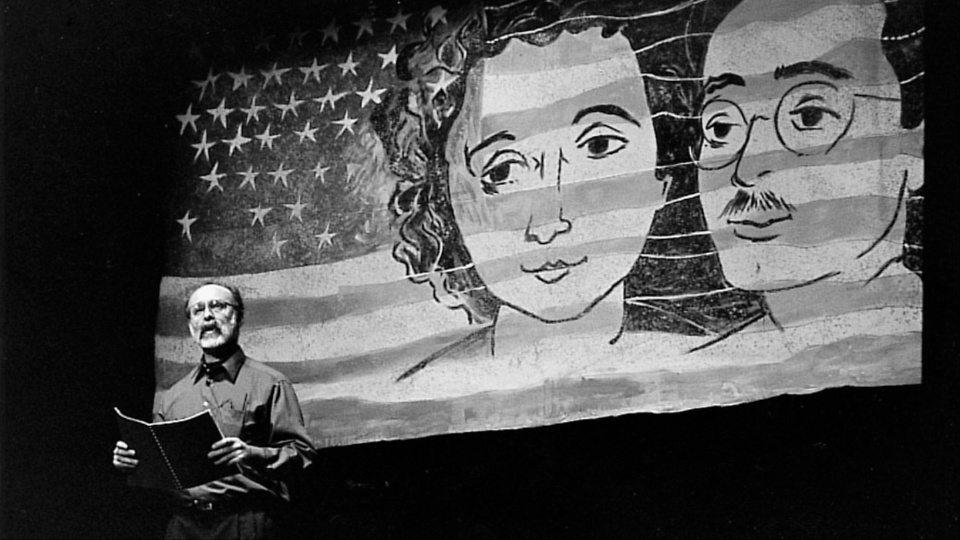
NORTHAMPTON, Mass.—The call of “Stronger Together, Solidarity Forever” echoed through the main hall of First Churches in downtown Northampton, Mass., on April 11 as over 200 people gathered to celebrate the 35th anniversary of the Rosenberg Fund for Children (RFC).
Founded in 1990 by Robert Meeropol, son of Ethel and Julius Rosenberg, the Rosenberg Fund provides grants for families of activists targeted by political repression. Meeropol, born Robert Rosenberg, was 3 years old when his parents were arrested and charged with giving atomic bomb secrets to the Soviet Union. When he was six, the government executed the Ethel and Julius at the height of the McCarthy era.
In its 35-year history, the Fund has received donations from over 10,000 people and granted over $10 million, with recipients in nearly all 50 states and across multiple continents. Recipients have used the grants to support the safety, stability, and health of their children, often amid turbulent and traumatic conditions.
Following an introduction by his daughter, Jennifer Meeropol, who serves as the Fund’s executive director, Robert Meeropol described the formation of the RFC as “a seed planted by the final letter” that he received from his parents. Though he said that it had “sat dormant for 35 years,” he found the inspiration of their words when he learned that the 1988 legal case of the United Freedom Front, commonly known as the “Ohio 7,” had involved FBI interrogations of children. Since then, the RFC has maintained a staunch focus on shielding children from state violence.
Under Trump, he said, the Fund faces a “flood” of targeted activists to support. With “the criminalization of abortion…and the rising tide of fascism,” the RFC’s work has taken on an ever-greater urgency and scope. RFC Granting Coordinator Cleo Rohn described how grants had supported families from all walks of life, ranging from an activist family terrorized by Proud Boys to advocates for transgender youth who had to seek political asylum abroad to a young adult hoping to join a circus troupe.
In opening and closing remarks, Jennifer Meeropol tied these experiences to her family’s unfinished struggle for justice. As the Trump administration is “pushing us ever closer to fascism,” she said, “many have bravely stood against authoritarianism, often at real cost to themselves and their families.”
At the same time, Meeropol acknowledged recent steps forward. Following the release of declassified NSA documents revealing that the United States government executed Ethel Rosenberg with full knowledge of her wrongful conviction, Rep. Jim McGovern, D-Mass., offered a formal apology on the floor of the House of Representatives. Though the renewed campaign to exonerate Ethel Rosenberg was unable to sway former President Joe Biden in the final months of his term, it lays out irrefutable evidence in her defense.
“The Board and staff of the Rosenberg Fund for Children was thrilled to mark our 35th anniversary with members of our community,” Meeropol said in a statement to People’s World. “We’re so grateful to everyone who was part of making this event possible and to the community which has supported us for the last 35+ years and allowed us to award more than $10 million to young people whose parents have faced targeting and repression for this progressive organizing.”
Though Prof. Angela Davis was unable to attend, the legacy of her work was ever-present through the event. Robert Meeropol described her role in the Fund—as a supporter and a standing member of its advisory board—as one which “predates” the organization itself. He explained that they had both attended the Elizabeth Irwin High School in Manhattan, charting their friendship which now spans over six decades.
Culture of resistance
As the speakers conveyed their shared sense of resilience and urgency, their words were interpolated with the poetry and music of struggle. Pamela Means, an Easthampton-based multimedia musician, performed “Strange Fruit,” afterward noting that its lyrics were first composed by Abel Meeropol in 1939, over a decade before he adopted the Rosenbergs’ children.
As Means remarked on her own career as a biracial artist and the legacies of the many Black musicians who risked their livelihoods to perform the song, she emphasized that the civil rights era isn’t over, saying, “We’re still in it”.
Martín Espada, a poet, author, and educator at the University of Massachusetts Amherst and a board member of the RFC, spoke in a similar spirit. Tracing the trajectory of the U.S. extreme right from the murderous Red Scare to the rise of the MAGA movement, Espada shared selections from his 2022 poetry collection, “Floaters.” His stories similarly focused on children of resistance: those detained in ICE camps who kick soccer balls to freedom beyond the walls, to the moon and into the White House.
His strongest words came from the eponymous poem, written about a Salvadoran immigrant family who drowned in the Rio Grande and the DHS agents who claimed their deaths were faked. From the elevated platform before the pipe organ, bathed in sunlight filtered golden through the stained glass of the church, Espada delivered a thundering condemnation:
When the last bubble of breath escapes the body, may the men
who speak of floaters, who have never seen floaters this clean,
float through the clouds to the heavens, where they paddle the air
as they wait for the saint who flips through the keys on his ring
like a drowsy janitor, till he fingers the key that turns the lock and shuts
the gate on their babble-tongued faces, and they plunge back to earth,
a shower of hailstones pelting the river, the Mexican side of the river.
People’s World is in the midst of its annual fund drive, trying to raise $140,000 by May Day. To support working-class journalism, please consider make a donation or become a monthly sustainer. Thank you.
CONTRIBUTOR