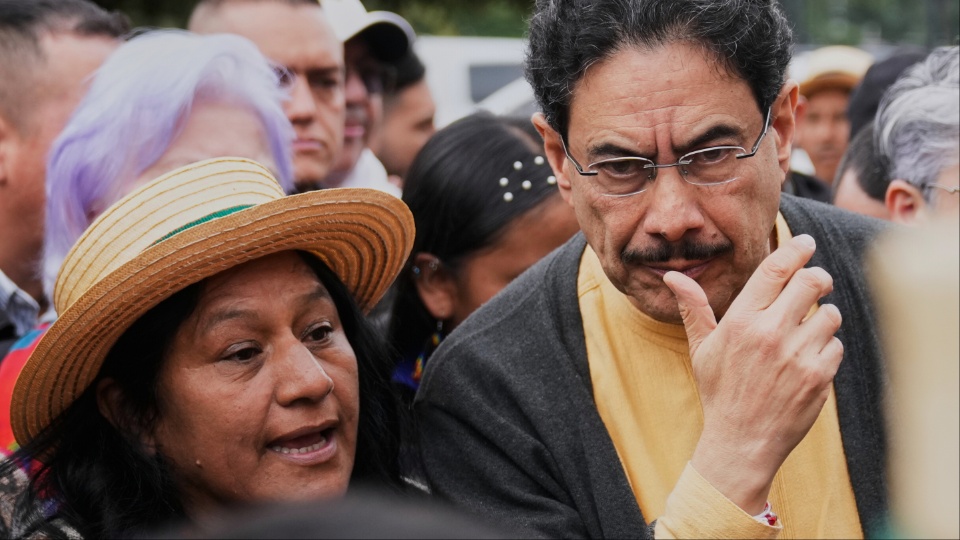
Gustavo Petro, Colombia’s first and only left-leaning president, leaves office soon. First round voting on his replacement takes place on May 31, and Iván Cepeda, standard bearer of Petro’s Historic Pact party, leads in opinion polls. Cepeda and his vice-presidential running mate are waging a vigorous campaign. She is Aída Quilcuée, of Nasa heritage and a leader of CRIC, Latin America’s oldest indigenous organization.
An opinion poll taken in late March suggests Cepeda might even win a first-round victory. He was first choice for 37.5% of those surveyed. Right-wing candidates Abelardo de la Espriella and Paloma Valencia, Cepeda’s closet competitors, polled at 20.2% and 19.9%, respectively. However, two other polls indicate voting will go to a second round, and Cepeda could be defeated—especially if the votes of the right consolidate around a single challenger.
Cepeda’s campaign gains strength from Petro’s 50% approval rating and the victories of Historic Pact candidates in legislative elections held on March 8. Candidates of dozens of parties competed. The Historic Pact won 25 seats of the 102 in Colombia’s Senate. The second-place Democratic Center party accounted for 17 seats. In voting for the Chamber of Representatives, with 183 seats, Petro’s party took 36 and the second-place Democratic Center won 25.
Interest in Cepeda’s crucially important campaign extends into the darkest corners. Assassination plots against Cepeda are coming to light, with suggestions being made of CIA involvement. One thing is for sure, Petro says: There’s electoral fraud on the way.
The candidate
Beginning in 2010, Cepeda, born in 1962, served in Colombia’s Congress as a representative and then as senator. In 2003, he and others founded the National Movement for Victims of State Crimes, a coalition of groups seeking justice for victims of armed conflict. As congressperson, Cepeda investigated former President Alvaro Uribe for his ties with paramilitaries and took him to court.
Manuel Cepeda, Iván Cepeda’s father, was a Communist Party leader, editor of the party’s newspaper, and a senator. Paramilitaries killed him in 1994. Violence and threats caused Iván Cepeda, alone or with his family, to seek exile abroad intermittently between 1964 and 2003, mostly in socialist bloc nations.
Cepeda’s government experience and exposure to Colombia’s way of violence well qualify him to bring the people’s cause to the country’s top job.
The party
The Historic Pact (HP) has a convoluted history. The Colombia Humana Party, founded and led by Petro, formed a coalition of parties in 2018 that was a platform for Petro’s unsuccessful presidential run in 2018. Colombia Humana in 2021 formed a coalition of parties and social movements that became the Historic Pact for Colombia. Petro won the 2022 presidential election on that ticket.
In September 2025, the National Electoral Council converted that coalition into a political party. The parties formally making up the coalition could no longer participate in elections, specifically the Patriot Union, the Alternative Democratic Pole, and the Communist Party. In primary voting in October 2025, the new Historic Pact Party selected Cepeda to be its presidential candidate.
In power
The record of the Historic Pact government is mixed, but there were clear accomplishments. The Congress rejected Petro’s healthcare reform program, though his broad-based pension reform plan featuring gender equity gained approval. Implementation awaits a Constitutional Court decision.
A comprehensive labor reform program took effect, mostly. Petro recently ordered a 23% minimum wage increase for 10% of the workforce. His government also increased direct investment in the infrastructure of municipalities, prominently in schools and universities.
There are results that he can point to. Colombia’s GDP is up 3.6%. Inflation dropped from 13.3% in 2023 to 5.5% in late 2025. Under Petro, Colombia’s multidimensional poverty rate, which covers “access to education and available infrastructure,” continued its long drop from 30% in 2010 to 12.9% in 2022, to 9.9% in 2025. Rural poverty is 22.4%; the urban variety is 6.3%.
Government figures show that 2,038,619 acres were delivered to “peasants, ethnic communities, and victims of [past] conflict,” but Petro’s government did not institute a comprehensive land reform program. As of 2022, only one percent of Colombia’s population, those with means, own 81% of the country’s land. And Petro’s call for a constituent assembly has failed.
What lies ahead
Taking office, Petro proclaimed his goal of “total peace.” He was reacting to violence continuing long after the 2016 signing of the government’s Peace Agreement with FARC insurgents. The violence remains as he leaves office, mostly in rural areas. Responsibility lies with paramilitaries in the service of narcotraffickers, dissident FARC insurgents, and the National Liberation Army. That insurgency has negotiated peace, but unsuccessfully.
If Cepeda loses in the coming elections, either one of his two closest competitors would form an extreme right-wing government prone to revitalizing Colombia’s traditional alliance with the United States.
Colombia’s government under Petro retained an inconsistent but real attachment with the small bloc of left-leaning Latin American and Caribbean governments opposed to U.S. regional domination.
With a conservative Colombian government in power, only Brazil, Cuba, Nicaragua, and Mexico would be standing in the way of U.S. aggression. The recently-announced U.S. National Security Strategy promulgated by the Trump administration weaponized the Monroe Doctrine like never before
Traditions count
A new conservative government would undoubtedly fortify Colombia’s tried and true regimen of ruling-class control over land and natural resources and of exploitative financial, commercial, and narcotrafficking ventures.
That long state of affairs gave rise to multiples horrors, among them: the massacre of striking banana workers in 1928, repression and terror in rural areas in the 1940s and peaking during conservative president Laureano Gómez’s era (1950-53), the Rojas Pinilla military dictatorship (1953-57), the onset in the 1960s of violent paramilitary rampages backed by Colombia’s military, the murders of thousands of Patriotic Union political activists after 1986, and the presidency of Alvaro Uribe (2002-10), marked by paramilitary killings and narcotraffickers’ intrusion in political life.
The Historic Pact Party joins another tradition, that of political resistance. High points were: Congressman Jorge Eliécer Gaitán in 1928 demanding justice for the banana workers, Gaitán leading the March of Silence in 1948, the reformist presidencies of Alfonso López Pumarejo (1934-38 and 1942-45), the insurgency (1965-2016) represented by the Revolutionary Armed Forces of Colombia (FARC), and the early trajectory of the Patriotic Union under FARC and Communist Party leadership.
For U.S. reactionaries, a kindred Colombian government returning to power would surely reinforce their own ample tradition of warmaking in Colombia. Precedents abound. A U.S. Special Forces consultant arrived in Colombia in 1962 with the recommendation that paramilitaries be employed to tamp down disorder and rebelliousness in the countryside.
Decision-makers had long ago opted for U.S. air bases in Colombia plus troop displacements and military contractors. Through the U.S. “Plan Colombia” (2000-10), Colombia’s government received billions in military funding, military intelligence on call, funds and advice for new prisons, and military assistance. The U.S. was fighting a war on drugs, it was said, but another purpose—and many argue the real one—was war against leftist insurgents.
Cepeda’s top two electoral opponents represent old political ways. Paloma Valencia is the presidential candidate of the Democratic Center Party, founded by Uribe. According to analyst Horacio Duque, Valencia “is the granddaughter of Guillermo León Valencia, one of the toughest conservative presidents of the 20th century.… Her program expresses a classical conservatism partaking of (Spanish dictator) Francisco Franco: defense of the traditional family and of Catholicism.”
Abelardo de la Espriella, the other candidate, is on the ticket of the Movement for National Salvation. Its founder was the son of the aforementioned and widely-reviled President Laureano Gómez. Duque characterizes the candidate as a “far-right nationalist backed by Vox and Abascal, the ultra-Catholic scourge of Spanish politics … He proposes deploying the military in the streets, forming a military alliance with the United States and Israel… and promoting what he calls a ‘Colombia of property owners.’”
The U.S. government sticks to its warmaking mode of being, as evidenced by war against FARC rebels. Simón Trinidad was a FARC soldier. He was captured and remains in a high security U.S. prison, serving a 60-year sentence. The message that Colombia solidarity activists are sending to Washington officials is: “Please get unstuck. That war is over. Think peace not war. Let Simón Trinidad return to Colombia.”
People’s World is in the midst of its annual fund drive, trying to raise $140,000 by May Day. To support working-class journalism, please consider make a donation or become a monthly sustainer. Thank you.
CONTRIBUTOR