Following LA Opera’s Falstaff, at a post-performance talk, the English actor and raconteur extraordinaire Stephen Fry stated that Queen Elizabeth I so enjoyed the character of John Falstaff, who appeared in both Part I and Part II of William Shakespeare’s Henry IV, that she told the Bard to write yet another play featuring the rotund, lovable rogue. The result was The Merry Wives of Windsor, which debuted circa 1600. Talk about a command performance!
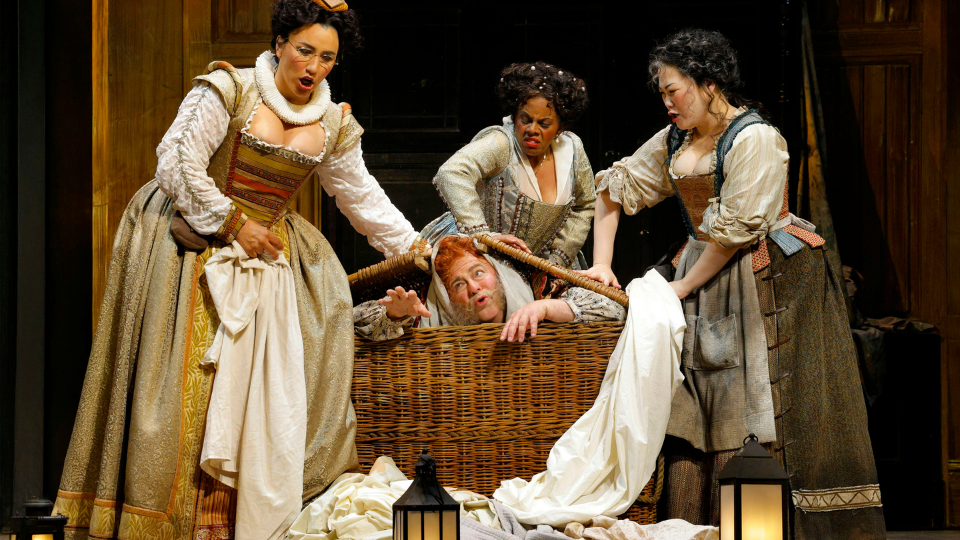
Proving that the theft of intellectual property is truly the sincerest form of flattery, deriving plot points and characters from all three Shakespeare productions, composer Giuseppe Verdi and librettist Arrigo Boito conjured up the comic opera Falstaff, which debuted in 1893 at Milan’s La Scala. Their heady concoction, here punctuated with projected quotes from Shakespeare’s plays with John Falstaff, is likely the wittiest, funniest opera I’ve yet to see and hear on the boards of the Dorothy Chandler Pavilion. According to the current production’s director, Texan Shawna Lucey, Falstaff is “the opera’s most colorful figure,” and Claremont, California’s Craig Colclough is the bass-baritone who amusingly portrays this character who gives in to his basest desires.
In essence, here’s the storyline: Running short on money, the outlandish womanizer Falstaff, who has devoted his life to quenching his insatiable thirst and wenching, seeks to seduce much younger, married, wealthier women whom he believes fancies him, in order to not only satisfy his endless lust, but to con them out of their husband’s fortunes, so that he can continue to finance his wicked, wicked wastrel ways and lays. (He is a man after the heart of The Producers’ Max Bialystock.) As Ford (Italian baritone Ernesto Petti) calls him, he is an “epicurean villain.” In Freudian (not “Fordian”) parlance, Falstaff is the embodiment of id and ego, unencumbered by pesky things such as a superego, who, as he confesses in his first monologue, eschews the virtues of “Honor!”
There’s only one problem with this best laid plan of mice and men: Falstaff is no Don Giovanni. He had hobnobbed with the crown prince (Hal is nowhere to be seen in this opera, although the once and future king is indeed referred to in the above-mentioned projections of quotes), but not only has he aged, Falstaff is terribly obese. He is so self-deluded that the aging, overweight Falstaff imagines he can seduce not one younger, attractive, well-to-do woman, but two of them, more or less at the same time. Although he may yet possess some of his charm and wit, the objects of his desire, Alice Ford (Chicagoan soprano Nicole Heaston) and Meg Page (California mezzo-soprano Sarah Saturnino), consider the old man to be utterly undesirable, if not downright repulsive.
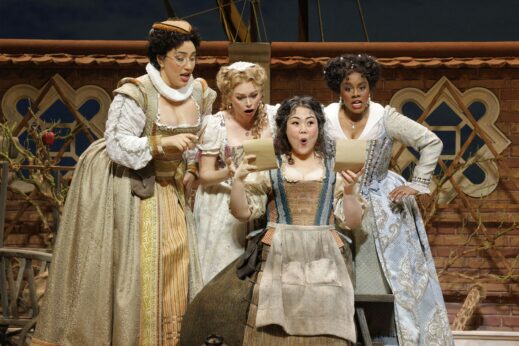
When Alice and Meg discover Falstaff’s scheme to deceive, seduce, and fleece them, they resolve to turn the tables on the erstwhile wannabe lover boy with ploys, plots, and pranks a-plenty of their own. It is a case of feminine wiles versus the male ego. In other words, our man Falstaff doesn’t stand a chance!
The story is presented with much verve and a slapstick-like sensibility, with mise-en-scène directed with great alacrity and skill by Lucey. The garb and sets by scenic and costume designer Adrian Linford evoke the period, as do little touches like rug beaters (I suppose the action takes place in Elizabethan England, although, of course, the lyrics are all sung in Italian). The architecture has a Tudor flair (according to Performances Magazine, the “Scenery [was] constructed by CBS Scenic Studios, Hollywood”), and there are projections of Windsor Castle. There are also projections of sunsets, et al, that help to open up the action beyond the stage.
In addition to Colclough as the title character, standouts in the large cast include mezzo-soprano Hyona Kim as Mistress Quickly and Utah soprano Deanna Breiwick as Nannetta, who both perform with great comedic panache. Their comic acting shines with expressive delight. And lest we lose sight amongst all the frivolity and come to conclude that if life is but a jest, and all mortals mere jokers, and that thus romance is nothing but a game, Nannetta and her beloved Fenton (California tenor Anthony Leon) remind us that there is such a thing as true love, and true lust.
These two young lovers can’t keep their hands off one another, even if it pits Nannetta against the wishes of her father, Ford, a Windsor gentleman who wishes to marry his daughter off to the middle-aged Dr. Caius (California tenor Nathan Bowles). But much to her credit, Nannetta is determined that this Petti won’t be, shall we say, one of the heartbreakers. Nannetta and Fenton serve as a counterpoint to the gameplaying Machiavellian machinations of the heart displayed by the older characters. Singing about their “lips of fire,” the young lovers remind us what l’amour and sexuality are really all about. (BTW, the attentive 21st-century eye and ear will note a reference to same sex marriage, so hopefully Falstaff won’t be canceled by the thought police any time soon, and we won’t have to sing “Bye Bye Verdi.”)
In this comic opera, Verdi’s music appropriately has a light touch, embellished by flutes to soften the ambiance. As ever, music director James Conlon ably conducts the LA Opera Orchestra. In a note in Performances Magazine, Conlon points out that his first paying gig was conducting Falstaff in 1972, and it will be among the last he conducts as he steps away from his role since 2006 as LA Opera’s music director, literally handing off the baton to Venezuelan conductor Domingo Hindoyan.
During his tenure, Conlon has certainly worked hard conducting at one of America’s best opera houses, but his job as interlocutor at the post-performance talk by Stephen Fry in Stern Grand Hall was a breeze. The music director barely introduced Fry, and the Cambridge graduate with countless screen credits was off to the races, holding forth on Shakespeare, Verdi, and whatever else seemed to cross his feverish mind, in his impeccable English accent, holding the packed hall in thrall. That gifted guy, who directed the excellent 2010 documentary Wagner & Me, sure has the gift of gab on steroids. When Conlon finally managed to get a word in edgewise, he said that of all his jobs, “the only place I was able to do pre-performance talks has been L.A.” Having attended a number of them, I can sincerely say that we shall miss them—and him—as Conlon writes the next chapter of his life.
In the meantime, this Falstaff is a sheer delight to behold, an ode to joy, with a good, fun philosophy about what life is all about. You don’t have to be a Shakespearean scholar like Stephen Fry to experience it; just go because you love enjoying life, the merry lives of splendor. During a night at the opera, this mash-up of the Marx Brothers and the Bard is guaranteed to lift your spirits with the gift of laughter.
Falstaff is being presented April 30, May 2, May 6 at 7:30 p.m., and May 10 at 2:00 p.m. at the Dorothy Chandler Pavilion, 135 N. Grand Avenue, Los Angeles, CA, 90012. The opera is sung in Italian, with English supertitles. For tickets, go here or call (213)972-8001.
We hope you appreciated this article. At People’s World, we believe news and information should be free and accessible to all, but we need your help. Our journalism is free of corporate influence and paywalls because we are totally reader-supported. Only you, our readers and supporters, make this possible. If you enjoy reading People’s World and the stories we bring you, please support our work by donating or becoming a monthly sustainer today. Thank you!
CONTRIBUTOR