Elected officials in Alabama, Tennessee, and elsewhere in the South are meeting Wednesday to eliminate any congressional districts in their states where it is still possible to elect African Americans or other non-white lawmakers. If they succeed, many of the states that constitute the old Confederacy will, as they did in the 19th century, have only white representation in Washington, D.C.
The racist moves, designed also to eliminate any Democrats from the state delegations to Congress, are also upending a number of primary elections currently underway. In some places, tens of thousands of early voters have already cast ballots that could end up being tossed in the trash pile by the racist lawmakers engineering the moves.
The stepped-up redistricting war was triggered last year by President Donald Trump when he put the squeeze on Texas lawmakers to redraw their lines to eliminate Democrats. It is now intensifying in the wake of last week’s Supreme Court decision restricting states from drawing district lines to remediate existing racial discrimination.
The ruling, which struck down the drawing of a majority-Black congressional district in Louisiana, has unleashed “a wave of nefarious actions” across states that threatens to disenfranchise Black voters, Alanah Odoms, executive director of the American Civil Liberties Union of Louisiana, said.
Republicans are now racing to cement in place new racially gerrymandered lines before the November 2026 elections. Until now, the Supreme Court never permitted maneuvers like this in the leadup to elections.
An extraordinary legislative session to redraw lines aimed at eliminating minority representation began Monday in Alabama and started Tuesday in Tennessee. Louisiana lawmakers, who were already in session, are also moving to redraw their congressional districts.
Civil rights activists, Democrats, labor unions, and others are fighting back with everything from marches and protest rallies to actions in the courts.
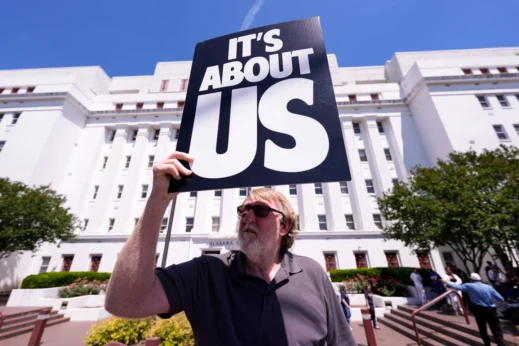
Hundreds are descending on state capitals in the South condemning the efforts. At mass rallies in front of the Alabama Statehouse this week, demonstrators carried signs declaring “We fight back, Black Voters matter.”
From the moment the Supreme Court issued the Louisiana ruling, which effectively killed the Voting Rights Act, the AFL-CIO stepped up its ongoing campaign against racist gerrymandering. The labor federation issued a statement in the name of President Liz Shuler and Secretary-Treasurer Fred Redmond that called the ruling an “outright attack on the fundamental freedoms of all working people.
“The Voting Rights Act came out of a triumph of organizing and activism, a victory the people of the civil rights movement, with labor standing shoulder to shoulder, fought and died for over decades. But from the moment it was signed into law, there has been a concerted effort to reverse that progress.
“Voting rights are worker rights. When working people have a real voice at the ballot box, we can elect leaders who will respect our right to join a union, fight for fair wages, ensure safe workplaces, and retire in dignity,” the federation said.
Continuing the opposition to voting rights mentioned by the AFL-CIO, Trump is cheering on the wave of racist redistricting sweeping the South. He is bragging that Republicans are working to gain at least 20 House seats with the measures being considered in various states.
He’s also actively taking retribution against GOP state lawmakers who don’t go along with him. In Indiana Republican primaries this week, he backed people who opposed lawmakers who would not go along with his demands for new racist district lines.
Five of the seven state candidates he backed won their primary races. This will turn the Republican legislature in Indiana, if the party wins a majority of seats in November, into even more of an extremist MAGA-dominated body than it already is.
One of the ways Democrats are fighting back includes an effort to redraw lines favorable to them. U.S. House Democratic Leader Hakeem Jeffries pointed to redistricting in New York as an example.
New York law, however, will not allow those lines to take effect until 2028. To adopt new districts, New York lawmakers must pass a constitutional amendment twice in two years, and voters would also have to approve it.
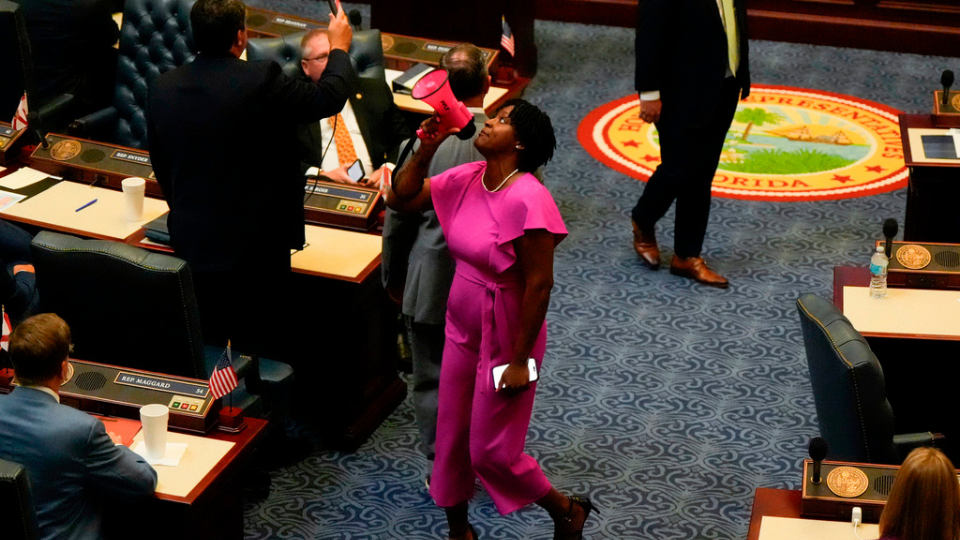
Florida, on Monday, added itself to the list of Southern states enacting new discriminatory district lines. Republican Gov. Ron DeSantis announced he had signed a redrawn map passed by lawmakers last week that could help Republicans win as many as four additional House seats.
The new map was immediately challenged in court as a partisan gerrymander that violates a state constitutional provision against drawing districts that favor one political party over another.
In Louisiana, tens of thousands had already early voted as the state legislature began moving to delay its May 18 primary election. The Republican aim is to re-draw the lines in an even more discriminatory fashion than they have been drawn thus far.
At the very least, the moves in Louisiana have caused mass confusion, which is, in itself, a major aim of Republicans determined to suppress the vote in an election cycle during which they are expected to lose seats in Congress. The Democrats have encouraged people to continue early voting in the current districts in Louisiana in the hope that courts, later on, will allow those votes to be counted.
In Alabama, Republican Gov. Kay Ivey called legislators into a special session to consider contingency plans for special primary elections in hopes the U.S. Supreme Court will let Alabama switch congressional maps ahead of the November midterms.
Federal judges previously ordered Alabama to use a court-selected map—with a second district that has a substantial number of Black voters—until a new map is drafted after the 2030 Census. Alabama appealed that decision and has asked the court, in light of the Louisiana ruling, to let it revert to a 2023 map drawn by Republican state lawmakers. That map would substantially alter the district now represented by Rep.Shomari Figures, a Black Democrat.
In Tennessee, Republican Gov. Bill Lee announced a special session designed to eliminate the state’s only Democratic House district which is largely in the majority Black district of Memphis.
“This latest attempt at redistricting is not just about lines on a map, it is about misrepresentation,” said the Rev. Earle Fisher, a pastor at the Abyssinian Missionary Baptist Church and the founder of Up the Vote 901, referring to the Memphis area code. “It’s about whether the voices of Black people in this state will be heard or hidden.”
AP contributed to reporting for this story.
We hope you appreciated this article. At People’s World, we believe news and information should be free and accessible to all, but we need your help. Our journalism is free of corporate influence and paywalls because we are totally reader-supported. Only you, our readers and supporters, make this possible. If you enjoy reading People’s World and the stories we bring you, please support our work by donating or becoming a monthly sustainer today. Thank you!
CONTRIBUTOR