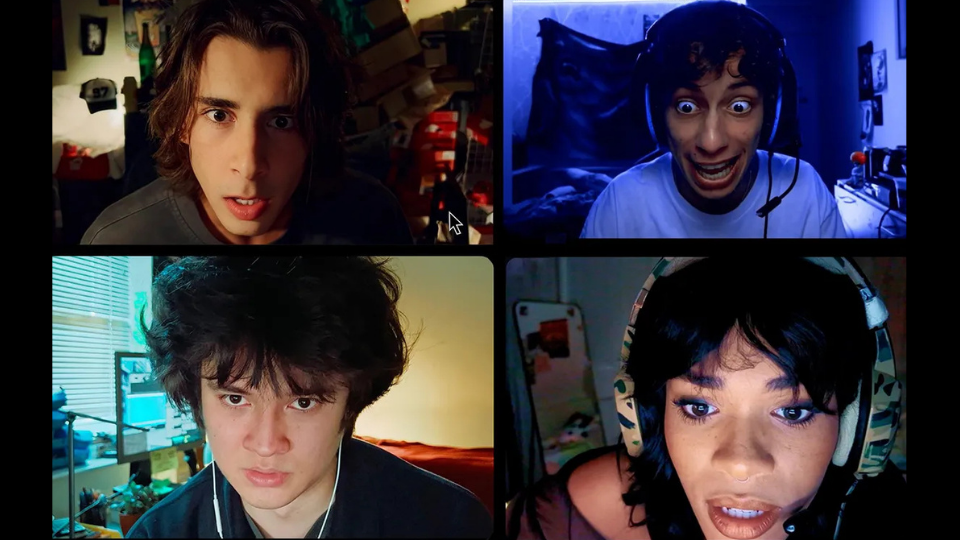
LifeHack is a heist film for a generation bombarded by technology but increasingly aware that the system feels tainted and imbalanced. It takes direct shots at the figures and ideologies that have emerged in recent years, which lean on toxic masculinity, greed, and the hoarding of wealth. At the same time, it provides the audience with characters worth rooting for, understanding, and perhaps identifying with, in their frustration at their plight and their search for community in a world of ever-growing alienation, where everyone seems “connected” through technology but is actually more disconnected than ever. It touches on these themes and still manages to be fun and heart-pounding, taking the genre of “screenlife” films to a higher level.
LifeHack is a screenlife action thriller directed by Ronan Corrigan and co-written with Hope Elliott Kemp. The plot of the movie centers on a group of four friends who spend most of their time online playing video games and using their hacking skills to prank internet scammers. Each have their own set of problems and obstacles. The group’s leader, Kyle (Georgie Farmer), sets his sights on tech billionaire Don Heard, who presents himself as a self-made, alpha-male billionaire. Kyle convinces his friends to break into Don’s cryptocurrency account (because, of course, he has cryptocurrency) so they can steal funds and make money. They choose to do this through Don’s daughter, Lindsey (Jessica Reynolds), a rich, spoiled young woman who broadcasts her whole life online for the world to see.
All the action in the film unfolds across various screens (computers, public cameras, news broadcasts, video games, chat messages, video calls, etc.). Things seem to go well for the gang initially but take a dark turn when Lindsey catches on to their scheme, blackmailing them into an impossible situation that may cost them their freedom.
Screenlife films can be polarizing among viewers. The technique emerged in the 2010s as a new method of visual storytelling (often much less expensive to produce) that seemed to reflect society’s ever-growing reliance on technology. At its best, screenlife can feel innovative. At its worst, it can feel like a stifled gimmick attempting to make up for a weak script. At its super worst, it can feel downright illogical, as characters are made to stay in front of the camera despite, say, a killer attacking them, where it would be better for them to log off and call the police. It would seem that the key to a quality screenlife film is that the use of screenlife makes sense for the film itself. LifeHack accomplishes this by using screens not only to serve the plot but also to elevate the tension and, in itself, reflect how the characters cope with their problems. 
One of the highlights of the film is its tongue-in-cheek social commentary. This may be director Ronan Corrigan’s feature debut, but the young filmmaker makes a memorable mark through his use of characters and action not only to tell a story but also to make a statement about how money and certain ideologies have come to dominate the world.
The character of Don Heard (Charlie Creed-Miles) is no doubt a heavy dose of real-world billionaire Elon Musk and all the posturing “alpha-male” public figures that have come to populate the media landscape. For those familiar with Musk’s rise to notoriety by presenting himself as the “cool” rich guy, only to eventually reveal himself to be just like any other boss or exploitative wealthy person, the similarities are put on full display. His daughter, Lindsey, seems to represent the wealthy nepo-babies that the media shoves in our faces (usually through reality TV series that just won’t go away), trying to make us believe that they are universally relatable despite being born with a ridiculous amount of wealth privilege that 99% of the population will never see.
LifeHack presents a refreshing contrast to an emerging (and concerning) trend in the Hollywood industry of centering stories on the rich and powerful as if they are the protagonists worth watching. The movie makes it clear that people like Musk are not the kind of people worth aspiring to be, but are rather part of a bigger problem: the way that the wealthy hoard riches and power for themselves while working people battle for scraps.
The four main protagonists provide the heart of the film, truly grounding the story. The dynamics and chemistry among Kyle, Alex (Yasmin Finney), Sid (Roman Hayeck-Green), and Petey (James Scholz) really shine through despite the audience rarely seeing them in the same room. In an interesting way, their bond and connection perfectly contrast the toxic alpha-male “manosphere” that has emerged. The male characters show vulnerability, cry, and often express their feelings—all things the manosphere “coaches” young men not to do, as they are seen as “weakness.” Finney’s delightful portrayal of Alex is notable not just for the charming performance but also for the fact that a Black trans woman is in the role, and that aspect of her identity is not made the defining point of her character. Representation without tokenism is always refreshing to see.
The film also, in a way, reflects the generation known as “Z” that is coming of age in a world of turmoil and economic uncertainty. Not that they’d be the first, as millennials can attest to a similar sentiment, but recent studies have shown that a growing number of that generation deal with mental health issues, self-medication, and an overall feeling of apathy regarding their economic futures. The film masterfully bundles that frustration into a thrilling roller-coaster ride of plot twists and emotional whirlwinds.
LifeHack is a heist film for people who have a bone to pick with a society that tells them the wealthy should be worshipped and that they should just accept their own powerlessness. It has humor, heart, and thrills throughout, making for an enjoyable and witty ride.
We hope you appreciated this article. At People’s World, we believe news and information should be free and accessible to all, but we need your help. Our journalism is free of corporate influence and paywalls because we are totally reader-supported. Only you, our readers and supporters, make this possible. If you enjoy reading People’s World and the stories we bring you, please support our work by donating or becoming a monthly sustainer today. Thank you!
CONTRIBUTOR