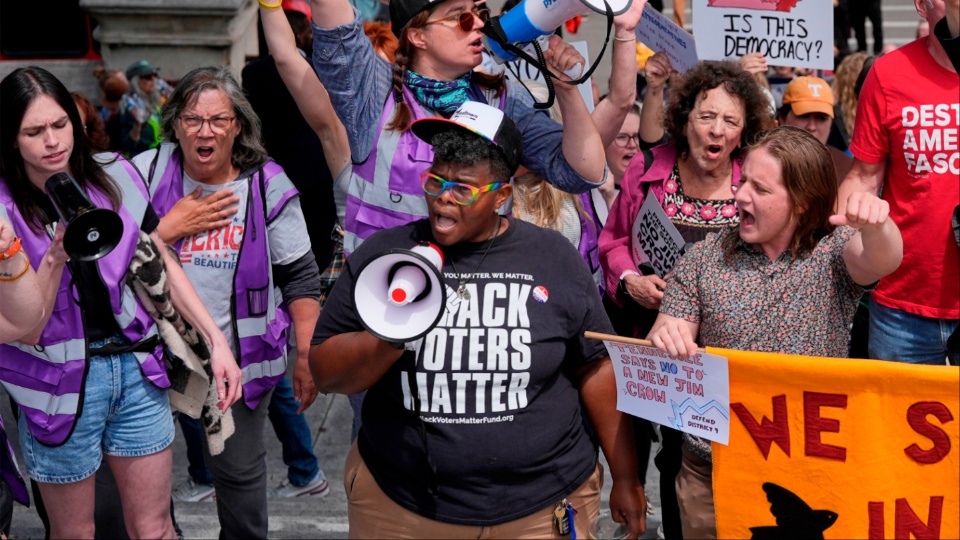
The electoral districts being redrawn across America right now aren’t just random lines on state maps. They’re blueprints for a Congress that answers to no one—certainly not to working people, of any color.
It started in Texas last summer, when Donald Trump ordered Gov. Greg Abbott to redraw the state’s congressional districts mid-decade, outside the normal post-census cycle, with the explicit goal of flipping five House seats to the Republican Party. Texas dutifully complied.
A federal court later ruled the new maps an illegal racial gerrymander, finding that Republican mapmakers targeted Black and Latino communities specifically to dilute their political power. The Supreme Court, over that ruling’s objections, let the maps move forward anyway.
Then the dominoes fell.
Missouri followed. After that, North Carolina. Florida’s Ron DeSantis pushed through maps that could reduce Democratic House seats in that state from eight to four. Tennessee’s GOP-controlled legislature split majority-Black Memphis into three pieces, stretching the fragments into rural Republican territory—and when two Black lawmakers showed up to object, they were physically removed from the hearing room. In South Carolina, the governor called a special session just to obliterate the district of a prominent Black Democratic congressman.

This is, as People’s World has reported, the fastest rollback of Black representation since the end of Reconstruction. The racial targeting is real, it is documented in court findings, and it is consistent with a century-long tradition of using the mechanics of democracy to suppress the political power of Black America. That history cannot be softened. When the Brennan Center’s Michael Waldman warns that these maps will “bleach the halls of Congress, state legislatures, and city councils,” he is describing what can only be called a white supremacist project.
But that framing, as true as it is, is also incomplete. And the incompleteness serves the people engineering these maps just fine.
Here’s what often gets lost in the coverage: When a progressive congressional seat disappears—whether the representative who held it was Black, Latino, white, or anything else—legislation dies with it. Not eventually, not theoretically. Now.
Every seat that flips means fewer votes for raising the federal minimum wage. Fewer votes for the PRO Act, which would be the most significant expansion of workers’ right to organize in decades. Fewer votes for student debt relief, for expanding ACA subsidies, for protecting Medicaid, for infrastructure funding that creates union jobs.
It also means more votes for privatizing Social Security. More votes for eliminating prevailing wage requirements on federal projects. More votes for eliminating student aid (what’s left of it). More votes for making abortion illegal nationwide and for prosecuting women. More votes to eliminate marriage equality. More votes for eliminating minimum wage.
The House is currently divided 218-212 with five vacancies, three of them Democratic-held. It’s a margin so thin that a handful of flipped seats, courtesy of rigged maps, could lock in a Republican supermajority capable of passing anything and blocking everything.
That means the white factory worker in rural Tennessee, already watching his union contract get clawed back, loses a vote in Washington. The white nurse in suburban Ohio fighting for safe staffing ratios loses a vote. The white retiree in Pennsylvania depending on Medicare—she loses a vote, too. Gerrymandering is a targeted weapon, but the shrapnel hits everybody.
This is, at bottom, a business decision by capital. The donor class that funds Republican redistricting efforts—the Chamber of Commerce money, the corporate PACs, the billionaires who showed up to celebrate Trump’s tax cuts—understand exactly what they are buying. A locked-in congressional majority isn’t just about what the media calls “cultural grievance politics” or “rolling back DEI.”
It’s about making sure that labor law stays weak, that health care remains tied to employment, that the minimum wage never catches up with inflation, and that tax cuts for corporations and the super wealthy never get reversed. Stoking racial division among working people is how you keep them from noticing they have common interests. The gerrymander is just the latest, most surgical version of a very old strategy.
None of this is abstract. In Missouri, where Republicans gerrymandered Kansas City’s Black community out of representation, over 300,000 people—union members, churchgoers, community organizers—signed petitions demanding the Republicans’ new maps be put to a public referendum. The coalition is multiracial and working-class, not because anyone issued a diversity mandate, but because the people being hurt are multiracial and working-class.

Missouri’s state Secretary of State is sitting on those signatures to please the man who occupies the White House, and the fight to force a referendum continues in court. This is what solidarity in action looks like, and also what obstruction in action looks like.
In California, voters overwhelmingly passed a remap that shifted five GOP seats there to the Democrats. Virginia voters narrowly approved a shift of four, but the Republican majority on the state Supreme Court overruled them.
The Redistricting Reform Act of 2025, introduced by Sen. Alex Padilla and Rep. Zoe Lofgren, would ban mid-decade redistricting nationwide and require independent commissions in every state. It has no chance of passing the current Senate, which is dominated by the GOP. But that doesn’t mean it’s irrelevant; it becomes the standard to demand, the legislation to organize around, the baseline for what a 2027 Congress could do with a different majority.
So, what can people do right now, beyond showing up for the midterm elections in November?
Get into your state legislature fight. Redistricting is a state-level process, which means state legislative races matter enormously. Contact your state legislators—Republican or Democrat—and register your opposition to mid-decade gerrymandering on the record.
Support the legal fights. Organizations like the NAACP Legal Defense Fund, the Brennan Center for Justice, the ACLU, and the Campaign Legal Center are in court right now challenging illegal maps. These fights need resources.
Join or support signature-gathering campaigns. The Missouri “People Not Politicians” model works—when it isn’t being sabotaged by partisan officials. If your state has a ballot initiative or referendum mechanism, use it.
Talk to the white workers in your life about this. Not with a lecture. With the practical question: Do you want a Congress that can raise your wages and protect your health care, or not? Because the maps are being drawn to make sure that such a Congress is never elected.
The people drawing these lines are counting on one thing above all else: that the Black and Latino workers and the white workers who are also losing representation will never see themselves as being in the same fight. But that bet has failed before—in the union halls of the 1930s, in the civil rights coalitions of the 1960s, in the multiracial labor campaigns winning living wage fights today.
When working people organize across racial lines around shared interests, they can win.
People’s World has been covering these fights in depth—read our recent reporting on the Missouri people’s campaign against gerrymandering, labor’s backing of California’s redistricting response, and the latest MAGA remap wins in Virginia, Tennessee, and Florida.
We hope you appreciated this article. At People’s World, we believe news and information should be free and accessible to all, but we need your help. Our journalism is free of corporate influence and paywalls because we are totally reader-supported. Only you, our readers and supporters, make this possible. If you enjoy reading People’s World and the stories we bring you, please support our work by donating or becoming a monthly sustainer today. Thank you!
CONTRIBUTOR