BOSTON —Some 70,000 rideshare drivers in Massachusetts unionized, in what speakers said was the biggest private-sector unionizing win since 1941.
The state certified the App Drivers Union on May 26, under terms worked out between that union, the state Labor Relations Department, and two AFL-CIO member unions, the Machinists and the Service Employees 32BJ, whose organizers helped the drivers.
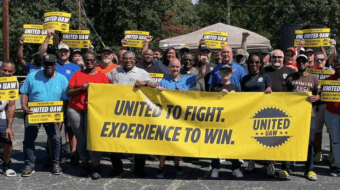
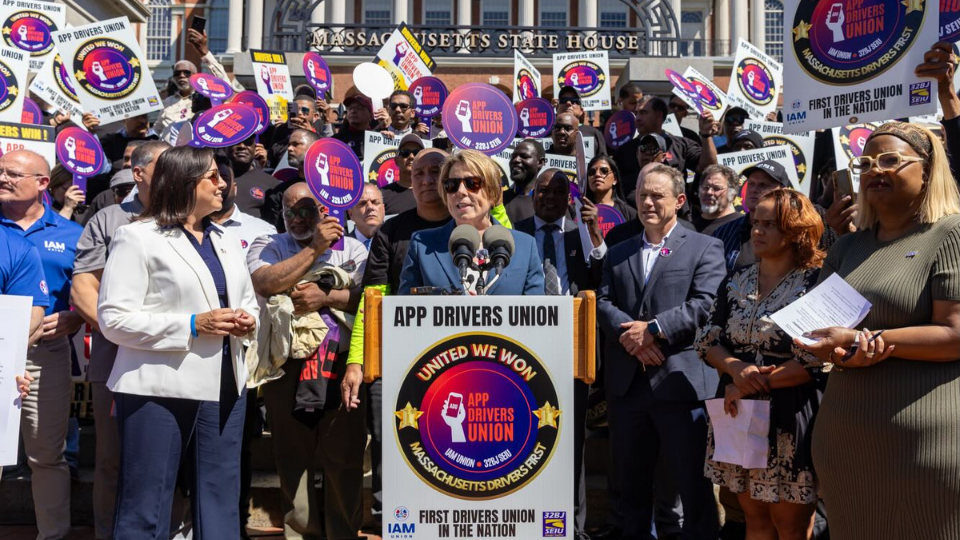
The workers, most of them drivers of color, celebrated with a mass rally on the State House steps the same day their union was certified. Frequent chants in Spanish occurred before speeches began.
Under the state’s rules, the estimated 70,000 rideshare drivers statewide will still technically be “independent contractors” under federal labor law, but not under the agreement that then-state Attorney General Maura Healey (D) worked out between the unions, the rideshare drivers, and the two big rideshare firms, Uber and Lyft.
That pact lets all 70,000 unionize under state Labor Relations Department jurisdiction. To get card-check recognition, the App Drivers Union had to gather signed union authorization cards from 25% of the drivers, or 17,500. They got 23,000 signatures, winning what speakers said is the first rideshare drivers’ union in the U.S.
The state rules say that when a contract is bargained–and the two sides have six months to voluntarily reach a pact before its terms go to mediation and arbitration–the union must win a majority for it among all the workers. The state’s Labor Secretary must also approve the contract.
The workers celebrated with the mass rally on Boston Common and with Healey, now the governor, addressing them, followed to the podium by Service Employees President April Verrett and Machinists President Brian Bryant.
“This is a historic day for the state, for the country,” Healey said, noting that drivers’ being able to unionize “means better pay, better wages for them, for their families.”
Harvard’s OnLabor blog reported key issues in the upcoming talks will be wages, appeals against “account deactivation”—de facto firing—”and protections against autonomous vehicles. “It’s one of the biggest organizing union victories in the last century,” App Drivers Union Executive Director Autumn Weintraub told OnLabor.
The two rideshare firms worked out the agreement with 32BJ, the Machinists, the drivers’ union, and Healey after the drivers petitioned a pro-worker ordinance through a state referendum in 2024. It won 54% of the vote, paving the way for all sides to agree upon its terms, including state regulation.
The governor, Service Employees President April Verrett, and Machinists President Brian Bryant addressed the victory rally, comprised mostly of workers/rideshare drivers of color. Frequent chants were in Spanish.
Healey claimed the rideshare drivers’ victory is the biggest private-sector organizing win in the U.S. since the Auto Workers organized Ford Motor Company in 1941. SEIU’s Verrett emphasized that,
“1941. It was before Neil Armstrong walked on the moon. It was before Dr. Martin Luther King and Bayard Rustin, and A. Philip Ramdelph marched on Washington. Hell, it was before my mother was born,” Verrett elaborated.
“It hasn’t happened in 84 years,” Verrett added. “It happened because workers willed it into being. It happened because workers exercised their power…To the driver organizers, you are the architects of this victory, and you deserve to be proud.”
“Two unions came together with one mission” behind the drivers’ campaign, said Machinists President Bryant. Unionizing “gives the drivers the power and the voice they deserve.”
The pact, under the state rules, allows for “sectoral bargaining” for the drivers with the two big rideshare firms. Sectoral bargaining is common in the European Union, but rare in the U.S., though notable individual union leaders, such as retired Communications Workers President Larry Cohen, have advocated it in the past.
Sectoral bargaining puts all the companies in a sector—ride share firms in this case—and all the unions at those firms at the same bargaining table, all working to gain a master contract. That prevents firms from playing off workers and unions against each other, while guaranteeing industry-wide stability in wages and work rules.
Besides the agreement, the Worcester Telegram and Sun reported the state’s Department of Public Utilities is also working on regulations to “ensure drivers face more rigorous background checks and riders get more ways to verify they’re in the right car.”
We hope you appreciated this article. At People’s World, we believe news and information should be free and accessible to all, but we need your help. Our journalism is free of corporate influence and paywalls because we are totally reader-supported. Only you, our readers and supporters, make this possible. If you enjoy reading People’s World and the stories we bring you, please support our work by donating or becoming a monthly sustainer today. Thank you!
CONTRIBUTOR