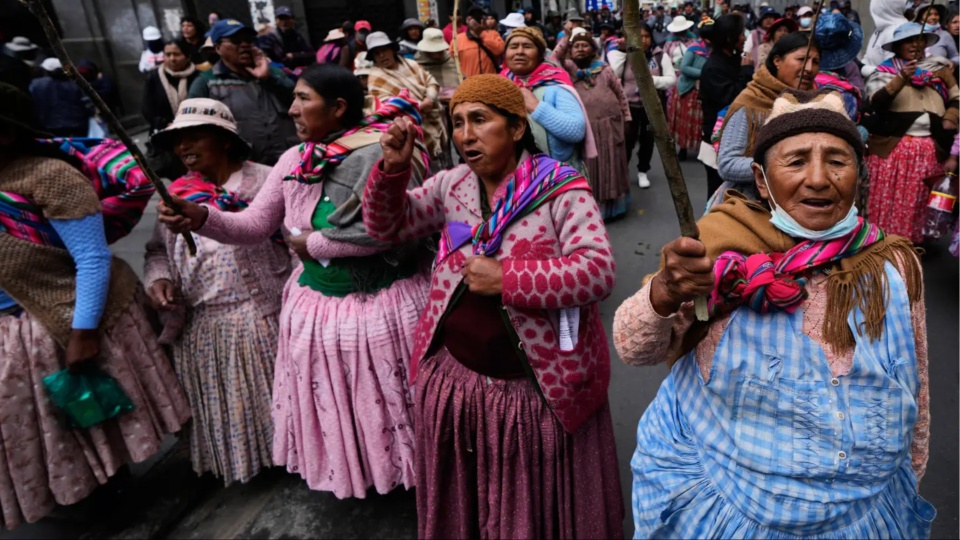
For more than two months, Bolivian Indigenous and working people have been protesting the repressive measures imposed by the government of conservative President Rodrigo Paz, in office since Nov. 8, 2025. Since he took office, it has been one attack after another against living standards and stability.
Pursuing Paz’s agenda, Bolivia’s parliament has eliminated taxation of the very wealthy. Presidential Decree 5503, issued in December, ended longstanding fuel subsidies and instituted privatization measures. Subsequently, fuel prices skyrocketed. Poor-quality fuel is damaging Bolivians’ cars and trucks, leaving them with repair bills.
His government enacted Law 1720 in April, allowing small farmers’ land holdings to qualify as collateral for bank loans. Via foreclosures, bankers and wealthy landowners would consequently be able to absorb more and more small bits of land into larger tracts to further mining and industrial-scale agriculture. Small farmers are losing protections for land ownership established by land reform legislation in 1953.
Chaotic times
Predictably, a firestorm of opposition emerged in response to all these measures. On April 8, Indigenous peoples in Pando and Beni Departments, in the Amazonian lowlands, began a 600-mile march to Bolivia’s capital, La Paz.
Already, the country’s major labor federation, the Bolivian Workers’ Central (COB by its Spanish initials) was demanding higher salaries, better pensions, lower gasoline prices, and limits on privatization—and that President Paz resign.
Together, the Indigenous marchers and COB protesters assembled in La Paz on May 4. The COB represents powerful miners’ unions and labor bodies representing rural teachers, healthcare employees, transportation workers, and farmers. In total, some 70 different unions were on hand.
An alliance between the FSTMB, a federation of mine workers’ unions, and the CSUTCB, a federation of small farmers’ unions, was emblematic of the renewed unity of the labor movement against the common enemy represented by President Paz.
Highway blockades appeared in La Paz and nearby El Alto and extended along roads connecting the capital with Oruro in the Amazonian North. As of May 29, 100 points of blockade were active in six departments. Now, essential goods are not arriving in peripheral areas. This is essentially a general strike.

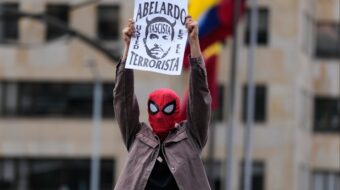
The government mobilized 3,500 troops and police to create a “humanitarian corridor” through roadblocks in La Paz, El Alto, and along the highway heading north. They arrested hundreds of protesters, wounded many, and killed four. Their arrests and killings failed to end the blockades, however.
Officials then resorted to ordering the arrests of COB executive secretary Mario Argullo and 24 other union officials on charges of terrorism and funding by narcotraffickers.
Responding to the pressure, Paz installed a new cabinet, canceled recently-instituted salary increases for high officials, and proposed salary cuts for himself and his cabinet. He dropped the proposed privatization measures and rescinded Law 1720. But the Chamber of Deputies immediately began to consider a revised version.
Paz endorsed a plea for dialogue from the Catholic Church. Even so, Bolivia’s parliament on May 27 voted to allow a “state of exception,” thus authorizing the president to order the army into action against the protesters.
The emergence of Paz and governmental repression of Bolivia’s majority population is reminiscent of the old order that prevailed in the country until 2006. Likewise, the new government projects a highly negative view of progressive political changes put in place after 2006 by President Evo Morales and his Movement Toward Socialism (MAS) party.
Looking back
Historical perspective is useful. Indigenous peoples, reduced to slavery-like conditions, resisted their colonial rulers. Indigenous peoples, small farmers, and workers would later take on Bolivia’s own upper echelons, always given over to plunder and racism. As of 2012, 41% of Bolivia’s population identified as Indigenous. Agrarian reform in the 1950s instituted protection of small land holdings.
Achieving a lot, the Morales government advanced social protections and improved lives and living conditions. Income generated by newly-nationalized oil and gas exports paid for social programming. Then, the troubles began. Dwindling production and sales of natural gas led to reduced funding for both human needs and the purchase of essential imported goods, like fuel.
Additionally, Morales’ problematic scheme for evading constitutional barriers to a third presidential term provoked much criticism.
A U.S.-assisted coup ended his presidency in 2019. MAS presidential candidate Luis Arce won a surprising first-round electoral victory the following year, but Bolivia’s economic situation worsened. Arce and Morales were competing for control of MAS, a situation which contributed to the party’s miserable failing in the 2025 elections.
By that time, Bolivia’s GDP growth was contracting; it had averaged 4% annual growth over 20 years. Imported goods became scarcer, particularly food products, gasoline, and diesel fuel. Foreign currency reserves, source of the dollars needed for imports, were depleted. Inflation exceeded 23%. An observer pointed to “the worst economic crisis in the last four decades.”
Hordes of MAS voters backed presidential candidate Paz. His rhetoric about “Capitalism for all!” was both appealing and ambiguous, while his vice presidential running mate Edman Lara, a progressive, attracted more votes.
The U.S. and its friends
Upon taking office, President Paz restored diplomatic relations with the United States and invited the DEA (Drug Enforcement Administration) back to Bolivia. Former President Morales, alleging dangerous interventions, had expelled the DEA and the U.S. ambassador in 2008.
Responding to the current uprising, Secretary of State Marco Rubio commented: “Let there be no doubt: the U.S. unreservedly supports the constitutional and legitimate government of Bolivia. We don’t allow criminals and narcotraffickers to overthrow democratically elected leaders in our hemisphere.”
The United States on May 15 joined with eight right-wing regional governments in a statement backing President Paz and condemning the strike.
It seems clear that U.S. intervention is on the horizon.
The general secretary of a Cochabamba farmers’ union reported the arrival in Santa Cruz Department on May 28 of a U.S. Air Force Hercules cargo plane carrying “munitions and U.S. military personnel.”
A union official representing six federations in the Trópico region of Cochabamba on May 31 referred to the presence in Cochabamba alone of “296 communication antennas” claimed to be providing “intelligence for the pursuit and capture of the principal leaders who are defending the homeland.”
The same official said U.S. intervention is motivated by the desire “consolidate the delivery of strategic resources like lithium and rare earths to transnational companies.”
The report from Cochabamba mentions U.S. intelligence gathering activities in Santa Cruz Department. That’s significant because U.S. operatives collaborated with the Santa Cruz dissidents who staged the 2019 coup that removed \Morales.
Santa Cruz is a major center of agribusiness and of oil and gas production. The wealthy and privileged of Santa Cruz have long dedicated themselves to suppressing left-leaning politics and Indigenous aspirations. A plot to kill Morales originated there in 2009, and reports emerged at that time of successionist stirrings.

The fascist-inclined Santa Cruz Civic Committee recently hosted a meeting on the current crisis attended by representatives of the country’s other civic committees and by a stand-in for President Paz. Meanwhile, the Santa Cruz Association of Municipalities indicated through a spokesperson that, “We cannot allow an insignificant and radical group to settle in and ask the president to resign.”
Sen. Branko Marinkovic, emblematic Santa Cruz agricultural mogul and secessionist plotter against Morales, was a “key sponsor” of the aforementioned Law 1720. The media refer to the “Marinkovic Law.”
What future comes?
President Paz blames the protests on Morales, who responds that it is the government’s own policies which are sparking demonstrations. The former president told an interviewer recently that, “This government is totally subservient [to the United States]. I realize that the time has come to define who is in charge, the empire or the people…. This rebellion, I am convinced, opposes the neoliberal model and the neocolonial state.”
Morales, playing no major role in the current protests, is hiding in the Chapare part of Cochabamba Department, where his political and union-organizing career took off. Accused of sexually abusing and impregnating a 15-year-old girl, Morales faces criminal charges. His defenders dismiss these as pretext for his removal from politics, but an arrest warrant still stands and, legally, Morales is a fugitive.
Milton Machuca Cortez, author of Socialismo en Bolivia, commented on June 3 that President Paz may yet resign, but also that this protest, or general strike, must “mature.”
He adds, “It is not enough to bring down a government if there is no political project capable of replacing it. It is not enough to say ‘out’ if we do not build a ‘toward.’ The left cannot be content with anger; it must turn that anger into a program, an organization, and a vision.”
We hope you appreciated this article. At People’s World, we believe news and information should be free and accessible to all, but we need your help. Our journalism is free of corporate influence and paywalls because we are totally reader-supported. Only you, our readers and supporters, make this possible. If you enjoy reading People’s World and the stories we bring you, please support our work by donating or becoming a monthly sustainer today. Thank you!
CONTRIBUTOR