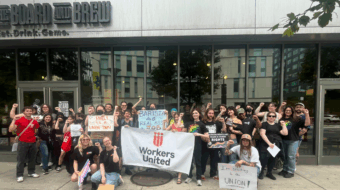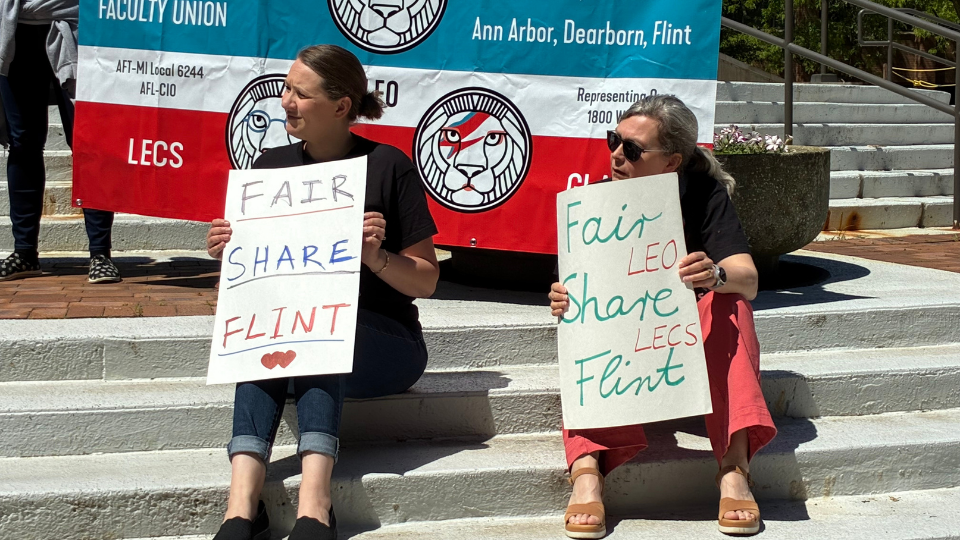
FLINT, Mich.—Outside the local University of Michigan (UM) satellite campus, Flint workers waited for the school to return their concerns with a counter offer. University management has responded with an offer of zero, leaving their employees wanting.
These disappointed workers belong to LEO Lecturers, a union formed in 2004 to secure fair pay and working conditions for the non-contract librarians, lecturers, archivists, and academic workers which make learning happen across all three UM campuses. Lecturers in Flint now fight against a budget proposal which many argue would keep their salaries laughably low while their employer makes money hand over fist.
Even before the double-whammy of the Flint-wide water crisis and the COVID-19 pandemic threatened UM-Flint’s campus operations, strategic transformation planning had been proposed. The most recent was done with the help of Huron Consulting Group, which has a very contentious history with academia.
Despite existing barriers to higher education, UM-Flint saw an increase in student enrollment and retention rates. According to reports from unions and the Chancellor of UM-Flint, lecturers saw a 27% increase in class size and taught 19.4% more credit hours between the Fall 2023 and Fall 2025 semesters.
This student boom increased revenue for the school, but it did not raise incomes for the staff; even after their workloads increased by more than a quarter, many Flint lecturers make less than $35,000 a year. Many live paycheck to paycheck, work part-time jobs to make ends meet, and even require federal assistance.
In 2024, LEO Lecturers successfully installed a Memorandum of Understanding (MOU), which calls for university management to renegotiate salaries if annual credit hours increase by at least 10%. Since a 19.4% increase is well above the stated threshold, LEO Lecturers met to bargain at the beginning of June.
“Excited to deliver a fair share,” said President Cydnee Giffen of LEO Lecturers to this reporter in a room surrounded by other union and community members standing in solidarity.
In that room showing solidarity was Penni Toney, a UMMAP member, who described “just bringing up wages of very low working workers that we represent” as a very difficult aspect of labor organizing.
The All Campus Labor Council on University Campus helped UMMAP; “We were able to tap into the knowledge from our union siblings, like, LEO… They were great at giving us strategy.”
Response from management
Accounts from both the bargaining team and rank-and-file lecturers indicated that management had not prepared an offer, despite knowing for months that the MOU had been triggered.
Much of this experience brought back memories for union members and allies of Huron Consulting Group’s involvement at UM-Flint.
This dismissal left many LEO members and allies feeling as if the university had not taken them seriously. These feelings would only intensify on Friday, June 5, when management returned with a proposed salary increase of zero dollars, even after the union had decreased its request from 6.5% to 5.5%.
On Monday, June 8, management refused the raises yet again, even after the union, in good faith, lowered its proposed amount by 0.5%.
Management pointed to trouble with financing and other spending commitments for building maintenance, but it is unclear how they are connected to financing.
Many members and allies at a virtual rally after the June 8 meeting expressed their concern as they felt management’s pushback neglected the increased work intensity of the lectures and the cost-of-living crisis.
In response, LEO members and allies are organizing a cordial “phone zap,” in which a great number of people call the Chancellor at a specific time to express the dire need for a salary increase.
Why is this allowed?
One could argue that if this week-long battle with UM-Flint to make them honor an MOU—an agreement they had voluntarily made years ago—teaches the public anything, it is that universities do not have to listen to their unions.
This power imbalance, like many others, comes down to money; unions often do not have enough funds to organize more substantial countermeasures, hence why they regularly employ cost-effective measures such as phone zaps.
American unions were much tougher to ignore in the 1970s, before companies unceremoniously shipped off the bulk of their manufacturing jobs to countries with few to no labor protections. 1977 saw the Supreme Court rule that unions could collect dues even from non-unionized workers, a decision that could only have been made during a time when unions were deemed an essential component to maintaining democracy in the workplace.
Many union organizers assert that, at its core, a union’s responsibility is to protect every worker against corporate interests. Regardless of their membership status, practically every rank-and-file worker in a company structure benefits from pay raises, retirement benefits, and base safety standards secured by a strong union.
Fifty years later, the American economy is now dominated by information instead of goods, and corporations have seemingly “pivoted” away from virtually every industry that set a precedent for strong unions. The Supreme Court’s send-off to American union power came in their 2018 Janus V. AFSCME ruling, which repealed their 1977 decision and stated that “unions can be effective without agency fees.”
Newer, technology-oriented industries have struggled to unionize for the better part of 30 years and have only seen limited success in the last few years. A recent Executive Order from President Trump has only accelerated the number of federal agencies terminating their own collective bargaining agreements.
Despite financial hurdles, unions like LEO Lecturers continue to fight and bargain on behalf of workers. Yet, despite this good faith effort, management did not propose a counter and signaled they would be willing to meet Monday, June 15.
We hope you appreciated this article. At People’s World, we believe news and information should be free and accessible to all, but we need your help. Our journalism is free of corporate influence and paywalls because we are totally reader-supported. Only you, our readers and supporters, make this possible. If you enjoy reading People’s World and the stories we bring you, please support our work by donating or becoming a monthly sustainer today. Thank you!
CONTRIBUTOR