PHILADELPHIA—So far, it’s been “strike summer” here in Philadelphia. As the city prepared to take the global stage for the 2026 World Cup and the nation’s 250th anniversary, the battle lines of the class struggle were squared up across the city.
On one side stood corporations raking in ever-increasing, record-breaking profits. On the other side stood the workers—the bedrock of the city’s economy—holding the line on the pavement in oppressive, historic heatwaves.
Anticipating a massive influx of international tourists and booming profits for local hospitality monopolies ahead of the World Cup and America 250 celebrations, hotel workers, organized with Unite HERE Local 274, took the offensive by announcing their intent to strike.
Fortunately, the hotel workers did not stand alone. The Association of Flight Attendants (AFA-CWA) pledged that their members would refuse to cross any Unite HERE picket lines, threatening a massive disruption to the aviation and hospitality pipelines.
The threat of the potential strike forced the local government to act. The Philadelphia City Council introduced a new bill requiring hotels to notify guests of labor disputes and service disruptions, allowing them to cancel their stays without penalty. The bill, supported by the union and modeled after existing pro-worker consumer laws in New Jersey and New York, put the financial onus of labor disruptions squarely back on hotel management.
This summer’s offensive built upon the momentum of successful strikes last fall at three Center City hotel locations. Workers at the remaining unorganized or holdout Center City hotels used those victories as leverage, pressuring management to agree to a landmark $30-an-hour wage floor by 2028. Beyond wages, the new deals successfully lowered the grueling daily room quotas for attendants, secured vital improvements to pensions and healthcare coverage, and enshrined stronger protections for immigrant workers.
At the historic Warwick Hotel in Rittenhouse Square, workers voted unanimously to authorize a strike on June 24 if their demands were not met by midnight. Management blinked, and a strike was averted at the eleventh hour. Meanwhile, at the Center City Sheraton, workers successfully walked the picket line for nine days before forcing management to agree to a new contract.
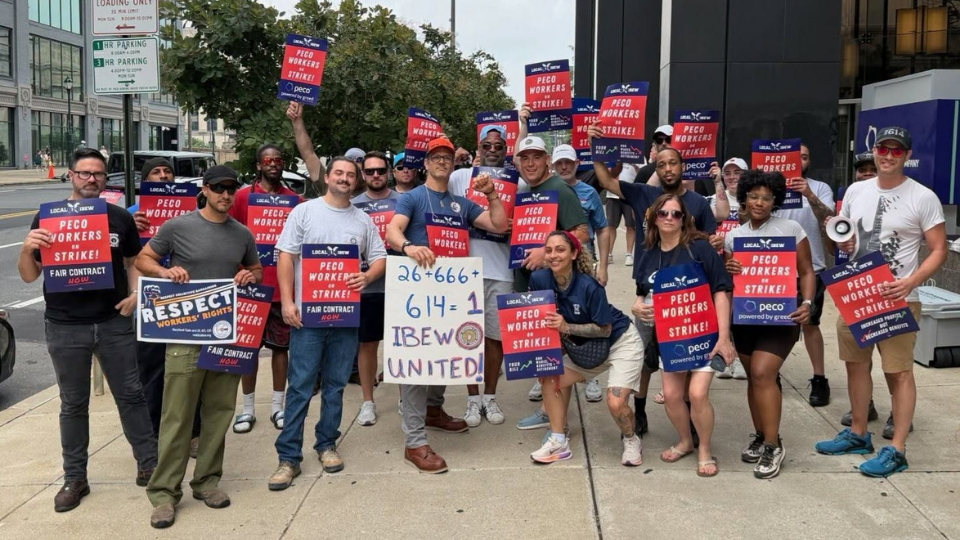
As the hospitality strikes cooled down, another major labor battle loomed. The International Brotherhood of Electrical Workers (IBEW) Local 614 officially put the Pennsylvania Electric Company (PECO) on notice. With their demands for better wages unmet by management ahead of a July 4th deadline, IBEW members walked out. It is the first strike in PECO’s history.
Like the hotel workers’ fight, the PECO strike highlights the profound economic inequality plaguing the city during a moment of public celebration. But while the hotel strikes focused on the city’s image as a tourist hub, the IBEW strike quickly escalated into a high-stakes battle over public infrastructure during a massive heat wave.
On July 4, the first day of the IBEW strike, Philadelphia broke a climate record, reaching over 101 degrees Fahrenheit for three consecutive days for the first time since 1873.
Ahead of the walkout, and under deep pressure, Mayor Cherelle Parker sent a letter urging PECO executives and IBEW Local 614 leadership to find common ground:
“Philadelphia is on the world stage, welcoming hundreds of thousands of residents and visitors to celebrate America’s birthday on the Fourth of July,” Parker said. “We are also in the midst of extreme weather conditions that we know will disproportionately impact our oldest and most vulnerable residents. Any disruption to PECO service and support would pose real risks to public health, safety, and economic activity…”
Over the holiday weekend, the extreme weather led to delays and cancellations of several America 250 celebrations. The weather, in combination with the effects of the strike, made it so that at one point, more than 50,000 customers across the region were without electricity.
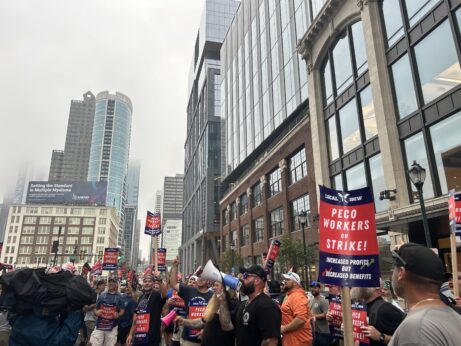
IBEW Local 614 workers began picketing outside PECO’s headquarters at 23rd and Market Streets on Saturday in record-breaking heat and were back again on Sunday. A small crew of Local 614 workers held the line, supported by rank-and-file members of other local unions who came out in solidarity. By Monday morning, with storm clouds looming on the horizon, hundreds of utility workers and community allies gathered on a massive picket line nearly the length of the entire block.
Barely a minute passed without a chorus of horns from passing cars, SEPTA buses, and commercial trucks blaring in solidarity with the workers. IBEW Local 614 reported a staggering 80% approval rating among the public for the strike.
It can be argued that, similar to the hotel workers’ strike, the Electrical Workers strike is yet another example of the massive wealth gap between the working class and the bosses: a $24 million executive payday and an 8% rate hike for residents, contrasted against workers whose wages lag 30% behind the cost of living and industry standards.
PECO and IBEW Local 614 reached a tentative agreement on Monday after 3 days of negotiations. The union celebrated major wins for all members: yearly wage increases, pension plans, and retirement health coverage.
“IBEW Local 614 is ending our strike with a historic win and a landmark contract,” said Larry Anastasi, President and Business Manager of IBEW Local 614. “This is the beginning of a new era at PECO, one where greed does not go unchecked, and the workers who make modern life possible get the respect and dignity we are owed.”
We hope you appreciated this article. At People’s World, we believe news and information should be free and accessible to all, but we need your help. Our journalism is free of corporate influence and paywalls because we are totally reader-supported. Only you, our readers and supporters, make this possible. If you enjoy reading People’s World and the stories we bring you, please support our work by donating or becoming a monthly sustainer today. Thank you!
CONTRIBUTOR