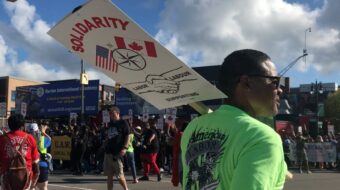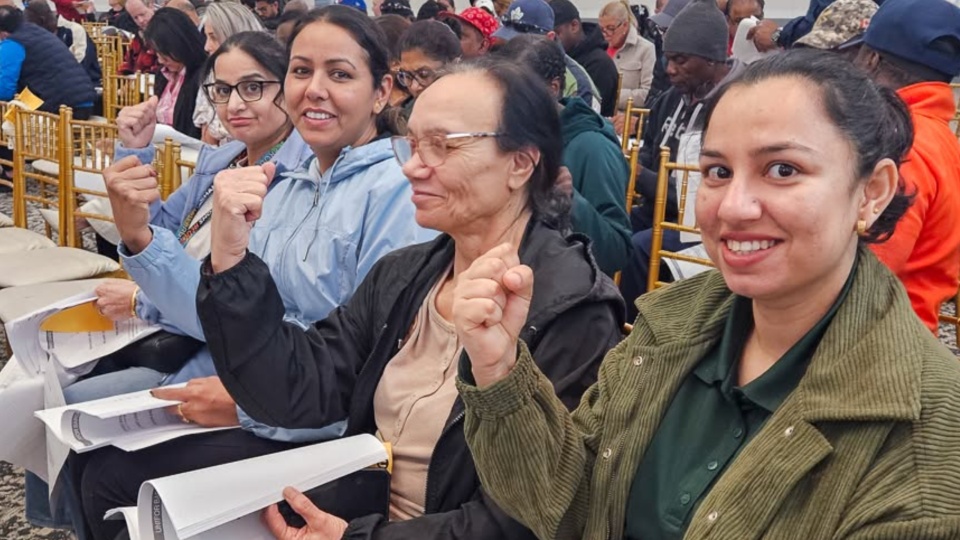
MISSISSAUGA, Canada—In a historic moment for organized labor, 800 Walmart workers at a warehouse in the Toronto suburb of Mississauga voted overwhelmingly to approve their first-ever collective bargaining agreement with the retail giant. The workers are members of Unifor Local 252, and their vote marks the first time that a union contract has been reached with Walmart anywhere in North America.
The contract vote, which passed with 93% approval, caps a nearly two-year organizing drive at the Walmart facility. Workers here first voted to unionize in 2024, marking a breakthrough in labor’s long and difficult history with the company, which is one of the most anti-union corporations in the world.
The new two-year agreement includes several hard-won provisions: wage increases of up to $5 per hour in the first year with a 3% increase in the second, a “me too” clause ensuring all Walmart warehouse workers receive wage increases (not just some), job security protections, and reparations for unfair labor practices stemming from Walmart’s denial of wage increases to its workers.
Organizing against a behemoth
Both the U.S. and Canadian trade union movements have historically struggled to organize Walmart, the largest private sector employer and one of the largest monopolies in North America. In the United States, the Teamsters, UFCW, and SEIU all launched campaigns, with the Teamsters beginning organizing efforts in the 1980s.
But Walmart founder Sam Walton, whose anti-union stance was shaped by his exposure to anti-union tobacco companies in the South, stifled progress. In Public Affairs, Rick Wartzman described Walton’s tactics: “All of this was illegal, but that didn’t seem to give Walton any pause.”
Walton died in 1992, but his anti-union legacy persisted at the company. As neoliberal austerity laws gutted labor militancy, the fight for workplace democracy at Walmart became harder in both the U.S. and Canada.
In an exclusive interview with People’s World, Unifor organizer Justin Gnopsky detailed the history of organizing Walmart in Canada. Before the Mississauga victory, previous attempts focused primarily on retail stores, led by UFCW Canada.
“There’s two cases here in Canada where a union was certified with Walmart,” Gnopsky said. “It did not reach a collective agreement, unfortunately, but they were certified.”
In one notable UFCW case, workers won a union vote, but as Gnopsky recounted, “Walmart had broken the law there.” Under Quebec law, the province’s labor minister could impose arbitration if bargaining stalled. On April 29, 2005, just months after that provision took effect, Walmart responded by completely shutting down the organized store.
The company avoided bargaining with organized labor by closing stores or particular parts of its operations—like its tire and lube auto centers—entirely. This history convinced Unifor to try focusing on distribution and logistics centers rather than retail outlets.
The road to unionization
The push to organize came from workers’ frustration over stagnant wages. “They had just lived through the pandemic,” Gnopsky said. During COVID-19, Canadian essential workers received so-called “hero pay.” But as soon as lockdowns ended, Gnopsky said, attitudes from employers shifted.
“It’s back to minimum wage for them,” he said. “If they don’t like it, hit the bricks because everyone else is looking for a job. That’s what these workers were told.”

As the cost of living rose with rapid inflation—driven largely by corporate profit-maximizing—Walmart distribution workers began exploring their options. Organizing efforts began in late 2023. By early 2024, Walmart had become aware that something was up.
“The company would send security guards out whenever we went to sit there,” Gnopsky said. “There’d be like eight of them. It was intimidation.”
Despite the coercion, organizers persisted, collecting more union cards and preparing for ballot elections and legal challenges from the company. The union applied for a ballot vote in August 2024, and on Sept. 13, 2024, the union was officially certified.
The fight for a contract
Between September 2024 and May 2026, Walmart employed its classic delaying tactics. “These guys slow-roll everything they can,” Gnopsky said.
During that period, Walmart granted wage increases to non-union workers, outsourced jobs to temporary workers and contractors, and engaged in other actions aimed at undermining the union. But the workers’ steering committee—made up of longtime employees of the facility—remained persistent.
“We have a strong group of folks,” Gnopsky said. “A lot of these people have high seniority, and they have respect. They’re what we would call the natural leaders within the workplace.”
During this time, Unifor succeeded in organizing two more bargaining units with Walmart in Alberta and British Columbia. After those victories, Walmart gave non-union workers another wage increase, Gnopsky said.
Despite the slow-rolling and other unfair labor practices, a collective bargaining agreement was reached in May 2026.
A win for the Canadian labor movement
Gnopsky emphasized that patience is key to organizing. “You have to be invested in the time,” he said. “Spending the time with the committee and building them up.”
That advice comes as Canada’s labor movement seeks to reverse declining union density, which has fallen from 37.6% in 1980 to 30.4% in 2023. While the drop has been far less severe than in the United States, the trend is steady.
For decades, Canadian workers have faced setbacks from austerity and free trade agreements like NAFTA. Corporate profits in Canada grew more than 800% between 1980 and 2023, according to an Oxfam report. In just the past few years, the wealth of “Canada’s richest 40 billionaires grew by almost $95 billion—more than 20%.”
In an attempt to revitalize the labor movement, the Canadian Auto Workers (CAW) and the Communications, Energy, and Paperworkers Union of Canada (CEP) merged in 2013 to form Unifor. The union’s constitution allocates 10% of national dues revenues—at least $10 million annually—to organizing.
In the aftermath of COVID-19, Unifor and other Canadian unions have seized on growing worker dissatisfaction, launching campaigns and building solidarity. Unifor supported locked-out workers at a Co-Op refinery and launched a “Warehouse Workers Unite” campaign. It was because of the latter that workers at the Mississauga Walmart warehouse reached out to Unifor.
While Unifor is not formally part of the Canadian Labour Congress (CLC), its recent organizing victories—including the landmark Walmart agreement—demonstrate that despite decades of austerity and recent pro-corporate measures by Liberal Prime Minister Mark Carney’s government, victories for organized workers are still possible.
We hope you appreciated this article. At People’s World, we believe news and information should be free and accessible to all, but we need your help. Our journalism is free of corporate influence and paywalls because we are totally reader-supported. Only you, our readers and supporters, make this possible. If you enjoy reading People’s World and the stories we bring you, please support our work by donating or becoming a monthly sustainer today. Thank you!
CONTRIBUTOR