DETROIT—Primary election results Aug. 4 showed corporate donors—as well as pro-Israeli government lobbyists—that it’s not going to be easy for them to buy voters anymore. In many areas across the nation, and not just in deep-blue districts and states, mass movements beat corporate cash and manipulation by Democratic Party leaders determined to maintain a status quo that makes tweaks around the edges rather than institute the sweeping changes needed by the people.
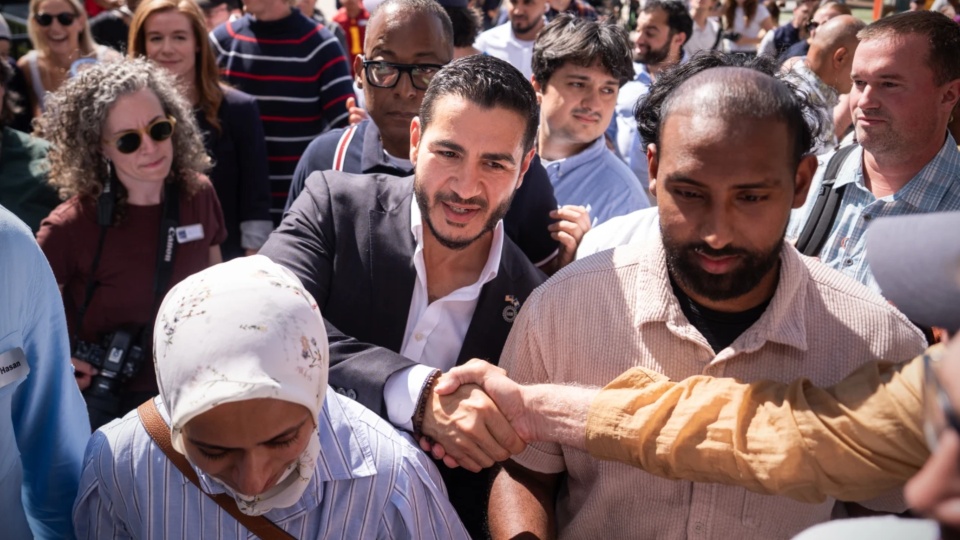
Dr. Abdul El-Sayed’s win in the Michigan Democratic Senate primary was the biggest example of what a mass movement can produce. Record turnout propelled him to victory over the party establishment’s choice, “moderate” Rep. Haley Stevens—despite the fact that he was outspent 10-to-1.
El-Sayed benefited from a strong ground game, as his volunteers were energized by his progressive stands on Medicare for All, against U.S. military aid to Israel, against the Trump-Israeli war on Gaza and Iran, and for battling climate change and for aid to education. On the stump, El-Sayed fiercely and passionately denounced MAGA’s attacks on workers, immigrants, and democracy.
“Dark money” donations, including $60 million funneled through the right-wing American Israel Public Affairs Committee (AIPAC), backed Stevens, who had support from the U.S. Senate Minority Leader Chuck Schumer and outgoing Michigan Gov. Gretchen Whitmer, among others.
AIPAC acts as a voice for Israeli foreign policy in U.S. politics, including the genocide in Gaza. It dumped more funds into the campaign against El-Sayed than it has spent in any other single election in history. AIPAC was so prominent in the primary that the vote became, in part, a referendum on its role in elections.
Michigan has a large and growing Muslim-American population centered, among other places, in Hamtramck, which is surrounded on all sides by the city of Detroit. It has long been a major center in the auto industry and went heavily for El-Sayed. Metro Detroit’s notable Jewish population split. Older voters went for Stevens, with aid to Israel a major concern. Younger ones, opposing the Israeli government’s war on Gaza—and the Israeli government’s close ties to President Donald Trump—went for El-Sayed.
After Stevens’ loss, AIPAC pivoted to essentially declaring it now backs the Republican nominee for the seat, former U.S. Rep. Mike Rogers. Trump endorsed Rogers, who has repeated the president’s false claims about election theft in 2020. AIPAC issued a statement saying that it remained “determined to ensure voters reject” El-Sayed “and his radical anti-Israel agenda.”
Despite the big money spent to block the progressive candidate, though, AIPAC came up short, and plenty of forces are determined to repeat that outcome in November. Volunteers on the ground and pro-worker organizations—including National Nurses United and the United Auto Workers—along with progressive leaders such as Reps. Rashida Tlaib, D-Mich., Ayanna Pressley, D-Mass., and Alexandria Ocasio-Cortez, D-N.Y., and Sen. Bernie Sanders, Ind-Vt., produced 735,625 votes (48.6%) for El-Sayed to 716,222 (47.3%) for Stevens.
Progressives gain steam
El-Sayed’s triumph wasn’t the sole people-powered win on Tuesday. Another was the victory in a congressional primary in Michigan by the young William Lawrence, a founder of the Sunrise Movement, an organization of young people determined to protect the environment.
In Michigan’s 13th U.S. House district Democratic primary in Detroit and suburbs, 34-year-old Donavan McKinney, a Democratic Socialist, defeated second-term incumbent and multimillionaire Shri Thanedar 52%-48%.
The seat is safely Democratic, and it also means Detroit, which is 75% African-American, 11% white, and 8% Hispanic, will have one African-American member of Congress, instead of none. The city’s other lawmaker, Tlaib, a Palestinian-American, scored an easy win in her race. She, along with Sanders and Ocasio-Cortez, aided McKinney’s drive.
These developments follow a pattern, apparent in Zohran Mamdani’s victory in the New York City mayor’s race last year: Take a progressive stand, defend it, stand up strongly against Trump and MAGA, and you can emerge triumphant.
That trend was also evident in a special U.S. House election in Arizona last year, where progressive Adelita Grijalva won, and in New York when former City Comptroller Brad Lander ousted millionaire pro-AIPAC Rep. Dan Goldman in the party primary, while progressive Darializa Avila Chevalier beat insider Rep. Adriano Espaillat.
Virginia featured two notable U.S. House primaries on Tuesday, both won by progressive Democrats. In the 2nd District anchored by Newport News and Hampton Roads, former Rep. Elaine Luria, a Trump impeachment manager and a military veteran, will face the pro-Trump Republican who narrowly unseated her four years ago, Jen Kiggans. The Steelworkers union is strong in the district.
In the 5th District, where deep-red territory surrounds the blue college town Charlottesville, former Rep. Tom Perriello, who represented the area for one two-year term, will face Republican Rep. John McGuire. The GOPer is a Trump backer, and the district tilts Republican.
Missouri’s mixed picture
Bucking the trend, the most prominent progressive loss came in Missouri’s St. Louis-based 1st U.S. House district. Rep. Wesley Bell, a “moderate” former prosecutor and a favorite of AIPAC, faced a rematch with the former incumbent, Cori Bush.
Bell beat Bush with AIPAC’s help two years ago. Their 2024 race was close, but this one wasn’t. Bell prevailed over Bush—a nurse and social worker, a member of “The Squad,” and a strong critic of U.S. military aid to Israel—59% to 37%.

Other outcomes in the state were positive, though. The Republican majority in the heavily gerrymandered state legislature pushed two favorite right-wing brainstorms to ballot referenda, but both lost.
One referendum was a constitutional amendment to gradually eliminate the state income tax and other taxes that hit the rich and shift the Show Me State’s chief revenue source to sales taxes, which disproportionately hurt lower- and middle-income voters. It was sunk, earning only 17% support.
The other constitutional amendment would have made it difficult for citizen-initiated referenda to pass, by requiring them to win majority support in every individual Missouri congressional district, not just statewide. The practical impact of that would be to give the most-right-wing district, in southwest Missouri, a veto over the rest of the state.
Had it been in effect already, Missouri voters could not override the right-wingers in the legislature and raise the state’s minimum wage, enact paid family and medical leave, support workers’ rights, and vote to keep abortion—as they’ve done in recent years. This outcome means voters can still exercise their will statewide, as this GOP brainstorm lost by a 4-1 ratio.
Unrelated to the primary or the two referenda but coming on the same day, Missouri’s Republican Secretary of State Denny Hoskins refused to certify a separate referendum initiated by citizens seeking to reverse the state’s new GOP-drawn congressional map, arguing that the effort was unconstitutional. Calling it a “desperate move to silence the people’s voice,” the key group opposing the Republican gerrymandering, People Not Politicians, said it plans to sue Hoskins.
Prairie progress
After the U.S. Supreme Court stripped women nationwide of their reproductive rights, the Kansas legislature’s GOP majority enacted an almost-total ban on abortions. Citizens groups and unions petitioned it to a referendum and decisively overthrew the ban.
Angered, Republicans reacted this year with a referendum to change how state Supreme Court justices are chosen—moving to a popular vote rather than having them be appointed by the governor with consent of the legislature. The voters saw through the scheme and defeated it, 61% to 39%.
Kansas Democrats nominated the pastor of the largest Methodist Church in the U.S., Adam Hamilton, to face off against incumbent GOP Sen. Roger Marshall in a race that GOP leaders in D.C. are suddenly worried about.
The party has a slim hold—53 seats out of 100 total—in the U.S. Senate, and the GOP has reserved more ad time on Kansas media this fall than it has in much-larger, and vastly more-expensive, Texas.
Other state races
Kansas and Michigan voters nominated potential successors to term-limited Democratic Govs. Laura Kelly and Gretchen Whitmer. In Michigan, the nominee is incumbent Secretary of State Jocelyn Benson, a progressive menaced by Trump supporters two years ago. Whitmer was also a target of a kidnapping plot.
Benson will face U.S. Rep. John James, a Trump supporter. His swing seat is open and former prosecutor Christina Hines won a three-way race for the Democratic nomination, garnering 46% of the vote.
In Kansas, GOP State Senate Majority Leader Ty Masterson will face Democratic State Sen. Cindy Holscher, who favors a ban on water-guzzling, power-guzzling data centers.
Years of work paying off
In many cases, Our Revolution said in a statement, the victories Aug. 4 followed years of community organizing by progressive labor and other organizations.
“Workers have learned that the elections are the way billionaires buy power to benefit themselves at their expense. The results last night show this clearly,” the group said.
“They want elected officials to take care of the crisis facing the nation, not just to manage our decline.”
We hope you appreciated this article. At People’s World, we believe news and information should be free and accessible to all, but we need your help. Our journalism is free of corporate influence and paywalls because we are totally reader-supported. Only you, our readers and supporters, make this possible. If you enjoy reading People’s World and the stories we bring you, please support our work by donating or becoming a monthly sustainer today. Thank you!
CONTRIBUTOR