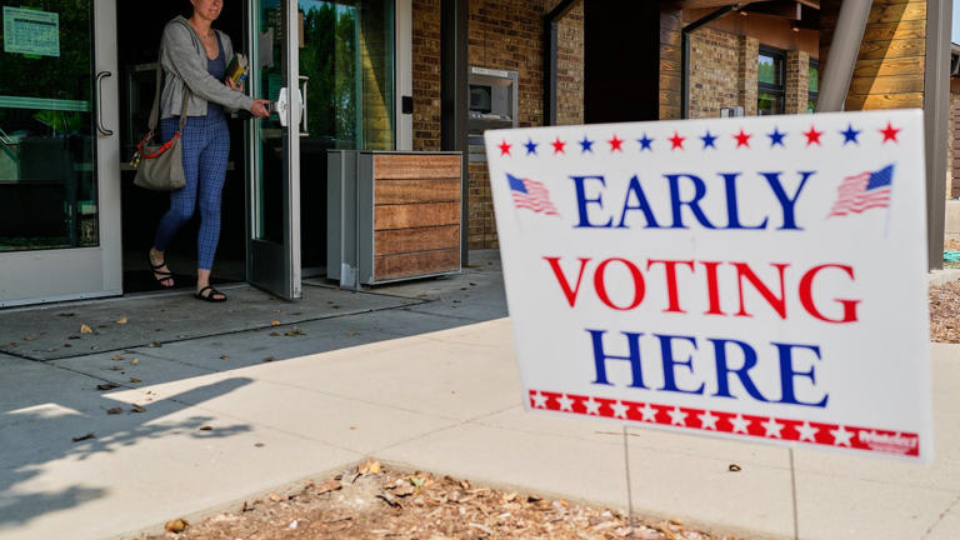
MADISON, Wis.—It may be the dog days of August, but these days are about much more than the weather for primary voters in Wisconsin, Minnesota, a congressional district centered on Hartford, Conn.
On Aug. 11, voters will go to the polls in several Democratic Party primary races and decide whether to keep the faith with the party establishment or nominate representatives of the party’s more progressive wing.
Polls show that the electorate will likely continue choosing candidates who take strong positions on the issues—particularly those listening to workers’ cost-of-living concerns as opposed to the ones who hold back thinking that “moderation” is the way to win against Republicans in November.
Wisconsin rejects red-baiting
In Wisconsin, State Rep. Francesca Hong is described as too radical by some of the Democratic Party regulars. They argue that nominating her would be a favor to Republicans, who have tried to tie her to the extreme left or to “socialists” and “communists.”
Hong, who is a chef, a single mother, and a community organizer who proudly calls herself a member of the Democratic Socialists of America, enjoys double-digit leads in the polls over Milwaukee County Executive David Crowley.
Progressives note that the moderate Democrats are ignoring reality. Republicans are red-baiting precisely because they have nothing else to offer beyond cuts to Medicare, Medicaid, and Social Security, along with the war on Iran. Candidates like Hong, meanwhile, back the substantial changes most voters want, including affordable prices and improved health care for all.
“We can fully fund our public schools and have universal childcare. We can guarantee paid leave and have cheaper health care. We can fix a rigged system that puts oligarchs over workers and small businesses,” Hong says in her campaign ad.
“I’m fighting for the working class because I am working class,” she declares. “I’ve been working-class my entire life. When COVID lockdowns decimated the Madison restaurant industry, we organized home meal delivery and mutual aid programs to keep our workers afloat and our most vulnerable neighbors fed.
“There’s no reason most of us need to endure an affordability crisis while our government gives tax breaks to data centers and the donor class, or that we need to sit by while our natural resources are put up for sale to whomever has the right political connections.”
Meanwhile, the Democratic establishment floundered for a candidate to oppose Hong. In a state where Democrat Joe Biden beat Donald Trump in 2020 by less than 1%, and Trump turned the tables on Democratic nominee Kamala Harris in 2024 by 0.9%, nothing can be taken for granted, particularly since the right wing can and has poured millions of dollars into its state campaigns.
One “establishment” candidate, Lt. Gov. Sara Rodriguez, dropped out when audits uncovered massive embezzlement by her campaign treasurer. Former lieutenant governor of Wisconsin, Mandela Barnes dropped out due to lagging poll numbers. Both—and others—withdrew so late, however, that their names are still on Wisconsin ballots.
A third establishment favorite, Crowley, endorsed by retiring Democratic Gov. Tony Evers, dropped out of the race on July 8, then dropped back in on July 18 when Barnes and Rodriguez withdrew. Crowley is bidding for moderate support by touting his record as County Executive, and his electability.
“To win, the Democratic nominee must do three things: Boost turnout in Milwaukee, grow margins in the suburbs, and hold the line in rural communities. David is the only candidate who can do all three with the results to prove it,” his website claims.
Crowley also states his moderation would help down-ballot Democratic legislative candidates retake total control in the state capital of Madison after more than a decade of partisan—and anti-worker—GOP rule there.
Tiffany, the leading Republican and a business owner, has refused to participate in Wisconsin candidate debates. He has tied himself to Trump and spouts Republican rhetoric against progressives and “coastal elites,” spouting code words about border security, “fiscal responsibility,” and “restoring order” while trashing “unelected bureaucrats.”
Minneapolis uprising continues
Across the Mississippi River, Minnesota has an open gubernatorial race, as incumbent Democrat Tim Walz was forced to drop his candidacy for re-election after becoming a Trump target of investigations over alleged fraud related to federal Medicare and other low-income aid.
U.S. Sen. Amy Klobuchar, also a Democrat, is expected to waltz into the executive mansion in St. Paul. The GOP nominee is Trump loyalist and major donor Mike Lindell, CEO of My Pillow.
The progressive standard-bearer in the state’s U.S. Senate race is Lieut. Gov. Peggy Flanagan, while the establishment favorite is U.S. Rep. Angie Craig. Sen. Tina Smith, DFL-Minn., who currently holds the seat, along with Sen. Bernie Sanders, Ind-Vt., are backing Flanagan.
Unlike the gubernatorial contest, this race is closer. One of the two most recent polls shows Craig with a two-percentage-point lead. The other shows a flat-out tie, with about a sixth of voters undecided. Other polls favor Flanagan, by anywhere from seven to 14 percentage points.
Trump, now deeply unpopular in Minnesota, is expected to be a dead weight on the ticket for down-ballot Republicans. The most recent polls there, six months after Trump’s ICE and Border Patrol troops gunned down Minneapolis residents Renee Nicole Good and Alex Pretti in cold blood as they were observing anti-immigrant sweeps, produce 94% Democratic disapproval.
Connecticut contention
In Connecticut’s 1st U.S. House District, three insurgents may split the vote, giving veteran Democratic Rep. John Larson the win. He’s got the support of the state’s entire House delegation, along with a list of unions, though the state AFL-CIO has stayed neutral.
The Working Families Party endorsed Larson, the only congressional candidate it backed in the Nutmeg State. That’s notable because the party was silent on the re-election bid of Rep. Jahana Hayes, D-Conn., a union member and former National Teacher of the Year—and whose 5th District produces one of the two lowest Democratic margins in U.S. House races. She won in 2024 by 53% to 46%.
The big issue pushed in the 1st District by the three foes—Luke Bronin, Jillian Gilchrest, and Julia Fortune—is that the district needs new and fresh blood to stand up to Trump. Larson was first elected in 1998. He touts his record on constituent service, his leadership on issues involving the aging and nurses, and his clout from seniority in Congress.
Bronin, a former Obama administration official and mayor of Hartford, drew 51% of the votes at the state Democratic convention, but its endorsement is non-binding. A hopeful needed 15% to make the primary ballot, and the other three—Larson, Gilchrest, and Fortune—did.
“We need a bold, clear vision. And we need members of Congress who are out there every day building the political movement to make it possible. That’s why we need new energy, new ideas, and new perspectives in Washington,” Bronin said in a campaign statement.
Voters’ priorities everywhere are clear
Regardless of whether it’s an established name or an up-and-coming progressive who prevails in each of these primary contests, the issues that are driving voters in state after state remain similar.
“The races will come down to how people feel about the economy, the war and the Trump threat to democracy,” a union analyst in Minnesota told People’s World. “The farmers feel they’re being squeezed by Trump’s tariffs, the high prices for gas for their cars and diesel fuel for their tractors, and even fertilizer, since it’s made with petroleum.
“And when you go to the grocery store, prices keep going up and up.”
Will the moderates get the message?
We hope you appreciated this article. At People’s World, we believe news and information should be free and accessible to all, but we need your help. Our journalism is free of corporate influence and paywalls because we are totally reader-supported. Only you, our readers and supporters, make this possible. If you enjoy reading People’s World and the stories we bring you, please support our work by donating or becoming a monthly sustainer today. Thank you!
CONTRIBUTOR