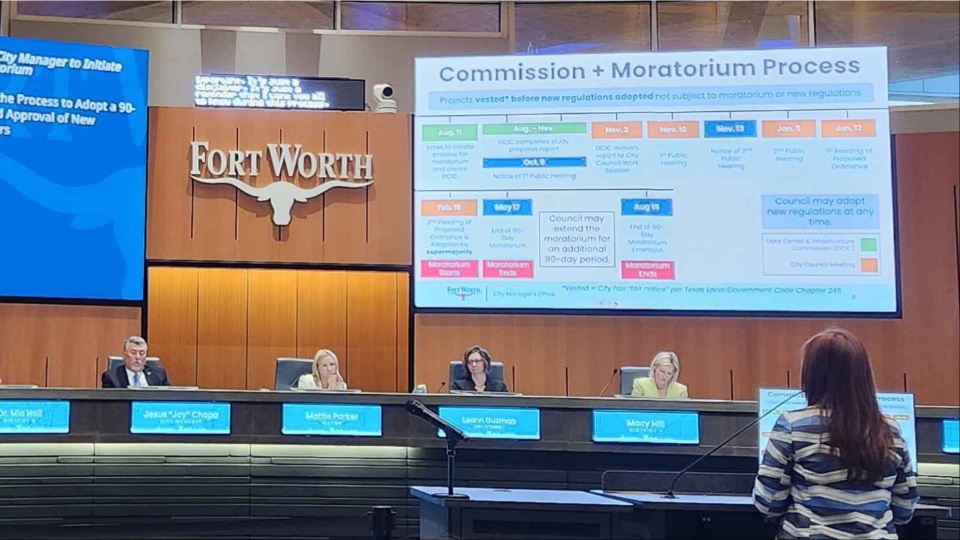
FORT WORTH, Texas—On the evening of Tuesday, Aug. 11, crowds of Fort Worth residents gathered at City Hall for a city council meeting to let lawmakers know their opinions on data centers.
Their demands: a moratorium halting all future data center construction in the city for 90 days with an additional 90-day extension as allowed by state law, a civilian body representing affected communities to make decisions on data centers, and requirements that data center applications will have to include proof that the Public Utility Commission of Texas and the Electric Reliability Council of Texas have approved their connection to the Texas electrical grid.
The push for a moratorium comes as Fort Worth-based oil and gas company Black Mountain proposes to build a massive 530-acre, $10 billion data center in southeast Fort Worth which is estimated to use five million gallons of water daily once complete and create major noise issues for local residents.
The areas impacted by the data center are primarily African-American and Chicano working-class neighborhoods, such as Forest Hill and Everman. The data center is set to be located directly adjacent to Weston Gardens, an historic botanical garden in the area.

southwest Fort Worth, situated between the predominantly Black and
brown neighborhoods of Everman and Forest Hill. | City of Fort Worth
The mayor of Fort Worth, Mattie Parker, has direct ties to the data center industry through her husband, David Parker who is listed as lobbyist (according to the Texas Ethics Commission) for the Data Center Coalition, which is based in Virginia. The coalition’s goal is to expand outreach to local politicians in various cities in order to facilitate the building of more data centers.
Parker is one of six partners at Longbow Partners, an Austin consulting firm that represents the coalition along with several large corporations. The mayor and her husband deny any conflict of interest. In June, however, three local experts recommended that the mayor abstain from voting on the data center decisions in council meetings. They pointed to a Texas law that requires city officials not participate in votes that would directly benefit them economically.
City Council presented the public’s resolutions, however the measure establishing a Data Center Commission rejected the local resident aspect that was demanded by local activists. They saw it as necessary for democratic decision-making, but officials only gave 5 out of 11 seats on the Commission to residents, with the six-seat majority being filled by “experts” decided by City Council, who may or may not even live in Fort Worth.
The Data Center and Infrastructure Commission is to be headed by Dr. Michael Slattery, professor and director of Texan Christian University’s Institute for Environmental Studies. Local residents criticized the appointment.
The decision to time the Commission’s presentation of its findings to the City Council on Nov. 3, midterm Election Day, was also criticized—especially in light of County Judge Tim O’Hare’s plan to cut over half of polling locations in Fort Worth, mainly affecting Black and brown Neighborhoods, to be decided in September. On Aug. 4, O’Hare had public attendees removed and arrested from his commissioners court for protesting his plan.

of the moratorium. | City of Fort Worth
State Rep. Vikki Goodwin, D-Austin, Democratic nominee for lieutenant governor of Texas, spoke in favor of the moratorium. “I know you’re wondering why I’m here, talking to the Fort Worth City Council, but I want to start by saying I am supportive of a moratorium. Listening to the presentation, it always strikes me how slow the government works.
“A moratorium passed by the Fort Worth City Council would send a signal to the state legislature and maybe even to the governor and lieutenant governor. I am one of the representatives who has called on the governor to call a special session so the legislature can set some regulations,” stated Goodwin.
Local Fort Worth Activist Nathan Chase told the council: “I’d like to state that for the commission I do agree that there is a necessity for it, however I have reservations about the language used in the proposal. Firstly, the language about members being from Fort Worth comes with the added qualifier ‘when feasible.’ I think being a resident should be a requirement, not a preference.
“Our city is the tenth largest city in the United States, so I find it difficult to believe that qualified residents cannot be found here,” Chase stated.
Lydia Faith of the Fort Worth Environmental Coalition of Communities stated: “I am for the 90-day moratorium; however, it is not enough time to research and understand both the short-term and long-term impact of data centers. That is why the extension is important, but I hope y’all understand this is just the first step of many steps you must take to protect our community, our resources, and our environment.
“Regarding the Data Center Committee, I am in favor, but only if it is led by impacted community members. Also, why is the Committee being run by Mike [Slattery], who doesn’t even live in Fort Worth?” asked Faith.
Resident Stephen Sanchez, an audio expert, recorded the sounds of a normal neighborhood without a data center and compared it to a cryptocurrency mine located in City District 6 near TCU. The latter was significantly louder and more disrupting than the former. Sanchez later played the sound of a data center with noise levels comparable to the crypto mine.
EJ Carrion of the local progressive 817 Podcast told council: “The real kicker is I don’t get why you guys think you can present the community a plan on data centers when we don’t even trust you guys anymore.

and Mayor Mattie Parker’s ties to corporate interests. | City of
Fort Worth
“Don’t act like you care about the data center fight. I’m surprised we’ve gotten this far, and nobody has brought up Mattie Parker and how you should be recusing yourself as your husband is a data center lobbyist,” Carrion pointed out.
Carrion noted that Mayor Parker is also a board member of the Fort Worth Economic Development Partnership, a private nonprofit whose mission is to attract large corporate interests to Fort Worth. Alongside her on its board of directors are billionaires such as Robert Isom, CEO of American Airlines, and Greg Ulmer, president of Lockheed Martin.
After the public speakers concluded, the city council voted on the resolutions. Mayor Parker did not recuse herself, despite her conflict of interest, and they council voted unanimously for each of their resolutions on data centers.
Public reaction was a mix of a sense of victory for starting the process on a moratorium, which is set to possibly occur in December per Texas law, but also deep skepticism that the city council would follow through with the proposed plan, especially after the midterms.
Public comments after the vote were reduced to one minute each from three people after Councilman Chris Nettles put forward an impromptu resolution, because he was tired, which passed. After being criticized by a local activist, Nettles made an inappropriate retort: “I know you don’t have nobody to go home to, but I do.” Residents made their anger at being silenced known in the one minute of time they now had.
Despite Parker and members of the city council being compromised by large corporate interests, they all voted to start the process to initiating the moratorium thanks to pressure from local residents concerned about the effect on their lives and environment.
And despite the city council decisions being seen by many as inadequate—especially its establishment of a commission composed mostly of “experts” rather than locals—Fort Worth residents vowed to continue pressuring the city government to prevent any more data centers from being built.
We hope you appreciated this article. At People’s World, we believe news and information should be free and accessible to all, but we need your help. Our journalism is free of corporate influence and paywalls because we are totally reader-supported. Only you, our readers and supporters, make this possible. If you enjoy reading People’s World and the stories we bring you, please support our work by donating or becoming a monthly sustainer today. Thank you!
CONTRIBUTOR