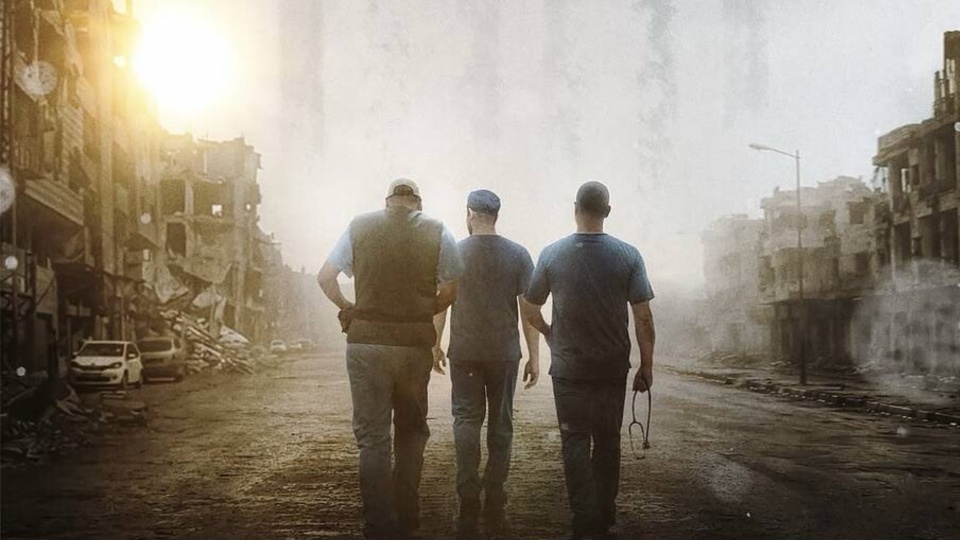
CHICAGO—The award-winning documentary “American Doctor” closed a three-night run at the Gene Siskel Film Center here recently with a full house and a standing ovation. There wasn’t a dry eye in the room: To one side, a middle-aged woman sniffled quietly; to the other, an elderly man’s tears poured down his long face.
“American Doctor” follows three U.S. surgeons—Dr. Mark Perlmutter, Dr. Feroze Sidhwa, and Dr. Thaer Ahmad—as they treat Palestinian children in Gaza, then return home to educate the public through the media, conferences, and lectures, and to advocate for their patients on the street and in the halls of Congress.
In the Q&A that followed the film, moderator Dr. Zildani Sulufa interviewed Ahmad. “Chicago is the home of the Palestinian Diaspora,” Ahmad said. “The largest amount of Palestinians are here in Chicago, and we’ve been here dating back as early as I can tell, the fifties or sixties in Chicagoland…. Now we’re the fourth generation of Palestinians in the Chicagoland area.”
A community with deep roots
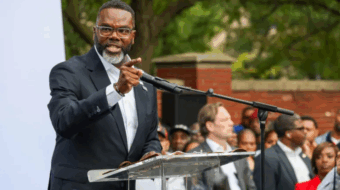
Ahmad pointed to the Chicago City Council’s January 2024 resolution calling for a ceasefire in Gaza, when the council deadlocked 23-23 and Mayor Brandon Johnson cast the tie-breaking vote in favor,making Chicago, at the time, the largest U.S. city to take that position. He credited organizing by the local Palestinian community and its allies.

“I think it’s a testament to the community here working to organize in the workplace that the first major metropolitan city to call for a ceasefire was the City of Chicago,” he said. “It was essentially a tie…. The mayor actually had to cast the tie-breaking vote, and I believe it was because of the pressure that came from Palestinians in the Chicagoland area, as well as all of the allies that were working on the ground. That was a huge signal.
“People say, ‘Well, it didn’t result in a ceasefire.’ But that’s the third-most-populous city in the United States of America, a major hub for the Democrats—the Democratic National Convention took place in Chicago—and the city is asking for a ceasefire.”
The council’s vote came seven months before Chicago hosted the 2024 Democratic National Convention that August, adding to its weight as an early marker of the party’s internal divide over the war.
Front-line stories
Earlier this year, Sidhwa spoke to a small group of Healthcare Workers for Palestine at the Unity Center on South Halsted in Chicago. He addressed a grave human-rights concern, saying Israeli forces had shot more child victims in Gaza than in any other conflict zone where he had treated patients. He showed X-rays of infants with sniper bullets lodged in their skulls, a scene that later went viral on YouTube and TikTok.
Despite the subject matter, Sidhwa was warm and often funny. One woman in the audience left the talk in tears, and he followed up afterward to ask if he could send her his prepared remarks.
In the film and at other engagements, he delivers dry, deadpan lines about Washington—“Our elected officials, who definitely represent us,” and “I just got out of a meeting with Senator Ted Cruz…which was fine.” He breaks character talking about his dating life, saying his relationships have been supportive “to a point”—until the subject of his work comes up.
“I always have to choose fighting against genocide,” he said, before breaking into a grin: “I’m blaming my dating life on the genocide against Palestinians.”
Sidhwa’s medical work before Gaza took him to Haiti and Ukraine; he and Perlmutter have said more children were killed and maimed in Gaza than in either of those conflicts.
Questions from the floor
Just before the Q&A opened to the audience, Ahmad said Palestinians have found a second home in Chicago and credited local organizing for the council’s ceasefire vote, again noting that Chicago is the third-largest city in the country.
At the end of the evening, People’s World asked Ahmad what more ordinary citizens can do to help change U.S. policy on Palestine. “In the United States we’re in a critical moment, and elections are coming up this fall,” he said. “Many candidates are running on a platform that we need a better policy for Palestine, and they’re winning because of it.
“For example: the race in Michigan for Senate. Abdul El-Sayed is running, talking about getting money out of politics and away from Israeli weapons manufacturers, and away from supporting the genocide, the apartheid, and the occupation. That’s a strong signal.
“I think we can all support his campaign one way or another—door-knocking, spreading the message, maybe donating. I’m not endorsing him for Senate, but I’m saying it’d be nice if he were a senator.”
A personal reckoning
After the Q&A, an audience member described his own journey to Sulufa’s, calling himself a “Christian Zionist in Recovery,” a reference to a moment in the film when Perlmutter says that “genocide is a disease” that should no longer be treated as politics.
The man, who was raised by missionaries, said he had never heard of the Israeli-Palestinian conflict until college, when he began protesting at an encampment at a university in Illinois. He said he had lost friends over his advocacy, and that when he called his mother from the protest, she joked, “I hope your cell phone doesn’t blow up.”
Sulufa was conciliatory: “There is a price that we all pay, and a risk that we all take, when we are taking these kinds of steps to stand up for what we believe. We have to stand up for what justice looks like. It’s a cost, but it’s a cost that a lot of people have been willing to bear. And maybe that’s part of the healing.”
To learn more about the film and its subjects, visit AmericanDoctorFilm.com or Sidhwa’s website, FerozeSidhwa.org.
No paywalls at People’s World
We hope you appreciated this article. At People’s World, we believe news and information should be free and accessible to all, but we need your help. Our journalism is free of corporate influence and paywalls because we are totally reader-supported. Only you, our readers and supporters, make this possible. If you enjoy reading People’s World and the stories we bring you, please support our work by donating or becoming a monthly sustainer today. Thank you!
CONTRIBUTOR