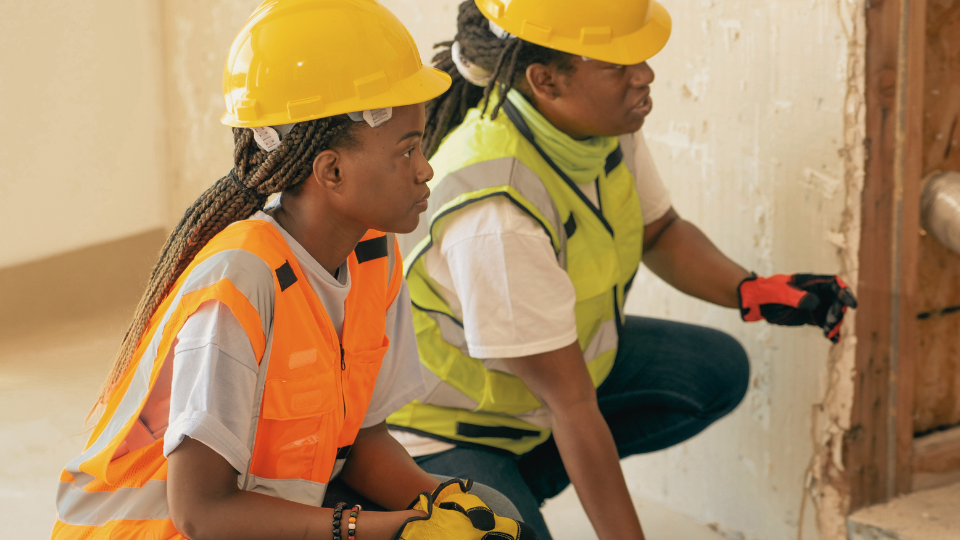
LOS ANGELES —For Los Angeles resident Sakina Mills, the road to being an electrician and a member of Electrical Workers (IBEW) Local 11 “was a bit of a challenge.”
That’s because, unlike her colleagues in what is still an overwhelmingly male profession, the building trades, “I didn’t have a sponsor.”
Mills had to work her way in over four years with little to no support—despite scoring high on the electricians’ exam.
She’s not done yet. And when she goes out to a job site, she often still has little support. Far from it.
Mills and other tradeswomen People’s World interviewed say they encounter other roadblocks and challenges which have nothing to do with book learning or entrance exams. Those roadblocks add up to a pattern of sexual harassment and discrimination on the job.
The pattern includes everything from slow promotions and the equivalent of glass ceilings to unequal paychecks for women with equal experience to an “old boys club” rife with sexual innuendos.
And when you’re the only woman on a job site with 19 other workers and all of them are men–the ratio of actual on-the-worksite tradeswomen to tradesmen, statistics show—it can be very tough. It can also be very lonely.
The Institute for Women’s Policy and Research reports that in 2024, the latest year for which statistics are available, women were 14% of all workers at construction firms. But that hides the real ratios.
Two-thirds of those women in construction are administrative, managerial, and support staffers. Only 4.7% of all construction workers are women actually out in the field, working at job sites. And that’s double the 2.5% female share of construction workers out at sites a decade ago.
And a report IWPR commissioned and released in March 2026 backs up the details women interviewed discussed. Its data included:
- 73% of women construction workers “reported bias on the job” in various forms.
- 20% of women construction workers surveyed, but only 9% of men, said they did not report harassment or safety concerns “out of fear of losing a job.”
- 24% of working women in construction reported “receiving sexual comments or gestures from colleagues.” Only 8% of male construction workers reported the same treatment.
- 32% of Gen-Z women construction workers and 38% of millennial women workers reported male colleagues are “assuming women are physically weaker.”
- 44% of women construction workers reported “corporate executives are more averse to suggestions” from them for improving on-site working conditions. Some 22% of male construction workers reported the same corporate reactions.
There were some points where construction workers of both sexes agreed. The big one was safety: 68% of both sexes “have felt unsafe while working in the industry.” Federal data, compiled by the
AFL-CIO, jibe with that concern. Construction is one of the most unsafe occupations, it shows.
But what makes it even tougher for construction women out in the field like Mills in Los Angeles, and Hannah Hurst, a former gold miner in Alaska, is that some local and international building trades unions are supportive, and some aren’t. And the same can be said of individual supervisors and colleagues, too. A non-union situation, like the gold mine Hurst toiled at, can be even worse.
All of this and more could be a lively topic at the annual Tradeswomen Build Nations Conference, the world’s largest convention of tradeswomen, on October 9-11 in Houston.
Mills, for example, is still an apprentice, in training for three or four more years for one of the top-line positions an electrician can hold, inside wiring. She sticks it out because the paychecks are high for top-of-the-line construction workers, a common theme in the field.
“On my first day on the job” out in the field, “I was excited and happy,” she said in an interview. “I’d chosen a classification where I could use my knowledge and skills, and I could earn while I was learning.
“But as I walked into the job site, I heard racial slurs,” added Mills, an African-American. “And my foreman told me, ‘Just deal with it.’”
And then came the sexism. “I heard ‘Oh, this isn’t a place for a woman,’ as I was lugging 60 pounds of pipe at a time.” And later, “I realized that a male could come on the job at 70%-80% efficiency, but I had to be at 110%.
“There may be 10 guys” with her on a job, “and two are verbal that women shouldn’t be in the field, two more are racial and sexual” in their remarks, “and four of the other six are silent.”
The story was much the same for Hurst, a former underground gold miner in Alaska.
People don’t think of mining as part of the building trades, but it involves a lot of tasks construction workers undertake: Trenching, drilling, tunneling, underground construction of roofs and supports, carting in generators and stringing in electric power lines, to name a few.
“There’s a lot of heavy diesel equipment and blasting” in a mine, too, Hurst added.
Hurst’s job was trundling rock that contained thin veins of gold ore from the mine itself in a haul truck to a plant where machines crushed it and extracted the valuable metal. That’s how gold is mined these days, post-Alaska Gold Rush. No more panning rivers for nuggets and flakes at the bottom.
“Driving that haul truck and running a loader and a zipper” are among the entry-level jobs that women miners such as herself were shunted into, said Hurst. “I was told, ‘Women do the driving and the zipping. Be happy with it.’”
Such an attitude wasn’t the only sexism on the job. The working environment deep in that mine—in 20-foot-wide underground tunnels, plus break rooms–was definitely chauvinistic.
There was an “old boys” atmosphere, with pin-up-girl posters in break rooms. “People had stickers on their lunch pails of a female miner on her knees with her legs spread, and the male miner standing over her,” Hurst added.
“The attitude was ‘We’re pigs, and we know we are pigs.’”
There was chauvinism in the paychecks, too. That’s something the late women’s rights activist Lilly Ledbetter discovered, as a supervisor, after 19 years at the Goodyear Tire Company plant in Gadsden, Ala. Male supervisors with a lot less experience were getting paid a lot more than she was.
Ledbetter took her equal pay case, demanding the right to sue to cover all that time, all the way to the U.S. Supreme Court, and lost to the GOP-named bloc of justices on a 5-4 vote. Thanks to the then-Democratic-run Congress, the Lilly Ledbetter Law gave women and other discrimination victims the right to sue to cover all the years of discrimination. Hurst used that right, and won.
“I was capable of running the bigger drills, and becoming a Level 4 miner,” one level below the top ofscale, Hurst said. She applied as spots became open—and was turned down. “I asked ‘Why?’ and the answer was ‘We don’t want her. She’s a girl.’”
Financially, that failure to advance because of sexism on the job cost Hurst $10,000-$15,000 a year, plus bonuses. By contrast, “I was in the Army Reserves” while mining “and there I was treated fairly.” Hurst eventually left the mine to become a federal Mine Safety and Health Administration inspector.
But before she left, Hurst took her complaints to the human resources department of what was then a Japanese-owned Alaskan gold mine, and got no response. Ditto when the Japanese sold the mine to an Australian firm.
So she contacted a prominent equal rights group, the Equal Rights Advocates, www.equalrights.org, which helped her file a complaint with the federal Equal Employment Opportunity Commission (EEOC).
Following its mandate set by the 1964 Civil Rights Act, the EEOC investigated Hurst’s case and then tried to mediate the dispute and convince the mine owners to settle her complaint by making her whole and by changing working conditions at the mine. When the owners refused, EEOC formally released Hurst and Equal Rights Advocates to sue for damages, and joined them. They won.
Which, as Hurst pointed out in a follow-up extensive e-mail, is unlikely to happen under the current Republican Trump administration. And that bodes ill for women in the building trades facing sexual harassment and discrimination on the job, she added.
Under Trump’s EEOC chair, Andrea Lucas, the agency has turned completely around, away from the cases it historically handled of discrimination in employment against women, people of color and other minorities on the basis of gender, religion, whether they’re able-bodied and especially on the basis of race.
The commission is even cutting back on data collection, making it tougher, if not impossible, to prove patterns of racism, sexism, ableism and religious discrimination in workplaces. Now the EEOC, like the Trump Justice Department’s Civil Rights Division, is focusing on alleged “discrimination” against white men. DOJ also emphasizes discrimination against “Christians.”
“This enforcement agency is important to women in the trades,” Hurst e-mailed People’s World after the telephone interview. “Attempts to weaken the EEOC are discouraging and unfortunate, to the extent that if women do not feel they have backing to call out wrongdoing in these male-dominated industries, sometimes it is easier to pick another career path.
“Congress wanted equal opportunities for all when this law was passed. The system they came up with to hold companies accountable for having systems in place that are fair for everyone is the EEOC. What good is a law if there is a weakened or no system for enforcing the law? The law then becomes useless.”
No paywalls at People’s World
We hope you appreciated this article. At People’s World, we believe news and information should be free and accessible to all, but we need your help. Our journalism is free of corporate influence and paywalls because we are totally reader-supported. Only you, our readers and supporters, make this possible. If you enjoy reading People’s World and the stories we bring you, please support our work by donating or becoming a monthly sustainer today. Thank you!
CONTRIBUTOR