
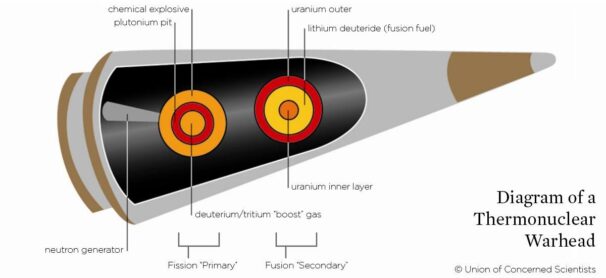
This summer, the National Nuclear Security Administration (NNSA) reversed its initial decision to withhold an unclassified summary of a study on the aging of plutonium in US nuclear weapons by JASON, a group of elite scientists advising the Pentagon. Far from revelatory, the brief JASON study is more notable for its consistency with earlier assessments that found the US stockpile’s plutonium is aging slowly, but not at a level that calls into question present weapons performance.
This latest assessment stands in contrast to the NNSA’s ambitions for accelerating US efforts to revive plutonium pit production—the cores of thermonuclear weapons. Recent developments indicate that the NNSA is pursuing a variety of means to speed up the program and demonstrate ambitious production capabilities. These calls come amid a lack of transparent requirements, before the project has demonstrated mature performance, and without integrated cost and schedule estimates. At the same time, congressional and independent oversight show troubling signs of erosion.
Accelerating a program that was already facing steep challenges comes with immense risks that must be weighed against actual national security needs. Rushing toward production threatens worker and community safety and increases costs. It is also likely to prove strategically destabilizing. The United States doesn’t need to build new warheads to maintain its land-based nuclear force, unless it dangerously seeks to load more warheads into its ballistic missiles.
If plutonium aging is not an imminent threat to the present stockpile—and by extension to US nuclear deterrence—accelerated pit production therefore signals that the United States is dangerously hurtling toward renewed nuclear competition in contravention of its legal obligations as a state party to the Nuclear Non-Proliferation Treaty.
It doesn’t have to be that way: Viable alternatives exist that would reduce strain on the US nuclear complex and reduce the risks and costs of the program itself. These alternatives would be more conducive to future arms control and nonproliferation efforts. But they have only one potentially elusive requirement: Restraint.
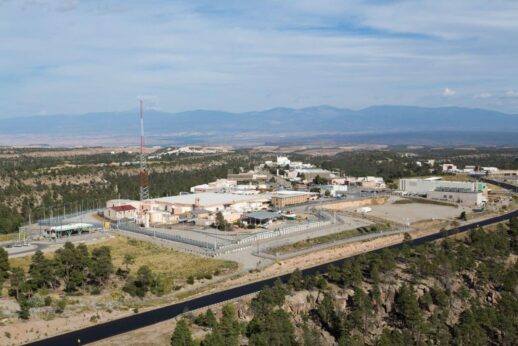
When no news is good news. The most recent JASON study on plutonium aging is the group’s third such assessment. In their first 2006 study, they concluded that most pits “have credible minimum lifetimes in excess of 100 years.” Pits in the current stockpile are roughly 37 to 48 years old. An updated summary in 2019 found that “in general, studies on [plutonium] aging and its impacts on the performance of nuclear-weapon primaries have not been sufficiently prioritized over the past decade.” The group then recommended further experimentation to quantify the effect of aging on weapons performance, along with establishing pit production capabilities “as expeditiously as possible.” The latter comment undoubtedly cast a sense of urgency over the issue, especially on Capitol Hill. But it could also be interpreted as a rebuke of Los Alamos National Laboratory’s insufficient investment in the science of plutonium aging and in its lack of commitment to maintaining previously authorized capabilities following the forced closure of Rocky Flats after an FBI raid in 1989. More recently, in 2011, a nuclear near-miss—involving mishandled rods of plutonium for a photo shoot—also resulted in a multi-year shutdown of Los Alamos’s plutonium facility and the resignation of criticality safety officers, raising further concern.
The latest JASON study conducted in 2025—of which only a three-page executive summary was released in August—reaffirms that plutonium is aging slowly, posing no imminent risk to the viability of the existing stockpile. The study repeats the recommendation that pit production capacity be re-established, but it does so without the urgency of the 2019 report. Instead, it makes clear that new production “may be needed to provide options to mitigate any future age-related issues,” noting that the NNSA has faced delays in executing key experiments that will help inform aging effects.
Proponents of pit production have cited the potential for new vulnerabilities in the stockpile. They argue that the United States would be poorly positioned to address them without at least some production capacity. So far, however, there has been no public evidence that the US nuclear stockpile’s performance is at risk. But, rather than establishing a cautious research and development program as a hedge against future risk, the current pit production strategy represents a full-speed-ahead approach—even as it may pose more risk to itself than it does to perceived adversaries.
The risks of running before walking. The NNSA seeks to supercharge its pit production efforts before they have even been fully developed. Like any attempt to troubleshoot something new while running it at full speed, any faults that are discovered along the way may prove to be a financial and security catastrophe.
The statutory requirements laid out by Congress call for producing 80 plutonium pits per year by 2030—split into 30 pits per year at Los Alamos and 50 at a second site being built at Savannah River, respectively. Rather than being tied to specific needs, the 80-pit production target dates back nearly 20 years and was a capacity-based estimate. In 2022, the NNSA publicly acknowledged that the labs will not meet this goal, but the agency is nonetheless still calling for doubling the sustained production rate at Los Alamos to 60 pits annually, producing at least 100 total pits by 2028, and testing previously unannounced “novel rapid capability weapons systems” and new “design-for-manufacturing” pit concepts that appear to lack specific military assignments. Speaking in favor of an amendment to the National Defense Authorization Act that would have required the NNSA to analyze alternative production targets, Rep. John Garamendi, a Democrat from California, recently questioned the statutory requirement as having put the United States “into a cycle of extraordinary expense and, probably unnecessary expense.”
The desire to accelerate pit work at Los Alamos appears to acknowledge delays and challenges in bringing the second site at Savannah River online. In February, the Government Accountability Office estimated that the second facility will cost over $22 billion to complete and that the Savannah site is not expected to contribute pits to the stockpile until at least 2035. And in October, the NNSA disclosed $1.5 billion in additional projected costs and pushed estimated completion to 2038. Despite recent optimistic statements from lab director Thom Mason, it remains unclear how Los Alamos will tackle this added burden while it has yet to finish installing critical equipment, such as gloveboxes.
Alongside increasing immediate production goals, budgets, and recently issued environmental impact statements lay the groundwork for even greater future cadence.
The FY2027 budget request of $8.78 billion for NNSA’s production modernization is 65 percent above the previous fiscal year’s enacted funding. This year’s National Defense Authorization Act calls for production of 180 pits per year by 2050, while a draft programmatic environmental impact statement from the NNSA establishes the basis for up to 205 pits per year once both production facilities are fully operational.
Such production levels are beyond what is required to sustain the existing US nuclear stockpile and signal that the program is being designed for future growth, irrespective of near-term requirements.
Cutting corners to meet goals. To accelerate production, NNSA officials propose shedding well-established administrative controls designed for safety and quality assurance. In a February memo, David Beck, the agency’s deputy administrator for defense programs, calls for loosening standards used to certify new pits by relying on “qualified processes, equipment, and staff rather than each pit being independently evaluated and qualified.” This is a significant departure from the rigorous metrology and inspection usually required for the diamond-stamping of war-reserve components to be used in the nuclear stockpile, especially given that “processes, equipment, and staff” remain in flux as the program matures.
The NNSA’s quantity-over-quality approach risks running counter to the stated intent of the program, which is ostensibly to address quality concerns that could affect weapons performance margins. Meanwhile, plutonium workers are subject to a new, higher administrative limit for radiation exposure pegged at the federal maximum to overcome what a NNSA official said is an overly “risk-averse culture.”
Forcing production to ramp up from 30 to 60 (or more) pits per year at Los Alamos before it has comfortably demonstrated initial goals may worsen central risks. The research, design, and development lab was never a mass-production facility, not even during the Cold War. Interruption of qualified operations, diversion of scarce engineering attention, and stress-testing what are barely established protocols in a facility that remains under construction are only a few examples of what could go wrong. For dangerous plutonium work, safety basis maturation, process qualification, workforce proficiency, and quality control are key components of production capacity—not administrative overhead that can be brushed aside as a barrier to quantity production.
In fact, many of the constraints that led to Los Alamos’s original 30-pit target remain. Space constraints, procurement lead times for complex items such as gloveboxes, the availability of qualified personnel, and the ongoing need for material accountability and radiological safety will not be overcome purely by increased funding or removing bureaucratic red tape. Instead, risks will only increase, which could threaten the program itself.
In 2017, the NNSA wrote that continuing to rely on Los Alamos’ plutonium facility (PF-4) for US pit production capability presents “unacceptably high mission risk,” adding that “it will be problematic for PF-4 to support additional changes in nuclear safety risk tolerance, increased pit manufacturing activity, and higher capacity for [other plutonium missions]”. In 2020, the NNSA reiterated facility-level risks that could challenge even the 30-pit requirement. These assessments appear lost on the current administration.
Safety concerns at Los Alamos are not hypothetical: The lab’s PF-4 facility has had recent instances of worker exposure to plutonium, floods, contamination issues, and multiple glovebox fires, including one as recently as June of this year. A new study that modeled the impacts of larger fires at NNSA’s pit production sites suggests that the agency vastly underestimates the potential consequences to the public of the lab’s activities. These findings appear supported by an independent assessment from May harshly criticizing Triad National Security, the lab’s managing contractor since 2018, over safety lapses, inadequate employee training, and for using “non-conservative accident analysis assumptions” for exposure of the public to plutonium. Los Alamos’s safety record suggests that speed could come at a cost to workers and the public.
Eroding oversight. As concerns mount over safety and loosening of administrative controls, oversight of the program is increasingly thin. Public reporting on facility and worker safety by the Defense Nuclear Facilities Safety Board has recently stopped, with reports that access for on-site inspectors is being hampered by the Energy Department. Meanwhile, requests for accountability from Congress have gone unanswered, as have requests for a special study by the Deputy Secretary of Energy, James Danly, issued last year over performance concerns. Requests by the Government Accountability Office for an integrated schedule and cost estimate for the entire pit production endeavor similarly remain unsatisfied even as the program marks roughly a decade since it began. Earlier this year, the office also found that NNSA’s major construction projects have seen cost overruns more than double since 2023. Despite this, appropriations reached record levels this year.
Public attention to the issue and demands for accountability are growing. The recent programmatic environmental impact statement was motivated by a lawsuit filed by several public interest groups in opposition to the program. The resulting public hearings and comment period attracted vigorous criticism of the program and the NNSA’s regard for community concerns.
Restraint is cheaper and safer. As the US nuclear weapons program charges from the gates, the idea of restraint may seem far-fetched. In reality, this apparently unbounded acceleration is a choice rather than a necessity. New pit production is not yet required for the existing US nuclear arsenal, only for its expansion or replacement with new designs.
Ultimately, some form of restraint may be forced upon the pit production program unless remaining challenges are acknowledged and addressed. The Savannah River facility faces a long, challenging, and exceedingly expensive path to completion, and it provides dubious redundancy. The Sentinel intercontinental ballistic missiles (ICBMs) and silos slated to host the warheads with Los Alamos’s new pits are themselves behind schedule, overbudget, and potentially antiquated as the Pentagon rethinks its strategic capabilities. Moreover, new warheads are only required for the ICBMs if the United States makes the dangerous choice to return to uploading more than one warhead per missile now that New START has expired. Sentinel’s woes come with the added cost of sustaining the existing Minuteman III ICBM fleet through at least 2050—something that officials previously deemed impossible.
As the recent JASON report shows, the existing US nuclear arsenal is not presently at risk of age-related degradation. The study does not support a requirement to manufacture 80, much less 205 pits per year. Having the capability to produce plutonium pits also does not require that they be deployed in new designs—a move that will only invite international response, increased countermeasures, and encourage an arms race that no one can win. An oversized plan for pit production driven by geopolitical uncertainty rather than technical need may ultimately prove more dangerous and more costly than a restrained approach defined by sound planning. The consequences, like those of running before walking, could be dire.
No paywalls at People’s World
We hope you appreciated this article. At People’s World, we believe news and information should be free and accessible to all, but we need your help. Our journalism is free of corporate influence and paywalls because we are totally reader-supported. Only you, our readers and supporters, make this possible. If you enjoy reading People’s World and the stories we bring you, please support our work by donating or becoming a monthly sustainer today. Thank you!
CONTRIBUTOR